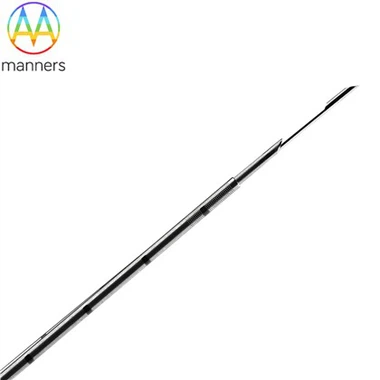
The Quality Code Of Trocars – From Medical-Grade Stainless Steel To Precision Assembly
Jun 11, 2026
https://www.lookmedchina.com/news-everything-you-should-know-about-trocar-needles.html
Behind a seemingly simple trocar lies the integrated achievements of materials science, precision machining and rigorous quality control systems. Understanding the material properties and production workflows of trocars empowers clinical practitioners to select and deploy this critical instrument more appropriately.
I. Selection of Core Materials
Per referenced specifications, trocars are primarily manufactured from medical-grade alloys including 304 and 316 stainless steel.
- Grade 304 Stainless Steel: The most prevalent austenitic stainless steel, featuring balanced corrosion resistance, mechanical strength and ductility at a moderate cost. It serves as the standard material for obturators and cannulas in most routine surgical trocars.
- Grade 316 Stainless Steel: Alloyed with molybdenum for superior resistance to chloride corrosion, ideal for prolonged contact with saline, blood and other bodily fluids. It is widely adopted for long-term indwelling drainage cannulas.
- Alternative Materials: Premium trocar models utilize titanium alloy (lighter weight, enhanced biocompatibility) or high-performance polymers (polycarbonate, polyethylene) for cannula bodies to cut weight and production costs. Obturators are almost exclusively stainless steel to deliver the hardness and sharpness required for reliable penetration.
II. Key Stages of Manufacturing
1. Obturator Fabrication
As the piercing tip of the trocar, the obturator's geometry directly dictates puncture resistance and procedural safety.
Cutting and Grinding: CNC lathes shape stainless steel bar stock into conical or pyramidal tips, followed by multiple polishing passes to achieve a mirror-smooth finish. Tip angles generally range from 15° to 30°, enabling smooth fascia penetration while avoiding overly sharp edges that risk uncontrolled deep puncture.
Heat Treatment: Select obturators undergo quenching and tempering to boost hardness and wear resistance whilst retaining sufficient toughness to prevent fracture during insertion.
2. Cannula Fabrication
The cannula acts as a working channel for surgical instruments, requiring ultra-smooth inner walls, uniform outer diameter and reliable airtight performance.
- Tube Forming: Blanks are seamless stainless steel tubes or roll-welded stainless steel sheets, processed via drawing, annealing and straightening to hold inner and outer diameter tolerances within ±0.05 mm.
- Tip and Rear End Finishing: The cannula's distal front edge is chamfered and rounded for tight fit with the obturator and reduced insertion friction. Threads or snap lock structures are machined on the proximal end to connect sealing caps and gas valves.
3. Assembly and Air Tightness Validation
- The obturator is inserted into the cannula with zero play or excessive clearance. Some designs incorporate an O-ring at the obturator base to reinforce sealing performance.
- Fully assembled trocars undergo leak testing: devices are submerged in water while pressurized from the proximal end; escaping bubbles indicate defective sealing, which would compromise pneumoperitoneum stability or drainage efficiency.
III. Surface Finishing and Coating Technologies
- Lubricating Coatings: Many obturators are coated with hydrophilic lubricants such as PVP. The coating becomes extremely slippery upon contact with water, cutting puncture force by 40%–60%.
- Antibacterial Coatings: High-end trocars are infused with silver ions or chlorhexidine on inner and outer cannula walls to lower port-site infection risks. These coatings pass mandatory cytotoxicity and inhibition zone validation tests.
- Radiopaque Markers: Barium sulfate or other X-ray-opaque additives are embedded at the cannula tip or obturator apex for intraoperative localization under fluoroscopy or ultrasound.
IV. Full-Spectrum Quality Control System
Compliant with ISO 13485 and ISO 9001 standards, every production batch of trocars must complete the following inspections:
- Dimensional Inspection: Projectors and micrometers measure obturator length, cannula outer diameter, wall thickness and other critical dimensions.
- Sharpness Testing: Specialized equipment quantifies the force required for the obturator to pierce standardized silicone membranes; acceptable thresholds are typically below 5 Newtons.
- Cyclic Simulation Testing: Trocars are repeatedly punctured through multi-layer phantom tissue (laminated silicone and foam) to check for burr formation, structural deformation or coating delamination.
- Sterilization Validation: Post ethylene oxide (EO) sterilization, residual EO levels are tested to ensure compliance with safe concentration limits.
Conclusion
Though compact in size, trocars integrate cross-disciplinary expertise spanning metallurgy, ultra-precision machining and polymer chemistry. Premium raw materials, refined manufacturing workflows and stringent quality checks collectively forge dependable minimally invasive surgical instruments. Familiarity with these technical details helps surgeons make informed brand selections and facilitates constructive communication with engineering teams for product optimization.