The Millimeter-Scale Balancing Act Of Centimeter Markings & Sliding Stoppers
Jul 24, 2026
In the high-stakes theater of interventional radiology, the physician's senses are bombarded with data. The hum of the CT scanner, the flickering grayscale of the ultrasound monitor, and the palpable tension in the room converge into a singular focus: the precise placement of the biopsy needle. In this environment, the Centimeter markings and optional sliding stopper on our 18G Soft Tissue Biopsy Needles cease to be mere accessories; they transform into vital sensory extensions of the clinician's hand, embodying the pinnacle of medical ergonomics and human-factor engineering.
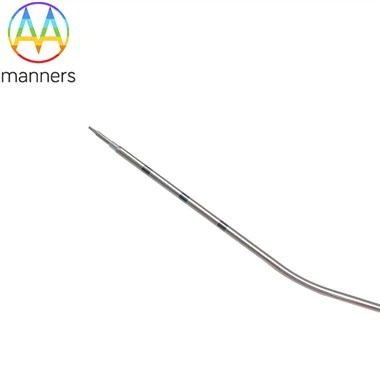
The importance of Centimeter markings begins long before the needle breaches the skin. During the pre-procedure ultrasound or CT scan, the radiologist maps the trajectory to the lesion. They note the distance from the epidermis to the pleura, the proximity to major blood vessels, and the depth of the tumor. Once the 18G Soft Tissue Biopsy Needles is in hand, these mental calculations must translate into physical reality. Traditional ink-based markings are anathema in modern medicine; they fade under the intense heat of autoclaving or dissolve during chemical sterilization. Our solution lies in Computer Numerical Control (CNC) laser etching. A high-intensity laser ablates the steel surface to create permanent, high-contrast marks. These aren't just lines; they are precision instruments. The depth of the etch is carefully controlled-too shallow and it lacks contrast, too deep and it becomes a stress riser that compromises the needle's structural integrity.
But vision is only one sense. Interventionalists frequently operate in "blind" scenarios-such as when their view of the needle hub is obscured by the ultrasound probe or sterile drapes. To address this, our premium line incorporates Tactile Markers. At specific intervals (e.g., every 5 centimeters), the laser etch is accompanied by a subtle indentation or a change in the spacing pattern. This allows the clinician to "read" the needle's depth through the sensitive pads of their gloved fingers. It is a haptic language that communicates progress without requiring a visual shift away from the imaging screen. This seamless integration of tactile and visual cues reduces cognitive load, allowing the physician to maintain focus on the critical task of guiding the needle through complex anatomy.
Complementing the markings is the optional sliding stopper, a component whose simplicity belies its profound utility. Injection molded from medical-grade polycarbonate or ABS, this small device is a marvel of friction management. The bore of the stopper must fit snugly around the 18-gauge needle-a diameter of approximately 1.27mm. If the tolerance is too loose, the stopper will creep down the shaft under the resistance of dense tissue, rendering it useless. If it is too tight, the clinician will struggle to adjust it while maintaining sterility, potentially compromising the drape or losing needle positioning. Our mold flow analysis ensures that the internal surface of the stopper has microscopic ridges that provide high static friction (to hold position) but low dynamic friction (to allow easy sliding when intentional force is applied).
The clinical application of the sliding stopper is most evident in procedures involving critical depth limits. For instance, when performing a renal biopsy, the needle must traverse the cortex and arrest precisely at the medulla. Overshooting into the renal pelvis can cause severe hemorrhage. By setting the sliding stopper to the pre-measured distance, the physician creates a physical barrier. As the needle advances, the stopper makes contact with the skin or the ultrasound transducer. This provides immediate tactile feedback-a physical "brake" that prevents further advancement. This feature is particularly crucial for trainees or in emergency settings where rapid decisions are made under pressure. It adds a layer of redundancy to the ultrasound guidance, ensuring that even if the electronic calipers are slightly off, the physical stopper prevents a catastrophic puncture.
Furthermore, the synergy between the Semi-automatic spring loaded biopsy system and these ergonomic features cannot be overstated. The handle of the biopsy gun is sculpted based on anthropometric data from diverse populations. The contours fit naturally into the palm, reducing the muscle fatigue associated with prolonged gripping. The trigger requires a deliberate amount of pressure to fire-enough to prevent accidental discharge but light enough to allow for delicate manipulation. When the trigger is pulled, the tactile click of the firing mechanism, combined with the visual confirmation of the depth markers and the security of the sliding stopper, creates a multi-sensory experience that instills confidence in the operator.
In the realm of infection control, these components are designed for single-use efficiency. The markings and stopper do not interfere with the sterile packaging process. Whether the needles are packed in Standard carton quantities or custom-configured kits, the integrity of these features is maintained through sterilization. By obsessing over these millimeter-scale details-the depth of a laser etch, the frictional coefficient of a plastic ring, the curvature of a handle-we demonstrate our commitment to the clinicians who rely on our tools. We understand that in the quest for a definitive diagnosis, every millimeter counts, and our 18G Soft Tissue Biopsy Needles are engineered to ensure that those millimeters are always under the clinician's complete control.