The Materials Science And Manufacturing Evolution Of Bone Marrow Biopsy Needles
Jun 19, 2026
https://www.chamfondbiotech.com/4-types-of-bone-marrow-biopsy-needles/
The bone marrow biopsy needle, a device that appears deceptively simple, embodies a century of accumulated wisdom in materials science and precision manufacturing. Its evolution-from a rudimentary metal tube to a sophisticated instrument integrating strength, toughness, and biocompatibility-mirrors the micro-history of modern medical engineering.
I. The Cornerstone: The Reign of Medical-Grade Stainless Steel
Historically, early bone marrow needles were fabricated from ordinary carbon steel. While possessing acceptable hardness, these materials suffered from poor corrosion resistance and biocompatibility, leading to rust and potential local inflammatory reactions. With advancements in metallurgy, the industry rapidly shifted to medical-grade stainless steel. Alloys such as 316L and 304, stabilized by the addition of molybdenum and nickel, form a robust austenitic structure. This grants the needle shaft exceptional corrosion resistance, allowing it to withstand high-temperature steam sterilization or ethylene oxide (EtO) processing without deformation or rust. Simultaneously, its optimal balance of toughness and hardness ensures that the shaft resists bending or fracturing when physicians apply the necessary force to penetrate dense cortical bone, thereby guaranteeing operational stability and safety.
II. Lightweighting and High Strength: The Rise of Titanium Alloys
Despite the excellent properties of stainless steel, its high density (~7.9 g/cm³) makes longer needles feel heavy in hand. In delicate biopsy procedures, any excess weight can compromise the operator's tactile precision. Consequently, high-end bone marrow needles have begun adopting medical titanium alloys (e.g., Ti-6Al-4V). With a density roughly 60% that of stainless steel, titanium alloys significantly reduce instrument weight and enhance maneuverability. More importantly, titanium offers superior biocompatibility, eliciting almost no adverse tissue reactions. Its natural radiolucency ensures it does not produce significant artifacts on CT or MRI scans, a crucial feature for image-guided targeting. However, due to high processing difficulty and cost, titanium alloys are currently reserved for specialized models demanding the highest precision and imaging compatibility.
III. The Art of the Needle Tip: Geometry and Surface Finishing
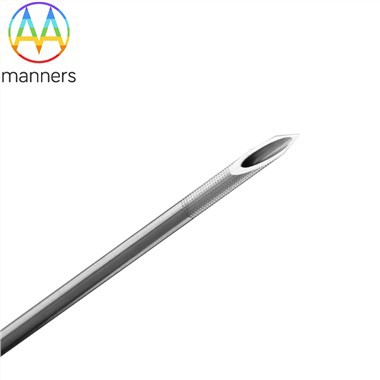
Beyond bulk material properties, needle performance is critically dependent on tip design and surface treatment. Traditional beveled tips (such as Crown point or Huber point) utilize precise grinding angles to balance bone-cutting efficiency with minimal tissue trauma. Modern manufacturing employs laser cutting and electropolishing technologies to create edges that are microscopically sharper and smoother, drastically reducing insertion resistance. Furthermore, mirror-polishing the inner and outer walls of the shaft is vital. A smooth lumen minimizes adhesion and mechanical damage to the bone marrow sample-particularly the fragile cellular components-during aspiration. Preserving sample integrity and cell viability is the lifeline of accurate pathological diagnosis.
IV. The Empowerment of Coating Technology
In recent years, surface modification of bone marrow needles has emerged as a key technological frontier. For instance, applying an ultra-thin coating of polytetrafluoroethylene (PTFE) or silicone-based lubricants to the outer shaft dramatically reduces friction between the needle and surrounding tissues. This facilitates smoother insertion, easing patient discomfort. Researchers are also exploring antimicrobial coatings to further mitigate the risk of localized infection.
Conclusion
From a common piece of metal to a masterpiece of precision engineering, the material and process advancements in bone marrow biopsy needles have elevated operator efficiency and diagnostic confidence while fundamentally improving the patient experience. Looking ahead, with the integration of cutting-edge technologies such as nanomaterials and shape memory alloys, we can anticipate that this "probe" will become even smarter, safer, and more efficient.