The Material Science And Performance Competition Between SS303 And SS304 In The H2O2 Transfer Needle
May 28, 2026
In the manufacturing of medical devices, the selection of materials forms the cornerstone of performance design. For components like the H2O2 transfer needle, which requires frequent puncturing of rubber seals, long-term exposure to highly oxidizing chemical media (hydrogen peroxide), and withstanding pressure cycles within the sterilization system, the material must be carefully considered. Manners Technology did not adopt a single material solution; instead, it creatively selected two different types of stainless steel for different parts of the needle body: the base is made of AISI 303 (SUS303), while the needle tip part is made of AISI 304 (SUS304). This "dual steel combination" strategy is based on a precise match between material science and application scenarios.
Role Division: Why Are There Two Types of Steel Needed?
A H2O2 transfer needle is subjected to two completely different types of stress during operation:
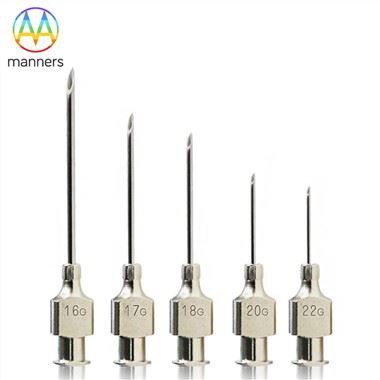
- Base - The Foundation for Connection and Sealing: The base is rigidly connected to the injection valve of the sterilization equipment through its hexagonal hub, mainly bearing torsional loads and compressive stresses. It must have excellent machining performance to form complex hexagonal structures and also need sufficient strength and rigidity to ensure a stable connection without slippage. Additionally, although its outer surface does not directly come into contact with high-concentration H2O2, it is in a humid and chemical atmosphere environment, requiring good resistance to general corrosion.
- Needle Tip - The Piercing and Corrosion-Resistant Leader: The needle tip is the part that pierces the rubber plug and delivers hydrogen peroxide. It requires extremely high hardness and wear resistance to maintain sharpness, remaining sharp even after penetrating dozens or even hundreds of times; it directly and continuously comes into contact with high-concentration (such as over 59%) hydrogen peroxide. This strong oxidant has a strong corrosive tendency towards metals, therefore requires top-level corrosion resistance, especially resistance to pitting and crevice corrosion; at the same time, it also needs certain toughness to avoid brittle fracture when subjected to lateral forces.
In-Depth Analysis of Material Characteristics: 303 vs. 304
AISI 303 (Elastic Cutting Stainless Steel):
- Key Advantage: Exceptional Cutting Performance. 303 is an elastic cutting steel type that is derived from 304 by adding sulfur (S) or selenium (Se). These additives form tiny, lubricating inclusions during the processing, making machining processes such as turning, milling, and drilling extremely smooth, reducing tool wear, and achieving high surface finish. This is an ideal choice for bases that require precise hexagonal shapes and complex contours, enhancing efficiency, ensuring dimensional accuracy, and reducing costs.
- Performance Trade-off: The addition of sulfur slightly reduces its corrosion resistance (especially resistance to pitting) and weldability. However, for bases that mainly perform structural connections and do not directly come into contact with high-concentration oxidants, its corrosion resistance is already sufficient. Its fully hard (Full Hard) state also provides sufficient strength.
AISI 304 (Classic Austenitic Stainless Steel):
- Core Advantage: Balanced and Excellent Corrosion Resistance and Comprehensive Performance. 304 stainless steel contains higher chromium (Cr) and nickel (Ni) content and does not contain elastic-cutting elements, so its corrosion resistance, especially its ability to resist uniform corrosion and oxidation media (such as hydrogen peroxide) corrosion, is significantly better than that of 303. After reaching the fully hard state through cold processing (such as cold drawing and cold rolling), its hardness (HRC value) significantly increases, meeting the requirements for wear resistance and rigidity needed for piercing rubber.
- Key Treatment: Fully Hard State (Temper- Full Hard). This is achieved through large deformation cold processing (such as cold drawing and cold rolling). This treatment not only significantly increases the strength and hardness of 304, but also refines the grains, further enhancing its corrosion resistance. A 304 needle tip in the fully hard state is like a finely sharpened blade, both strong and resilient.
The Realization and Advantages of the "Double Steel Combination" Manufacturing Method
Manners achieved a perfect connection between the 303 base and the 304 needle tube through the advanced laser welding process. The laser welding has a concentrated heat input and a narrow heat affected zone, which can effectively reduce the welding defects (such as intergranular corrosion sensitivity) that may be caused by the material composition differences between the two materials, resulting in a strong metallurgical bond.
This design brings multiple advantages:
- Performance Optimization: By leveraging the advantages of 303, which is easy to process and has controllable costs, in the base, and the advantages of 304, which is highly resistant to corrosion and has high hardness, in the needle tip, we achieved an overall performance that exceeded the sum of its parts (1+1>2).
- Cost Rationalization: While using the best materials for the most critical part (the needle tip), we used more cost-effective materials for the non-critical part (the base), achieving a balance between product performance and manufacturing costs.
- Reliability Maximization: The outstanding corrosion resistance of the needle tip ensures that there will be no corrosion perforation or metal ion contamination when in prolonged contact with H2O2; its high hardness guarantees the persistent stability of the puncturing performance. The good machining performance of the base ensures the precision and reliability of the connection structure.
Compliance and Safety Baseline
Whether it is 303 or 304, Manners ensures that all raw materials comply with the requirements of the RoHS Directive (2002/95/EC), eliminating the introduction of harmful substances such as lead, mercury, and cadmium. At the same time, through subsequent electrolytic polishing and chemical passivation treatments, the surfaces of both materials are further strengthened, forming a more stable and uniform chromium oxide passivation film, providing a "double guarantee" for the long-term safe use of the products.
Conclusion
The "303 base + 304 tip" design adopted by Manners on the H2O2 transfer needle is by no means a simple matter of material assembly. It is a scientific decision made based on a profound understanding of the component's function, stress state, corrosive environment, and manufacturing process. It embodies the design philosophy of "function-oriented, material-first" in the manufacturing of high-end medical devices. By precisely selecting and combining the characteristics of two classic stainless steel materials, Manners has created a product that achieves the best balance among processing efficiency, performance, long-term reliability, and economy. This itself is a successful application practice of materials engineering in microscopic medical components.