The Hypodermic Needle: Engineering The Bridge Between Medicine And Body
Apr 09, 2026
The Hypodermic Needle: Engineering the Bridge Between Medicine and Body
When people see a hypodermic needle, they see a simple, sharp tool. In reality, it is a precisely engineered biomedical interface, a temporary channel that overcomes the body's most fundamental barrier-the skin-to deliver treatments or retrieve diagnostic samples. This seamless breach, which we often take for granted, is the culmination of over 150 years of materials science, fluid dynamics, and ergonomic design. The story of the hypodermic needle is not just about a tube and a point; it's about how humanity learned to navigate the inner world of the body with minimal footprint and maximum effect.
What Exactly is a Hypodermic Needle?
At its core, a hypodermic needle is a thin, hollow, stainless steel cannula attached to a hub, which connects to a syringe or other fluid handling device. The term "hypodermic" comes from Greek: hypo-(under) and derma(skin), literally meaning "beneath the skin." Its primary function is to create a controlled, minimally invasive pathway across the skin's stratum corneumbarrier for fluid exchange.
Core Components & Terminology:
Hub: The plastic or metal base that connects the needle to a syringe or vacuum tube holder. It is often color-coded by gauge (e.g., pink for 18G).
Cannula/Shaft: The long, thin, hollow stainless steel tube. Its outer diameter (OD) defines its Gauge (G), and its inner diameter (ID) determines flow rate.
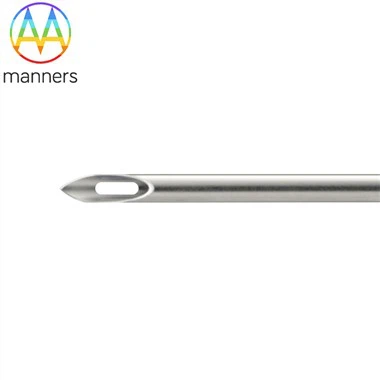
Bevel: The angled, sharpened opening at the tip. A sharper bevel angle (e.g., 12°) provides easier skin penetration but may be more fragile, while a larger bevel angle (e.g., 20°) is more robust.
Lumen: The hollow channel inside the cannula through which fluid flows.
Primary Functions: A Two-Way Street
Administration (Injection): To deliver substances intothe body-vaccines, medications, hormones, contrast agents, anesthetics.
Extraction (Aspiration): To withdraw substances fromthe body-blood for testing, bone marrow for biopsy, synovial fluid for analysis, bodily fluids for culture.
The Evolution: From Dangerous Curiosity to Precision Instrument
The hypodermic needle's development is a history of solving critical problems: sterility, pain, precision, and reliability.
The Problem of Pain & Precision (Pre-20th Century): Early "syringes" from the 17th century were crude. The true hypodermic needle and syringe is credited to Scottish physician Alexander Wood and French surgeon Charles Pravaz in the 1850s. Their designs allowed subcutaneous injection, but sterilization was primitive, needles were large and reusable, and infection risk was high.
The Solution of Sterility & Disposability (Mid-20th Century): The advent of stainless steel (corrosion-resistant, strong, and easily sterilized) and later, mass production techniques during WWII, were game-changers. The development of the single-use, sterile, disposable needle in the 1950s-60s dramatically reduced cross-infection (like hepatitis B) and revolutionized safety.
The Modern Era of Specialization & Comfort (Late 20th Century - Present): Today, needles are highly specialized. Ultra-thin walls maximize flow in a smaller gauge. Lubricant coatings reduce friction and insertion force. Shielded and retractable safety-engineered devices automatically cover the needle after use to prevent needlestick injuries. The focus has shifted from mere function to safety, patient comfort, and operator ease.
The Engineering Principles: How a Needle Works
A hypodermic needle is a masterpiece of minimalist engineering, balancing conflicting demands.
The Mechanical Challenge: Sharpness vs. Strength
The needle must be sharp enough to penetrate skin and tissue with minimal force and pain, yet strong enough to resist bending or buckling. This is achieved through:
Precision Grinding: The bevel is ground to a microscopic point, often with multiple facets (a "multi-bevel" point) for smoother entry.
Material Choice: Medical-grade 304 or 316L stainless steel provides an optimal balance of strength, flexibility, and biocompatibility. Its wall thickness is precisely controlled to prevent kinking.
The Fluid Dynamics Challenge: Flow Rate vs. Gauge (Size)
The Hagen–Poiseuille equation governs flow through the needle: Flow Rate is proportional to (Pressure x Radius⁴) / (Viscosity x Length). The key insight is the radius to the fourth power. This means:
Doubling the inner radius (ID) increases flow rate 16-fold.
This is why rapid fluid resuscitation uses a large-gauge (low G number, like 14G or 16G) needle with a large ID, while a subcutaneous insulin injection uses a small-gauge (high G number, like 29G or 31G) needle for comfort, accepting a slower flow.
The Biomechanical Challenge: Minimizing Tissue Trauma
A perfect needle creates a clean slit, not a hole. A tri-bevel point (three cutting surfaces) separates tissue fibers more cleanly than a simple single bevel, reducing the "coring" effect and post-injection soreness. The needle's surface finish is also electropolished to a mirror-smoothness to reduce drag.
The Modern Ecosystem: A Tool for Every Task
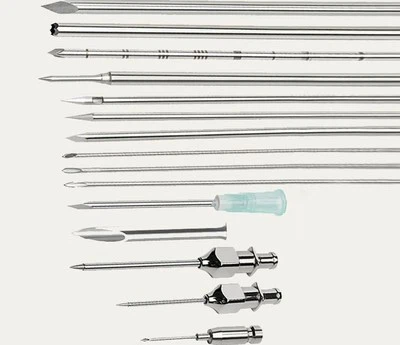
Hypodermic needles are no longer generic. They are a family of specialized instruments, with design variations for every clinical need.
By Procedure:
Intravenous (IV) Catheters: A hollow needle (stylet) inside a plastic catheter. The needle creates the entry, then is withdrawn, leaving the flexible catheter in the vein.
Hypodermic/Subcutaneous Needles: Shorter lengths (e.g., ½ inch) for vaccines or insulin. Often have ultra-thin walls (e.g., 31G x 8mm).
Intramuscular Needles: Longer lengths (1–1.5 inches) to reach deep muscle, with a robust gauge (22G-23G) for viscous medications.
Spinal/Epidural Needles: Very long, thin needles (e.g., 25G x 3.5 inch) with specialized pencil-point tips to separate, not cut, nerve fibers.
Biopsy Needles: Have cutting mechanisms or side-notches for tissue sample capture (e.g., Tru-Cut needles).
By Safety Feature: Safety-Engineered Sharps Devices (SESDs) are now the standard, mandated in many countries. These include needles with:
Retractable Sheaths that spring forward after use.
Hinged Shields that snap over the needle.
Blunt Cannulas for fluid withdrawal from IV lines.
Beyond the Point: The Critical Supporting System
A needle is useless alone. Its effectiveness depends on an integrated system:
The Syringe: Provides the positive or negative pressure. Its plunger seal and smooth barrel are critical for accurate dosing.
The Human Factor: Proper technique-angle of insertion, speed, bevel orientation, site selection, and securement-is what transforms an engineered object into a therapeutic tool. Poor technique can render the most advanced needle ineffective or dangerous.
Conclusion: The Unseen Lifeline
The hypodermic needle is a paradox: a symbol of fear, yet a primary tool of healing. Its evolution from a crude metal tube to a safety-engineered, micro-precision device mirrors the progress of modern medicine itself. Every vaccination, every life-saving drug infusion, every blood test that guides diagnosis, relies on the silent, efficient function of this most basic yet sophisticated instrument. It is, in the truest sense, the fundamental physical bridge between external medicine and the internal human system-a bridge built on a foundation of relentless engineering, stringent safety, and unwavering clinical purpose.