The Engineering Logic Behind Manners’ EBUS-TBNA Needle Material Selection
Jul 08, 2026
https://profed.olympuschina.com/gs/thoracicsurgery/12628/
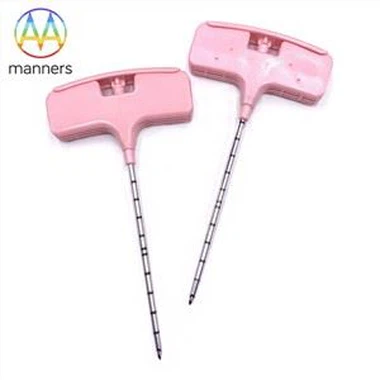
EBUS-TBNA needles endure a contradictory mechanical cycle: "long-distance flexible delivery → terminal rigid puncture." The needle shaft must navigate the flexible bronchoscope insertion tube through curves (radii potentially <20mm) traversing the oropharynx → trachea → carina → lobar/segmental bronchi. Upon reaching the target, it must instantly possess sufficient axial stiffness to pierce the cartilaginous airway wall and lymph node capsule. Material selection is pivotal to balancing these performance demands.
Manners offers two mainstream material solutions:
- Medical-Grade SUS 304/316L Stainless Steel: Compliant with ASTM F899 standards, this austenitic stainless steel offers excellent tensile strength (≥520 MPa), fatigue resistance, weldability, and grindability at a controlled cost. Post solution treatment, hardness is maintained at HV200-250, keeping the needle tip sharp for multiple punctures. A minor drawback is a slight tendency towards plastic deformation under extreme bending angles (e.g., >160° upward scope deflection); however, it performs reliably for most routine mediastinal stations (7, 4R, 4L). Grade 316L incorporates Molybdenum for superior corrosion resistance, ideal for repeated exposure to respiratory secretions.
- Nitinol (NiTi Shape Memory Alloy): Meeting ASTM F2063 standards, Nitinol exhibits Superelasticity. Under external bending forces, it sustains 6%–8% reversible phase-transformation strain without permanent deformation, instantly springing back upon force removal. This ensures the needle pushes smoothly without "kinking" or "locking" even at maximum bronchoscope deflection angles. This is particularly beneficial for deep, complex pathways or pediatric/narrow airways. Its wear resistance and biocompatibility are well-established, though its heat treatment and laser processing windows are narrow, requiring strict temperature control to prevent martensitic phase transformation that compromises elasticity.
Both materials rigorously comply with ISO 10993 biocompatibility requirements (cytotoxicity, sensitization, hemolysis, intracutaneous reactivity). Manners mandates chemical composition analysis reports and mechanical property reports for each raw material batch, supplemented by in-house incoming inspections verifying Vickers hardness and metallographic structure. Notably, laser etching parameters are material-specific due to differing thermophysical properties-Nitinol absorbs 1064nm fiber laser radiation differently than SUS. Excessive power density can thicken surface oxide layers, hindering subsequent electropolishing uniformity. Manners addresses this via Design of Experiments (DOE) to establish material-dedicated laser process cards.
From the end-user perspective: SUS 316L models represent the cost-effective mainstream choice for departments primarily performing standard lung cancer staging (targeting stations 7, 4). Conversely, Nitinol models offer a superior handling experience for centers tackling challenging locations (hilar stations 10/11 or severely tortuous bronchi) or aiming to reduce push-force within curved channels. Manners' dual-material platform provides clients with a product matrix adaptable to diverse clinical scenarios.