The Clinical Value Of EBUS-TBNA Needles in Lung Cancer Staging And Mediastinal Lymph Node Biopsy
Jul 08, 2026
How Manners Empowers Interventional Pulmonology
https://profed.olympuschina.com/gs/thoracicsurgery/12628/
In the diagnosis of lung cancer and preoperative staging of Non-Small Cell Lung Cancer (NSCLC), accurately assessing mediastinal and hilar lymph node involvement (N2/N3 staging) directly determines a patient's eligibility for curative surgery. Traditional "blind" Transbronchial Needle Aspiration (TBNA) relies on the operator's anatomical knowledge, resulting in low positive rates and risks of vascular injury. While surgical mediastinoscopy remains the historical gold standard, it requires general anesthesia and thoracotomy, involving significant trauma, high costs, and an inability to access hilar stations 10 and 11. The advent of Endobronchial Ultrasound-Guided Transbronchial Needle Aspiration (EBUS-TBNA) has revolutionized this landscape. By utilizing real-time imaging from a convex probe ultrasound bronchoscope to puncture through the bronchial wall and acquire tissue from mediastinal lymph nodes or masses, EBUS-TBNA achieves a sensitivity of 88%–93% and near 100% specificity, establishing itself as the preferred minimally invasive method for lung cancer staging per NCCN guidelines.
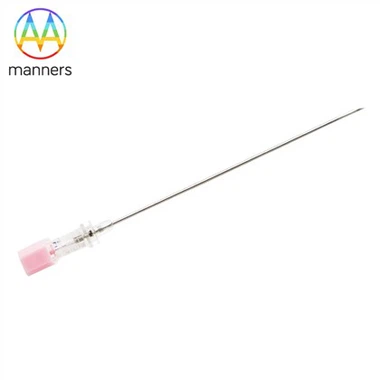
Within this technical ecosystem, the EBUS-TBNA needle serves as the core consumable interface. Manners, a specialized manufacturer of EBUS-TBNA needles, produces a 19G EBUS-TBNA biopsy needle (OD 1.06mm / ID 0.86mm / Length 115mm) specifically engineered to be compatible with the 2.0mm working channels of mainstream Olympus, Pentax, and Fujifilm ultrasound bronchoscopes. The needle tip features a Back-Cut Point geometry-distinct from traditional forward-facing bevels, the back-cut incorporates a secondary cutting edge on the posterior surface, forming a micro-"hook." This design incises rather than compresses tissue fibers during puncture, significantly reducing tissue crush artifact and facilitating the acquisition of coherent cell strands or even tissue cores. This satisfies the modern pathology lab's dual requirements for cytological (FNA) and histological (FNB) specimens, proving particularly advantageous for diagnosing lymphoma and sarcoidosis.
Beyond puncture performance, the Manners EBUS-TBNA needle shaft undergoes 5-axis laser etching to create helical micro-groove textures. These artificially induced interfaces promote ultrasound diffuse reflection, rendering the needle as a brightly continuous "lighthouse effect" on the ultrasound image. This allows physicians to track the needle tip position and insertion depth in real-time, effectively navigating around critical structures like the pulmonary artery and superior vena cava. Constructed from medical-grade SUS 316L stainless steel or NiTi (Nickel-Titanium) alloy (hardness HV200-250), the needles balance pushability with superelastic bending capacity, resisting kinking even during extreme bronchoscope deflections. Finished products undergo electropolishing to achieve an internal mirror-like surface (Ra < 0.2μm), reducing tissue aspiration resistance and cellular adhesion. Coupled with ultrasonic cleaning and comprehensive ISO 13485 process control ensuring batch-to-batch traceability, Manners guarantees consistent quality.
From a clinical standpoint, a high-quality EBUS-TBNA needle transcends being a mere "puncture tool"-it dictates first-pass success rates, specimen adequacy (impacting Rapid On-Site Evaluation-ROSE efficiency), and complication rates. Through micron-level tolerance control (±0.01mm), certified material selection (compliant with ASTM F899/ASTM F2063 Nitinol standards), and rigorous process validation, Manners provides interventional pulmonologists with a reliable instrument for lung cancer staging, differentiating tuberculosis/sarcoidosis from malignancies, and post-operative recurrence re-staging. This reliability supports the wider adoption of EBUS-TBNA from tertiary academic hospitals to grassroots interventional respiratory centers.