The Bionic Revolution: The Next Generation Of Smart Needles Inspired By Nature
Apr 30, 2026
The Bionic Revolution: The Next Generation of "Smart Needles" Inspired by Nature
The hypodermic needle, an iconic tool of modern medicine, has undergone no fundamental changes in its basic form since its invention in the mid-19th century. It is a double-edged sword: on one hand, it is an irreplaceable channel for delivering vaccines and drugs to save lives; on the other hand, the pain, fear, and potential damage to specific tissues (such as nerves and blood vessels) caused by its invasiveness have long been a shared concern for both patients and medical professionals. However, a quiet revolution is underway-engineers and scientists are shifting their focus from the workshop to nature, drawing inspiration from the survival strategies of mosquitoes, wasps, and even parasites to redefine the fundamental medical procedure of "injection." This is not only about alleviating suffering but also about enhancing the precision, safety, and accessibility of treatments.
The Mosquito Proboscis: The Ultimate Template for Painless Puncture
The mosquito, a pesky creature, is a master of painless puncture. The intricate structure of its proboscis provides a textbook model for the design of next-generation needles.
Structural Biomimicry: Unlike the smooth, tapered tip of traditional needles, the mosquito's proboscis features a serrated edge and a gradient in material stiffness (rigid at the base, flexible at the tip). This design distributes puncture stress and reduces concentrated irritation to skin nerve endings. A 2020 China-US joint study showed that microneedles mimicking this structure can reduce insertion force by 27%. A lower insertion force means less tissue deformation and a higher threshold for nerve activation, forming the physical basis for "painless" injection.
Dynamic Behavior Mimicry: The mosquito's ingenuity extends beyond static structure. Before piercing, it stretches the local skin to increase tension and ease penetration; during insertion, the proboscis generates high-frequency micro-vibrations, cutting through tissue rather than poking, which further reduces resistance. Future smart needles may integrate miniature piezoelectric actuators to replicate this vibration pattern, especially for high-precision, sensitive procedures such as ocular injections and nerve blocks.
Surface Chemistry Insights: Mosquito saliva contains anesthetics and anticoagulants. This inspires the concept of an "active surface" for needles. Using coating technology, local anesthetics (e.g., lidocaine) or anticoagulants (e.g., heparin) can be loaded onto the needle tip and released upon insertion, enabling "self-anesthesia" and preventing tract blockage-highly valuable for long-term indwelling catheters or frequent blood draws.
The Wasp Ovipositor: A "Flexible Navigator" for Deep Interventions
For procedures requiring deep tissue access (e.g., intratumoral drug delivery, deep brain stimulation, percutaneous biopsy), traditional rigid long needles face challenges such as bending, trajectory deviation, and damage to healthy tissue. The female wasp's ovipositor offers a transformative solution.
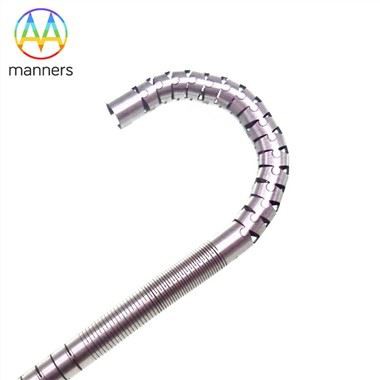
Segmented Propulsion Mechanism: The ovipositor consists of three interlocking, sliding valves, functioning like an extendable telescope or flexible drill to bore through hard wood or fruit via segmented, alternating movement. Inspired by this, a team at Delft University of Technology developed a bionic needle made from superelastic nickel-titanium alloy filaments. Less than 1 mm in diameter and up to 20 cm in length, it can navigate winding paths in soft tissues (e.g., artificial liver) like a measuring worm without losing stability.
Revolutionary Applications: This "flexible puncture robot" can navigate around critical blood vessels and organs with minimal trauma, reaching lesions inaccessible to rigid instruments. In oncology, it enables ultra-precise delivery of chemotherapy drugs or radioactive seeds; in neurosurgery, it provides a safer pathway for deep brain electrode implantation; in biopsies, it ensures the needle tip remains within small tumors, improving sampling accuracy and reducing "misses."
Parasites and Insects: Functionally Integrated "Smart Microsystems"
Nature's inspiration extends beyond the act of "piercing" to subsequent "anchoring" and "control."
Parasite-Inspired "Anchoring Needles": Certain parasites use hook-like head structures to anchor themselves in host intestines. Inspired by this, researchers are developing needles/catheters with expandable tips or deployable barbs. Upon reaching the target site (e.g., blood vessel, body cavity), the tip expands into a bulb or deploys a micro-scaffold for secure fixation, preventing displacement or dislodgement during patient movement. This is critical for long-term indwelling central venous catheters, peritoneal drains, or pain pumps, significantly reducing risks of catheter-related infections and dislodgement.
Hemiptera-Inspired "Surface Microfluidics": Insects such as aphids and bed bugs use micro/nanostructures on their bodies to guide secreted chemicals. This inspires the design of "surface-guided needles." By engineering specific microgrooves or superhydrophobic/superhydrophilic patterns on the outer needle wall, the direction and speed of drug flow along the exterior can be precisely controlled. For example, when injecting irritant drugs, the medication can be released laterally from the needle tip, away from major nerve bundles; when injecting viscous biologics (e.g., monoclonal antibodies), surface tension effects can reduce residual volume.
From Lab to Clinic: Challenges and the Future
Despite their promising prospects, translating bionic needles from the laboratory to the bedside faces multiple challenges:
Manufacturing Precision: The serrated nanostructure of the mosquito proboscis and the complex sliding joints of the wasp ovipositor demand ultra-high precision in micro/nanofabrication and advanced materials (e.g., shape-memory alloys, high-performance polymers). Cost control is critical for commercialization.
Reliability Validation: The long-term fatigue performance, biocompatibility, and sterilization resistance of bionic needles must be rigorously tested in dynamic, heterogeneous human tissues. For example, can expandable structures withstand millions of cardiac cycles and vascular pulsations?
System Integration: Future bionic needles will not be standalone devices. They must integrate with miniature sensors (to detect tissue resistance and drug concentration), micro-actuators (to control vibration and steering), and imaging navigation systems (real-time ultrasound/MRI guidance) to form a comprehensive "smart interventional diagnosis and treatment platform."
Conclusion: A People-Centered Engineering Revolution
The innovation of hypodermic needles driven by bionics is rooted in a core philosophy: shifting from disease-centered, invasive procedures to patient- and tissue-centered, precise, and gentle interactions. This is not just an upgrade of medical devices but an evolution of medical ethics-minimizing the physical and psychological burden of every treatment. When needles learn to be as gentle as mosquitoes, as agile as wasps, and as stable as parasites, we enter a new era marked by reduced needle phobia, tear-free childhood vaccinations, and cancer targeted therapy as precise as surgery. This inspiration drawn from nature ultimately returns to humanity's deepest care and respect for life.