Supplier Evaluation And Incoming Inspection
Nov 17, 2026
The Cost of a Cheap Needle
A biopsy needle that fails during use cannot be recovered by any downstream control. The procedure stops, the patient may need to return, and the specimen that was never obtained cannot be inspected for adequacy. Yet purchasing decisions on sampling devices are frequently made on unit price and lead time, with technical evaluation reduced to a visual check on arrival. The gap between a rigorous qualification process and a casual one is invisible until the failure occurs, at which point it becomes a clinical event rather than a supplier issue.
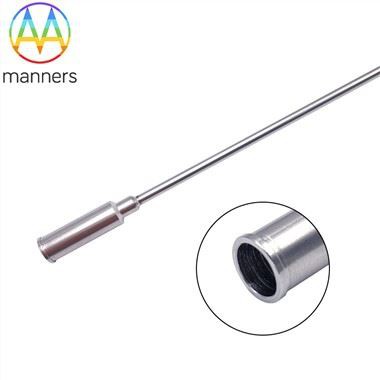
This article sets out how to evaluate a manufacturer of crown-formatted Crown End Needles and how to verify incoming lots, so that device performance is established before it matters. The emphasis is on properties that predict clinical behaviour: tip concentricity, lumen cleanliness, straightness, bond strength, and the traceability that supports all of them.
What Actually Determines Reliability
Reliability in a needle comes from process control rather than from inspection, because inspection samples a lot while use exposes every unit. The properties that predict behaviour are consistent and measurable. Concentricity of the tip determines whether cutting is uniform around the circumference. Sharpness and edge condition determine whether tissue is separated or compressed. Straightness determines whether the tip reaches the intended plane through a curved route. Internal surface finish determines whether the specimen survives transit. Hub bond strength determines whether the assembly survives withdrawal.
Material grade and passivation affect corrosion resistance and shelf life, while cleanliness affects both tissue compatibility and specimen purity. Each of these is produced by a process step, and each is only credible when the supplier can show that the step is defined, monitored, and recorded. That is what ISO 13485 certification is intended to demonstrate, and it is worth verifying that the certificate covers the actual manufacturing site and the product family in question.
Categorising Suppliers and Their Claims
Suppliers encountered in this market fall into recognisable categories. Traders resell without manufacturing control and cannot hold tolerances across lots. Assemblers purchase cannulae and perform hub bonding only, which limits their ability to influence tip geometry or straightness. Full-process manufacturers draw, straighten, grind, clean, and assemble in-house, and can therefore control the characteristics that matter most.
For Crown End Needles specifically, look for a manufacturer offering stainless steel cannulae from 0.25 mm to 30 mm in both thin and heavy wall, with injection and puncture configurations, the full range of tip forms including crown core cut, Franseen, Menghini, closed point, backcut bevel, trocar, Whitacre, and lancet, acceptance of customisation against 2D or 3D drawings or physical samples, free samples for evaluation, standard carton packaging, and ISO 13485 certification. A supplier who cannot describe which operations are performed in-house is unlikely to control them.
A Qualification and Receiving Sequence
Qualification should proceed in defined steps. Begin with documentation: certificate scope, site address, process flow, and a sample of inspection records. Then request samples and evaluate them functionally: roll each needle on a flat surface to check straightness, examine the tip under magnification for concentricity and edge condition, flush the lumen and inspect the flushate for particulate, and confirm patency with a fine wire or fluid flow test.
On approval, run a first-article inspection against the drawing, verifying diameter, wall, length, tip geometry, and hub dimensions. Establish receiving inspection that samples each lot for these characteristics plus packaging integrity and labelling accuracy. Retain records by lot number so that clinical feedback can be traced back to production. Finally, agree change notification in writing, because an unannounced process change can invalidate a qualification that took months to complete.
Failure Patterns Seen in Receiving Inspection
Certain defects recur and are worth targeting specifically. Bent needles caused by inadequate sheathing or carton design are the most common transport failure, and they appear as a subset of a lot rather than the whole. Tip deformation from poor handling during packing produces crowns with one folded point, which will tear rather than cut. Internal particulate from incomplete cleaning shows up in flush testing and is a strong indicator of weak process control.
Hub bond failures appear as leakage under pressure or as separation under pull, and are usually traceable to adhesive application rather than to hub design. Gauge mislabelling, where the hub colour or printed size does not match the cannula, is a documentation failure with clinical consequences. Operators who have audited suppliers report that the presence of any of these patterns in a sample lot predicts their recurrence, which makes sample evaluation unusually informative relative to its cost.
Inspection as a Relationship, Not a Gate
The most effective receiving programmes treat inspection as one part of an ongoing relationship. Data from incoming checks, clinical feedback, and supplier corrective actions are reviewed together, and trends are discussed with the supplier rather than accumulated internally. Free sample programmes support this by allowing evaluation before a specification is frozen, and by enabling comparison between candidate suppliers on the same functional criteria.
When this works, inspection volume can fall over time because process capability is demonstrated rather than assumed. The result is a supply chain in which device performance is predictable, which in turn makes every other improvement in the sampling pathway measurable. That is the practical return on qualification effort: not paperwork, but the elimination of a variable that would otherwise contaminate every clinical comparison.
What to Put in the Specification Now
The near-term priority for most departments is to convert unwritten expectations into a controlled specification. Write down the diameter range required, whether thin or heavy wall is appropriate for each application, the tip forms approved for each clinical scenario, the straightness and cleanliness criteria, hub type, packaging, and labelling. Attach drawings for custom items, and retain the approved sample as a reference standard.
Then verify that the chosen supplier can meet it consistently: full-process manufacturing in stainless steel from 0.25 mm to 30 mm, customisation from drawings or samples, ISO 13485 scope covering the product, free samples for pre-qualification, and standard carton packaging with stable delivery. A specification that names Crown End Needles plus these criteria gives purchasing a document it can enforce and gives clinical staff a device they can rely on before the first case of the day.
A final point concerns the difference between qualifying a supplier and qualifying a product. The two are often treated as one, but they answer different questions. Supplier qualification asks whether the organisation can control its processes consistently over years; product qualification asks whether a particular specification performs as required in clinical use. Both are needed, and neither substitutes for the other: a well-run manufacturer can still produce a device unsuited to a specific application, and a well-designed needle from an uncontrolled source will vary unpredictably between lots.
The practical resolution is to keep two records. One holds supplier-level evidence: certificate scope, audit findings, change notifications, corrective actions, and delivery performance. The other holds product-level evidence: the drawing, the approved reference sample, first-article results, receiving inspection data, and clinical feedback. When a problem appears, the two records together identify whether the cause lies in the process or in the specification, which is the difference between a corrective action and a redesign.
Finally, consider what inspection can and cannot do. It can reject a defective lot, confirm that a delivery matches its documentation, and generate the data that supports a conversation with the manufacturer. It cannot make an unsuitable specification suitable, and it cannot detect every unit-level defect in a sampled lot. That is why receiving checks are best understood as a confirmation step at the end of a chain that begins with a well-written specification and a properly qualified manufacturing process, rather than as the safeguard that catches everything else.