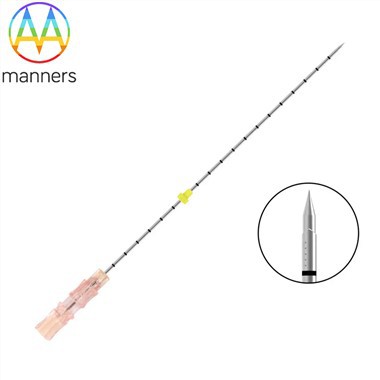
Size-Related Complication Risk Of PDO Thread Lift Needle Implantation
Nov 02, 2026
Pain Point
Most thread lifting complications are closely linked to improper needle size selection, but many training programs focus only on barb technique and ignore size-associated risk control. Thick 18G–22G needles carry high probability of cutting larger subcutaneous blood vessels, forming obvious hematoma and long-lasting bruising. If ultra-fine 28G–30G needles are used for heavy sagging correction, thread buckling and anchoring failure occur quickly, leading to rapid effect loss and customer complaints. Extra-long 100–150mm body needles extend the puncture tunnel, and any break in sterile protocol raises infection risk sharply. This risk mechanism is consistent with acupoint catgut embedding for weight reduction: every puncture wound is a portal for blood-borne pathogens such as HIV and hepatitis B, and a larger needle track increases exposure risk. Even qualified HA composite coating with multi-molecular hyaluronic acid can only ease inflammatory swelling; it cannot stop vascular laceration caused by oversized needles or mechanical failure caused by undersized needles. When complications happen, many clinics misattribute adverse reactions to thread quality instead of reviewing whether needle gauge and length match the treatment demand.
Working Principle
Thicker low-gauge needles create wider puncture tunnels, so the chance of intersecting subcutaneous blood vessels rises during advancement. Hematoma forms when the needle tip tears capillary clusters, and larger needle size means heavier bleeding volume. Ultra-fine high-gauge needles have limited shaft rigidity; when pushed through dense fascia and fat, they bend and twist preloaded threads, making barbs unable to lock surrounding soft tissue. Extra-long needles increase the total contact area between track and tissue fluid, which accelerates bacterial spread once contamination appears. After the needle is withdrawn, the thread stays in tissue to generate immediate mechanical lift and delayed collagen stimulation. The HA coating lubricates the needle path, reduces friction injury and modulates mild inflammation, yet it has no hemostatic or anti-infective therapeutic effect. PDO, PLLA, PCL and WPDO thread materials themselves are biocompatible; most adverse events originate from size mismatch and operational error.
Classification of Complication Risks by Needle Size
18G–22G thick gauge: Main risks are hematoma, large-area bruising, persistent induration, visible thread contour if placed superficially. Suitable only for thick body fascia and heavy structural lifting.
23G–26G medium gauge: Moderate risk, occasional small bruising and transient redness, the safest general-purpose size for most facial lifting cases.
27G–30G ultra-fine gauge: Low bleeding risk, primary complications are tiny pigmented needle marks, thread buckling and weak anchoring if used for heavy sagging.
80–150mm extra-long needles: Higher infection spreading risk, long strip induration, myofascial soreness if penetrating too deep near muscle layer. All specifications must be packed as single-use sterile kits or independent sealed units; reusable needles are forbidden for all invasive embedding procedures.
Practical Operation Guidelines
Build a risk screening workflow before selecting needle size. For patients with coagulation disorder, aspirin use and easy bruising tendency, choose one gauge thinner than the standard specification. Avoid thick 18G–22G needles on facial thin skin. When inserting extra-long body needles, advance slowly and stop immediately once sharp radiating pain appears, which indicates approaching nerve trunk or large vessel. After needle withdrawal, perform local compression hemostasis for 3–5 minutes for thick-gauge cases. If hematoma develops, apply continuous cold compress and pressure dressing; never knead the treatment zone. If thread extrusion occurs, carry out sterile trimming instead of rough pulling. Strictly use disposable sterile kits, as acupoint embedding therapy also requires independent sterile packages with tray, pad, scissors, tweezers, gloves, mask and sealing sleeve to block cross infection. Record complication events and corresponding needle size for internal case review.
Real Clinical Experience
Statistical feedback from aesthetic clinics shows that over 60% of hematoma cases are related to unnecessary thick-gauge needle selection. Ultra-fine 29G–30G mono threads almost never cause severe bruising, but many operators abandon them for structural lifting because of worries about rigidity. Extra-long body needles seldom cause acute infection if sterile rules are followed, yet once contaminated, infection spreads much faster along the loose subcutaneous track than short facial needle wounds. HA coating can reduce the duration of inflammatory induration, but it cannot reverse hematoma caused by vascular laceration. Clinics with low complication rates usually classify needle sizes by risk level and set extra supervision for thick and long specifications.
Summary
Every needle size carries its unique complication risk spectrum. Thick gauges mainly bring bleeding and bruising hazards; ultra-fine gauges carry anchoring failure risk; extra-long needles raise infection spread risk. These risks cannot be eliminated by HA coating or high-quality thread material alone. The infectious hazard of large puncture tracks follows the same principle as unsafe acupoint catgut embedding, where poor disinfection and reused needles transmit blood-borne viruses. Standardized size risk awareness, preoperative patient screening and aseptic discipline together form the core prevention system.
Prospect and Suggestion
Manufacturers will print risk warning labels on packaging of thick-gauge and extra-long needle products. Aesthetic training will add case drills focused on size-related complications including hematoma, thread exposure and infection. Clinics should make separate SOP for high-risk thick and long needle treatments, with enhanced follow-up frequency. Practitioners should communicate size-related risk differences clearly with clients and select the gentlest effective specification instead of pursuing thick needles for stronger lifting sensation blindly.