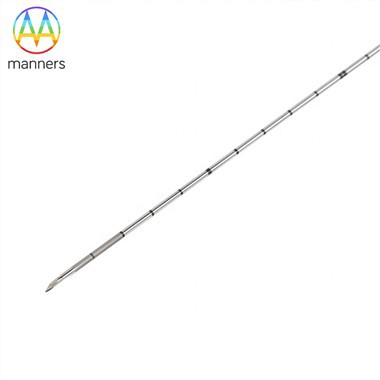
The Clinical Sweet Spot Of 23G 90mm PDO
Nov 02, 2026
The Clinical Sweet Spot of 23G 90mm PDO
The Pain Point: Two Camps, One Misunderstanding
Ask ten aesthetic doctors about thread selection and you will hear two extremes: "Use thick, use long, lift hard" versus "Use cannula, use PLLA, wait longer." Both camps miss the central question - what does the specific facial zone need at this stage of the patient's aging? The 23G 90mm PDO sharp-tip needle sits in the middle, and the middle is where most clinical decisions are actually made.
A useful mental model is to compare thread lifting with orthodontics: both disciplines apply controlled force to biological tissue and then rely on the body's remodeling response. The orthodontist does not pull the teeth; the orthodontist creates a force system and lets bone remodel around it. The thread physician does exactly the same with fascia and collagen. The 23G 90mm PDO sharp-tip needle is the bracket - the device that transmits the force - and the body is the orthodontist. This reframing changes clinical behavior: instead of asking how hard to pull, the physician asks how to arrange the vectors so that the body's remodeling produces the desired contour. It also changes patient language: a lift becomes a guided remodeling, and the patient understands why multiple sessions, like multiple orthodontic adjustments, produce the best result.
The Principle: Matching Biomechanics to Biology
Skin aging is not uniform. The mid-face sags because the malar fat pad migrates; the jawline blurs because the platysma and SMAS lose tension; the temples hollow because volume, not just lift, is lost. A 90 mm thread at 23G provides an optimal compromise: enough length to reach the anchor zone in the temple, enough rigidity to transmit pull force, and enough flexibility to follow the facial curvature. PDO's 6-month resorption window is the right "clock" for a first-time patient - visible correction now, collagen remodeling later.
This compromise is better understood through the lens of tissue biomechanics. The mid-face is not a single structure; it is a stack of layers - skin, superficial fat, SMAS, deep fat, and bone - each with its own modulus of elasticity. When the face ages, the superficial fat descends faster than the SMAS, and the skin loses its elastic recoil. A thread placed at 23G 90mm acts on this stack in a specific way: the cog engages the SMAS and the fibrous septa, transferring tension upward, while the thread body itself resists downward creep. Crucially, the 90 mm length allows the physician to create a tension-free fan: instead of pulling the tissue, the thread is placed slack and then engaged, so the lift comes from the body's own fibrous response rather than from brute force. This is why the clinical sweet spot is not about the strongest thread but about the most appropriate one. For a 45-year-old with early mid-face descent, a 23G 90mm PDO sharp-tip needle delivers enough immediate correction without the overtreatment of heavier systems, and the 6-month PDO window aligns with the patient's likely decision to continue with maintenance treatments.
Classification: The Geometry of Choice
Within the 23G 90mm family, the practitioner chooses by:
Cog density: 7–8 cogs per cm for mid-face lifting; 5–6 for gentler zones like the brow.
Thread profile: screw-type threads rotate under tension, useful for nasolabial folds; mono threads are reserved for volumizing "mesh" patterns.
Needle tip geometry: sharp-tip variants come with either tri-bevel or lancet points. Tri-bevel pierces with less force but a wider track; lancet cuts cleanly with less tissue drag.
The clinical sweet spot emerges when the physician pairs a 23G 90mm sharp-tip needle with a cogged PDO thread for the mid-face and switches to PCL or PLLA only in the lower face where longevity matters more.
Material selection interacts with geometry more than beginners assume. PDO threads in the 23G 90mm format are typically single-armed with a pre-attached needle; the thread is swaged into the needle hub, which eliminates the risk of the thread slipping during insertion. Screw-type PDO threads, popular for nasolabial work, require a slightly larger gauge to accommodate the twisted profile - hence the 23G is often chosen over 25G when the physician plans a screw pattern. The choice of 90 mm also affects the fan geometry: with two entry points per cheek and four vectors each, the physician can cover approximately twelve square centimeters of mid-face tissue - enough to correct malar descent without entering the high-risk infraorbital zone. For practitioners managing a multi-material portfolio, the discipline is to document not only which thread was used, but which profile (cog density, screw pitch, mono) and which gauge, so that outcomes can be compared across patients with similar anthropometry.
Practical Guide: A Zone-by-Zone Protocol
Mid-face: Two entry points per side, fan of 4–5 vectors per point, thread placed at 5–7 mm depth. Pull vector: 45° superolateral.
Nasolabial fold: Single-entry perpendicular technique, thread depth 4 mm, using short-pull increments to avoid bunching.
Temple anchor: The 90 mm length reaches from the preauricular entry to the temporal fascia. Anchor by rotating the thread 90° before final seating.
Jawline: For jowls, use two layers - a deep PDO cog thread at 8 mm and a superficial mesh of mono threads at 3 mm. The combination corrects both sag and crepe-like texture.
Before any zone-by-zone protocol begins, three planning steps determine half the result. First, photographic baseline: standardized frontal, three-quarter, and lateral views under fixed lighting, so that the lift can be objectively measured at follow-up. Second, laxity grading: the physician should classify the patient's tissue laxity on a simple scale - mild (pinch test shows 2–3 mm), moderate (4–6 mm), or severe (7 mm or more). Mild to moderate laxity responds well to 23G 90mm PDO threading; severe laxity should be referred to surgical options or combined with volumizers, and the patient must be told so honestly. Third, vector marking: with the patient upright, the physician draws the intended pull vectors and photographs them. This simple act reduces asymmetry complaints dramatically, because the patient sees the plan before the procedure. Experienced injectors add one more step: a small trial pull with a single thread on one side only, asking the patient to look in the mirror and approve the direction before completing the full fan. This patient-in-the-loop technique, though slower, converts technical success into perceived success.
Real-World Experience: The Learning Curve
Clinicians consistently report three phases. Phase one (0–20 cases): over-correction, visible dimples, and patient anxiety. Phase two (20–60 cases): consistent results but occasional thread palpability. Phase three (60+ cases): refined vector selection and reduced complication rates. A landmark observation from experienced injectors: the 23G needle, while requiring more skill than a cannula, offers better tactile feedback. The physician can "feel" the fibrous septa through the needle, allowing precise cog engagement. This proprioception is the true advantage of the sharp-tip design.
The learning curve is steepest precisely where it matters most - the transition from textbook anatomy to living tissue. Beginners are advised to practice on cadavers or high-fidelity simulators that replicate the tactile profile of the facial layers. Many training programs now use a standardized 23G 90mm needle on silicone models embedded with synthetic septa, allowing trainees to feel the difference between fat and fascia before touching a patient. The evidence from these programs is encouraging: trainees who complete ten supervised model sessions achieve patient complication rates comparable to practitioners with fifty unsupervised cases. The message is not that talent is irrelevant; it is that the 23G 90mm format rewards structured practice, and structured practice is available to every physician who invests in it.
Summary: Precision Over Power
The 23G 90mm PDO sharp-tip needle rewards the clinician who respects its limits. It is not the strongest thread on the market, nor the gentlest delivery system. It is the most communicative. In an era of aesthetic medicine increasingly driven by patient-specific planning, that communication is clinical gold.
Outlook: Standardization Meets Artistry
As thread lifting matures, expect digital mapping tools to guide vector placement, and needle manufacturers to embed micro-markers on the shaft for depth confirmation. The 23G 90mm format will likely remain the "training standard" - the gauge through which new physicians learn the feel of the facial planes - while advanced materials take over longevity-focused cases.