Seed Deployment Stability And Operational Error Prevention Technology
Oct 01, 2026
1. Industry Seed Deployment and Error Pain Points
Traditional radioactive particle implantation surgery has prominent operational errors and unstable seed deployment problems. Ordinary localization needles have rough inner walls and unpolished cavities, which easily cause friction jamming, scratch and offset of radioactive seeds during pushing, resulting in incomplete seed release or position deviation. Traditional needle bodies lack stable structural support, and slight shaking during operation will drive seed displacement, affecting the uniformity of particle distribution. Clinicians are prone to errors such as excessive puncture depth, angle deflection and reversed bevel direction due to unclear scale and lack of directional markers. Intraoperative tissue extrusion and bleeding easily cause needle body position drift, leading to inconsistent actual implantation position with the preoperative plan. In addition, the lack of standardized seed loading and deployment operation process leads to inconsistent surgical quality, frequent occurrence of particle agglomeration, missing implantation and offset, resulting in uneven radiotherapy dose and affecting tumor treatment effect and normal tissue protection effect.
2. Core Deployment Stability and Error Prevention Principle
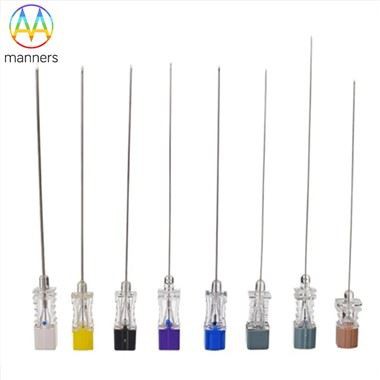
Radioactive Particle Localization Needles build a whole-process stable seed deployment and error prevention system relying on precision processing and structural optimization. The electropolished mirror smooth inner cavity completely eliminates internal friction resistance, realizing zero-resistance linear pushing and stable deployment of radioactive seeds, avoiding jamming, scratch and residual errors. The integrated swaging and necking molding structure enhances needle body rigidity, effectively resisting intraoperative shaking and tissue extrusion drift, maintaining fixed-point stable implantation state. The high-precision laser centimeter scales realize accurate depth control, preventing over-penetration and shallow implantation errors. The foil hub directional marker intuitively feeds back the bevel tip orientation, completely solving the problem of directional deployment deviation. The outer wall silicon coating reduces tissue traction interference, ensuring that the needle body position remains stable during seed pushing, and realizing accurate, uniform and error-free particle implantation throughout the whole process.
3. Error Prevention and Stability Product Classification
According to seed deployment stability and error prevention performance, the products are divided into basic stable deployment type and high-precision anti-error directional type. The basic stable deployment type adopts electropolished smooth inner cavity and high-rigidity needle body design, which can effectively avoid seed jamming and needle body shaking errors, suitable for routine uniform particle implantation of large-area tumors. The high-precision anti-error directional type adds foil hub orientation marking and ultra-precision scale calibration functions, with stronger anti-interference ability and directional accuracy, specially suitable for multi-point sparse implantation, edge tumor precise implantation and high-precision dose distribution control scenarios.
4. Standard Deployment and Error Prevention Operation Guidelines
Preoperative error prevention preparation: Select matching anti-error localization needles according to tumor size and implantation density requirements. Check the smoothness of the inner cavity, the clarity of scales and the effectiveness of directional markers to ensure no structural defects affecting seed deployment. Pre-set particle implantation spacing, depth and direction plan to avoid blind operation. Intraoperative standardized deployment: Puncture stably along the preset path, confirm depth and direction through scales and hub markers after reaching the target point. Push radioactive seeds slowly and uniformly at a constant speed, avoid rapid pushing causing seed bounce and offset. Keep the needle body static during deployment to prevent position drift caused by shaking. For multi-point implantation, adjust the angle and depth accurately in sequence to ensure uniform particle distribution without agglomeration or omission. Postoperative error verification: Use ultrasound or imaging equipment to scan the implantation area, check particle distribution, verify no deployment errors, and record all operation data for standardized filing.
5. Practical Deployment and Error Prevention Experience
Long-term clinical particle implantation practice proves that Radioactive Particle Localization Needles have excellent deployment stability and error prevention effect. The smooth inner cavity design realizes 100% complete seed release, completely eliminating residual and jamming problems that often occur in traditional instruments. The high-rigidity needle body structure maintains stable positioning during operation, and the particle position drift rate is reduced to less than 1%. The directional marking and precise scale system effectively avoids depth and direction errors, and the one-time accurate implantation rate is significantly improved. Standardized deployment operation process reduces artificial operational errors, makes the intraoperative particle distribution more uniform, effectively optimizes radiotherapy dose distribution, improves tumor local control rate, and reduces the risk of normal tissue radiation damage. The stable and error-free operation performance greatly shortens the learning cycle of new clinicians, improving the overall standardization of clinical particle implantation surgery.
6. Summary and Sublimation
Radioactive Particle Localization Needles effectively solve the industry pain points of unstable seed deployment, frequent operational errors and uneven particle distribution in traditional brachytherapy. Through inner cavity smoothing, structural rigidity enhancement and directional anti-error design, it realizes full-process stable and accurate seed implantation. It standardizes the clinical particle deployment operation process, avoids radiotherapy dose deviation and treatment failure caused by instrument defects and operational errors, improves the precision and safety of tumor brachytherapy, and provides a solid guarantee for improving the clinical cure rate of local tumors.
7. Industry Error Prevention Technology Development Suggestions
The industry should take stable seed deployment and zero operational error as the core optimization direction of particle localization instruments. Enterprises should continue to optimize the inner cavity precision polishing process and anti-shake structural design to further improve deployment stability. Strengthen the upgrading of directional marking and scale calibration technology to improve the anti-error precision of deep complex surgery. Medical institutions should formulate unified standardized seed loading and deployment operation specifications, summarize common error types and targeted prevention schemes. Promote the popularization of high-precision anti-error localization needles, comprehensively reduce the error rate of clinical particle implantation, and improve the overall precision level of tumor brachytherapy in the industry.