Safety Risk Prevention And Control Of Breast Biopsy
Aug 18, 2026
https://www.mayoclinic.org/tests-procedures/breast-biopsy/about/pac-20384812
Pain Points Although breast biopsy is a minimally invasive safe technology, non-standard operation and insufficient risk awareness in clinical application still lead to occasional safety accidents and complications. Blind puncture without imaging guidance easily damages breast blood vessels, nerves and deep chest wall tissue, causing subcutaneous hematoma, bleeding and local numbness. Non-standard sterile operation leads to incision infection and inflammatory exudation. Improper needle selection and excessive sampling cause unnecessary tissue trauma and postoperative pain. Incomplete sampling leads to false-negative diagnosis, resulting in delayed treatment of malignant lesions. The lack of systematic risk prevention system affects the safety and stability of breast biopsy clinical application.
Working Principle The safety control principle of breast biopsy is whole-process standardized risk prevention, relying on preoperative evaluation, intraoperative precise operation and postoperative standardized nursing to eliminate hidden dangers. Preoperative lesion assessment and equipment matching avoid operational risks caused by mismatched needle specifications and unclear lesion positioning. Intraoperative imaging visualized guidance eliminates blind puncture damage, and graded slow sampling avoids excessive tissue trauma and bleeding. Professional biopsy needle material with high biocompatibility reduces tissue irritation and inflammatory reaction. Strict sterile operation specifications prevent exogenous infection. Postoperative targeted compression hemostasis and wound nursing avoid delayed complications, realizing full-link safety control of biopsy operation.
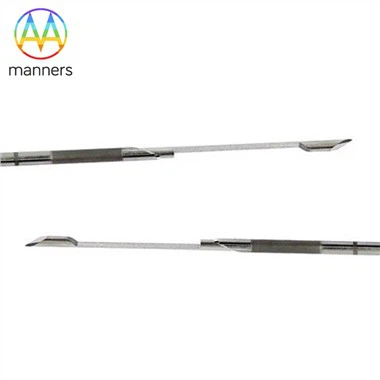
Equipment Classification Different safety-grade biopsy needles assist hierarchical risk prevention of breast biopsy. First, basic safety polymer needles: smooth surface and low tissue irritation, suitable for low-risk superficial lesion biopsy, reducing infection and trauma risks. Second, enhanced safety stainless steel needles: stable structure and accurate sampling, avoiding needle displacement and incomplete sampling, reducing false-negative diagnosis risks. Third, high-precision safety titanium alloy needles: lightweight and precise positioning, avoiding excessive penetration and deep tissue damage, suitable for high-risk deep lesion biopsy, maximizing operational safety.
Practical Operation Guide Implement whole-process safety control specifications for breast biopsy. Preoperatively, evaluate lesion depth, breast thickness and patient physical condition, select safety-matched biopsy needles, and screen high-risk factors such as coagulation disorders to formulate risk prevention schemes. Intraoperatively, adhere to imaging visualized puncture, advance the needle slowly and stably, strictly control sampling depth and range, avoid blind adjustment and violent operation, and implement standardized sterile operation throughout the process. Postoperatively, carry out graded compression hemostasis according to needle diameter, observe wound changes in real time, guide patients to avoid local extrusion and strenuous exercise, and intervene in abnormal bleeding and swelling in time to prevent complications.
Practical Experience Standardized safety management practice verifies that the complication rate of standardized breast biopsy is controlled below 1%, with extremely high clinical safety. Visualized precise puncture completely avoids vascular and nerve damage accidents. High-biocompatibility needle materials reduce postoperative inflammatory reaction and pain. Hierarchical equipment matching and standardized operation eliminate false-negative diagnosis caused by operational errors. Mature risk prevention system makes breast biopsy technology safe, controllable and repeatable, realizing safe popularization in large-scale early screening and high-precision diagnosis scenarios.
Summary and Sublimation Systematic safety risk prevention and control is an important guarantee for the large-scale popularization of breast biopsy technology. It solves various safety hidden dangers in traditional empirical biopsy operation through full-link standardized management and hierarchical safety equipment matching. The perfect combination of standardized operational norms and high-performance biopsy needle equipment realizes the organic unity of accurate diagnosis and safe operation. The mature safety control system makes breast biopsy a high-safety and high-reliability core diagnostic technology, laying a solid foundation for its standardized application in grassroots medical institutions.
Future Suggestions Future breast biopsy safety control will develop towards intelligent early warning. First, develop intelligent biopsy needles with pressure and resistance sensing functions to realize intraoperative abnormal risk early warning. Second, formulate exclusive safety norms for high-risk lesions and special patient groups. Third, build a whole-process safety traceability system for biopsy operations to summarize risk rules and optimize operational standards. Fourth, strengthen standardized safety training for grassroots operators to reduce human-induced safety risks.