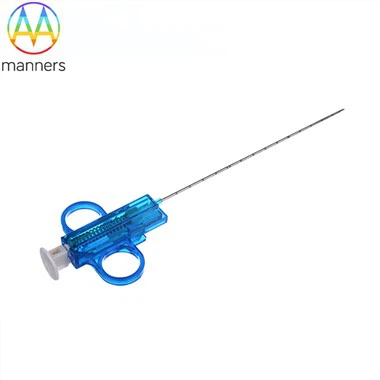
Safety Optimization Of Veress Needle In Laparoscopic Pneumoperitoneum Establishment
Oct 09, 2026
1. Surgical Pain Points in Traditional Pneumoperitoneum Creation
Laparoscopic surgery has become the mainstream minimally invasive surgical method in general surgery, gynecology, and urology, yet traditional pneumoperitoneum establishment faces prominent clinical pain points. Conventional blunt puncture tools lack automatic protection structures, leading to frequent accidental injuries to abdominal visceral organs, blood vessels, and omentum during abdominal wall penetration. Uncontrolled CO₂ insufflation pressure often causes extraperitoneal gas accumulation, resulting in surgical field blur, subcutaneous emphysema, and prolonged operation time. In addition, ordinary puncture needles adopt fixed structural designs, failing to adapt to different patient body types, abdominal wall thicknesses, and surgical scenarios, leading to low puncture success rates and repeated puncture operations that increase patient trauma and intraoperative bleeding risks. Disposable ordinary needles also have unstable material durability, while reusable tools suffer from residual contamination risks after repeated disinfection, restricting standardized surgical implementation. These problems seriously affect the safety and efficiency of closed laparoscopic access, creating an urgent demand for specialized precision puncture and insufflation instruments in clinical practice.
2. Working Principle of Veress Needle
The Veress needle is a core specialized instrument for laparoscopic pneumoperitoneum establishment, relying on a mature spring-loaded safety mechanical structure to solve traditional surgical defects. The equipment consists of two core components: a sharp bevelled outer stainless steel cannula and a retractable blunt inner stylet. In the initial puncture stage, the sharp outer cannula exposes the cutting tip to penetrate skin, subcutaneous tissue, and abdominal fascia layers under external force. When the needle tip breaks through the peritoneum and enters the low-pressure abdominal cavity, the external tissue resistance disappears instantly, and the built-in spring automatically pushes the blunt inner stylet forward to cover the sharp outer cannula tip. This structural design completely avoids sharp scratch damage to intraperitoneal organs and blood vessels. Meanwhile, the reserved side hole on the inner stylet realizes stable and uniform CO₂ gas delivery, enabling quantitative and controlled pneumoperitoneum establishment. The high-quality stainless steel material ensures overall structural rigidity and corrosion resistance, supporting stable mechanical operation during puncture and long-term surgical adaptation.
3. Equipment Classification and Characteristic Analysis
Veress needles are mainly classified into two categories according to usage attributes: disposable sterile models and reusable medical-grade models. Disposable Veress needles are made of medical stainless steel and polymer auxiliary materials, with integrated molding structure, no assembly gaps, and zero cross-infection risk after one-time use. They are suitable for primary hospitals, emergency surgeries, and infectious disease-related laparoscopic operations, featuring simple operation and no post-operation maintenance. Reusable Veress needles adopt high-strength thickened stainless steel overall forging, with enhanced spring fatigue resistance and high-temperature disinfection tolerance, supporting repeated high-pressure steam sterilization and long-term cyclic use. In addition, customized Veress needles can be produced based on 2D/3D drawings or customer samples, including differentiated adjustments of needle body length, outer diameter, puncture angle, and gas flow rate, adapting to pediatric minimally invasive surgery, obese patient abdominal puncture, and thoracic endoscopic surgery scenarios. Different classified models cover diversified clinical needs from conventional general surgery to specialized minimally invasive operations.
4. Standard Operational Guidelines for Clinical Use
Standardized operation is the key to giving full play to Veress needle safety performance. Before operation, surgeons need to check the spring reset sensitivity and gas patency of the needle body to confirm no structural blockage or mechanical failure. The conventional puncture site selects the umbilical low incision, with a 0.5–1.5 cm horizontal skin incision made according to trocar specification. During puncture, lift the abdominal wall fully to increase abdominal cavity space, hold the needle body fixing end (not the needle shaft) stably, and insert the needle at a 45-degree oblique angle to the abdominal wall. Two obvious popping sensations can be felt when passing through fascia and peritoneum, marking successful abdominal cavity entry. After puncture, implement a saline drop test and negative pressure aspiration test to verify correct needle tip position. Then start low-flow CO₂ insufflation, gradually stabilize intra-abdominal pressure at 12–15 mmHg, and withdraw the Veress needle smoothly after completing pneumoperitoneum establishment and before trocar placement. The whole process strictly avoids rapid forced puncture to prevent mechanical structural failure and tissue damage.
5. Practical Clinical Experience and Error Avoidance
Long-term clinical application experience shows that most Veress needle operation failures are caused by non-standard manipulation rather than equipment defects. Excessively fast puncture speed will lead to the blunt stylet failing to reset in time, causing visceral puncture injury; insufficient abdominal wall lifting results in narrow operating space and increased extraperitoneal puncture probability. For obese patients with thick abdominal walls, appropriately extend the puncture depth and reduce single propulsion force to ensure layered tissue penetration. For pediatric patients, select customized short thin-type Veress needles to match delicate tissue structures. In terms of equipment maintenance, disposable models must be discarded immediately after use to avoid secondary use risks; reusable models need thorough cleaning of residual gas and tissue fluid in the tube cavity before high-temperature disinfection, and regular inspection of spring elasticity and needle tip integrity to eliminate aging failure hidden dangers. Intraoperative real-time pressure monitoring can effectively avoid excessive insufflation pressure and reduce postoperative complications.
6. Summary and Technical Value Sublimation
As the essential front-end instrument for laparoscopic minimally invasive surgery, the Veress needle solves the core safety pain point of traditional pneumoperitoneum establishment through its unique spring-loaded safety structure and precise gas delivery design. Its classified product design and customized production mode meet the standardized and personalized needs of different clinical scenarios, effectively reducing intraoperative injury rates and improving surgical precision. The equipment's high-strength stainless steel material ensures stable performance and high medical safety, becoming an indispensable basic tool for closed laparoscopic access technology. Standardized operation and scientific maintenance further maximize the equipment's clinical value, laying a solid foundation for the smooth development of minimally invasive surgery.
7. Industry Development Prospects and Optimization Suggestions
With the continuous popularization of minimally invasive surgery and the expansion of precision medical scenarios, the market demand for high-performance Veress needles is steadily rising. The industry's future development direction focuses on intelligent optimization and scenario refinement. It is suggested to add real-time pressure sensing and automatic early warning functions to the needle body to realize intelligent monitoring of puncture state and insufflation pressure. Strengthen customized product research and development, launch special models for pediatric, obese, and thoracic surgery scenarios, and enrich product matrix. Optimize material technology, improve the wear resistance and anti-fatigue performance of reusable needles, and reduce product use cost. In addition, standardize clinical operation training guidelines, improve surgeons' standardized operation level, and form a complete set of equipment application system to further promote the popularization and upgrading of Veress needle technology in global minimally invasive surgery.