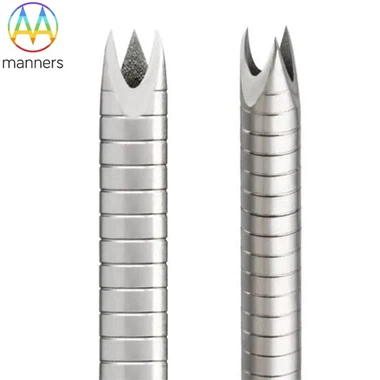
Macro Back Eyes
Oct 09, 2026
The Pain Point
At the other end of the spectrum, Back Eye Needles from 10–30 mm OD serve industrial dispensing, veterinary injection, bioreactor sampling, and heavy-fluid transfer. Here, the challenge is not collapse but force management. A 30 mm tube has hundreds of times the cross-sectional area of a 1 mm tube. Punching a side hole requires massive force, which can deform the tube, shift the port position, or create dangerous burrs on the inside edge. Industrial buyers often accept rough ports because "it's just for grease," then wonder why their dispensing system drips, clogs, or sprays inconsistently. The pain is poor process control disguised as "good enough for industrial."
How It Works
Macro back-eye forming relies on brute force and rigid support. The tube wall may be 1–5 mm thick. Stamping is impractical; laser cutting is slow and may not penetrate thick stainless in a single pass. The dominant methods are EDM (electrical discharge machining), milling, and saw slotting. Each has trade-offs:
EDM slotting: Uses a wire or sinking electrode to erode a slot. No mechanical force, so no deformation. Slow but precise. Recast layer must be removed.
CNC milling: A rotating cutter carves a hole or slot. Fast but generates heat and burr. Requires rigid fixturing.
Saw slotting: A thin abrasive or carbide blade cuts a slot. Cheap but rough edge; requires extensive deburring.
Waterjet cutting: High-pressure abrasive water cuts through thick tube. No HAZ but edge quality varies; not common for small ports.
After forming, the inside edge is the critical area. In dispensing applications, a burr or rough edge causes fluid to "string" or drip after the valve closes. In sampling probes, a rough edge can catch debris or create turbulence that affects flow measurement.
Device Classification
By Macro Application:
- Industrial adhesive dispensing – 10–20 mm OD; back-cut slot for controlled droplet.
- Veterinary injection – 14–20 mm OD; large back eye for high-viscosity medications.
- Bioreactor sampling probe – 15–30 mm; side port for representative sampling.
- Hydraulic fluid transfer – 20–30 mm; reinforced back eye for pressure resistance.
- Food/pharma processing – 10–25 mm; sanitary back eye with polished interior.
By Port Type:
- Through-hole – Full penetration for flow-through sampling.
- Blind slot – Partial cut for directional dispensing.
- Multiple back eyes – Array of ports for uniform distribution.
- Threaded back eye – For screw-in fittings or filters.
Practical Guide
Specifying macro Back Eye Needles:
- Define fluid properties: Viscosity, particulate content, temperature, pressure. High-viscosity fluids need larger ports and smoother edges.
- Choose forming method: EDM for precision; milling for speed; saw for cost. Match to quality requirement.
- Specify edge finish: Inside edge radius ≥0.1 mm for dispensing; electropolish or passivation mandatory for food/pharma.
- Wall thickness: Minimum 1 mm for EDM; 2 mm preferred for milling to avoid vibration.
- Port position tolerance: ±0.5 mm typical; ±0.1 mm for precision sampling.
- Pressure rating: Hydrostatic test to 1.5× operating pressure; helium leak test for gas applications.
- Surface finish: Ra ≤0.8 µm for industrial; ≤0.4 µm for food/pharma; electropolish for medical-adjacent.
- Material: 304/316L standard; duplex stainless for corrosive; Hastelloy for extreme chemical.
Real-World Experience
A biotech company used 25 mm OD sampling probes with saw-cut slots for fermenter broth. The rough edges caught mycelial particles, causing false readings and frequent clogging. Switching to EDM slots with a 0.2 mm edge radius and electropolish reduced clogging by 90%. Sampling accuracy improved, and the probes lasted 6× longer.
A veterinary vaccine manufacturer dispensed thick adjuvant through 18 mm back-eye needles with milled slots. The inside burr caused "stringing" that wasted vaccine and contaminated vial caps. Adding a tumble-deburr and citric passivation step eliminated stringing. Vaccine waste dropped by 4%, saving $80,000 annually.
Summary
Macro Back Eye Needles are not just "big needles"-they are engineered fluid-control components. The side port must be formed with methods appropriate to the diameter and wall thickness, and the inside edge quality directly determines dispensing or sampling performance. Industrial buyers who treat back eyes as trivial will pay in waste, downtime, and inconsistent product.
Outlook
Macro back-eye manufacturing will adopt robotics and automated inspection. EDM will become faster with multi-wire and adaptive control. In-line vision will measure edge radius and port position on every part. Industrial buyers will demand "dispensing consistency reports" showing droplet-size variation or flow uniformity. The line between industrial tube and precision fluid device will blur, and suppliers who offer engineering support-not just cutting-will lead the market.