Redo Ablation Access
Oct 13, 2026
The Pain Points
Redo ablation procedures are the ultimate test of an electrophysiologist's skill. The patient has already been through at least one ablation procedure, and the anatomy has been permanently altered. Scar tissue from the previous ablation distorts the normal contours of the heart. The fossa ovalis may be fibrotic or calcified. The coronary sinus may be narrowed or obstructed. The atrial walls may be thinned and fragile.
The challenges of redo access are compounded by the psychological state of the patient. These are often patients who have failed initial treatment and are seeking a second chance. They are anxious, sometimes frustrated, and often less tolerant of complications. The operator feels this pressure acutely.
The traditional approach to redo access uses a straight needle to puncture the septum. But the straight needle encounters a septum that is no longer the soft, pliable structure it was in the first procedure. The fibrotic tissue resists mechanical puncture, requiring more force. The increased force increases the risk of overshoot and collateral damage. The scar tissue may also create false passages or irregular tracts that are difficult to navigate.
The clinical consequences are severe. A failed access attempt in a redo case may force the operator to abandon the procedure entirely, leaving the patient without treatment. A complication such as tamponade or aortic root puncture is even worse, potentially requiring emergency surgery.
Principle
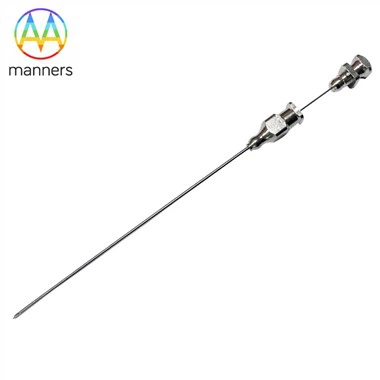
The Curved Tip RF Puncture Needle is particularly well-suited for redo ablation access. The curved tip allows the operator to "re-aim" the approach without heavy forward load. Instead of pushing a straight needle through a fibrotic septum, the operator can use the curve to approach the septum from a different angle, finding a path through the tissue that is less resistant.
The RF capability is the key advantage in redo cases. The RF energy can clear fibrotic barriers that resist mechanical puncture. The energy creates a controlled thermal tract through the scar tissue, allowing the needle to cross with minimal force. This is a game-changer for redo procedures.
The principle is simple: the curve provides direction, and the RF provides penetration. The operator guides the needle along the desired path, and the energy does the work of crossing the tissue barrier. This reduces the mechanical demands on the operator and increases the predictability of the puncture.
Categories
Several types of curved RF needles are available for redo ablation access.
Scar-Penetrating RF Needles are specifically designed for crossing fibrotic or calcified septa. These needles have a more aggressive RF tip that delivers higher energy density, allowing them to penetrate scar tissue that would resist a standard needle.
Re-Entry Transseptal Curved Needles are designed for patients who have had a previous transseptal puncture. The curve is oriented to allow the operator to find a new puncture site, avoiding the previous tract and the scar tissue surrounding it.
Low-Trauma Pediatric-Size Needles are available for pediatric patients or for adults with particularly fragile tissue. These needles have a smaller diameter and a gentler curve, reducing the risk of tissue trauma.
Generator-Locked Disposable Tips are designed for use with a specific RF generator. The tip is locked to the generator, ensuring compatibility and preventing the use of incompatible combinations.
Guide
The following steps represent best practice for using a curved RF needle in redo ablation access.
Step 1: Mark Old Puncture Sites on the 3D Map. Before the procedure, review the previous ablation report and mark the location of the previous transseptal puncture on the 3D electroanatomic map. This will help you avoid the scar tissue and choose a new puncture site.
Step 2: Choose a New Septal Zone if Safe. If the previous puncture site is surrounded by scar tissue, choose a new zone for the puncture. The new site should be away from the aortic root, the atrial roof, and other critical structures.
Step 3: Use Echo to Avoid Aortic Root or Atrial Roof. Transesophageal or intracardiac echocardiography is essential in redo cases. The anatomy is distorted, and the risk of puncturing the aortic root or the atrial roof is higher. Use echo to confirm the position of the needle tip before activating the RF.
Step 4: Keep RF Duration Short. In fibrotic tissue, the RF energy may need to be delivered for a longer duration to achieve penetration. However, the surrounding myocardium is fragile and should not be exposed to excessive energy. Keep the RF duration as short as possible while still achieving penetration.
Step 5: Confirm Crossing Before Advancing. After the RF burst, confirm that the crossing has occurred before advancing the needle. Use contrast dye injection or pressure monitoring to confirm left atrial access.
Field View
Redo centers have developed a clear preference for curved RF needles over straight mechanical needles. The reason is simple: predictability. In redo cases, the anatomy is unpredictable, and the operator needs a device that provides consistent, controlled access.
A needle that crosses once, cleanly, beats a cheap needle that crosses three times messily. This is the mantra of redo centers. The curved RF needle may cost more than a traditional needle, but the cost is justified by the reduced complication rate and the higher success rate.
One important lesson from the field: the RF energy should be delivered in short bursts, with careful monitoring of the impedance. In fibrotic tissue, the impedance may be higher than normal, and the generator settings may need to be adjusted.
Another lesson: the curved tip is particularly useful in redo cases because it allows the operator to approach the septum from a different angle. This can help avoid the scar tissue from the previous puncture and find a cleaner path through the tissue.
Summary
In redo ablation, access quality predicts case quality. The curved RF needle provides the controlled, predictable access that redo cases demand. The curve allows the operator to find a new path through distorted anatomy, and the RF energy clears fibrotic barriers that resist mechanical puncture.
The result is a procedure that is safer, faster, and more likely to succeed. For patients who have already failed one ablation, this is a critical advantage.
Advice
For hospitals and EP labs performing redo ablations, the following advice is offered.
Stock Both Fixed-Curve and Adjustable Models. Different redo cases present different challenges. Having both fixed-curve and adjustable models allows the operator to choose the right tool for the specific anatomy.
Validate Cleaning/Sterilization Only for Labeled Reuse. If a needle is labeled for single use, do not reuse it. The sterilization process may not be validated for multiple uses, and the needle may not perform as expected after the first use.
Prefer Single-Use RF Tips. For redo cases, single-use RF tips are preferred. The risk of cross-contamination and the risk of performance degradation after reuse are simply not worth the cost savings.