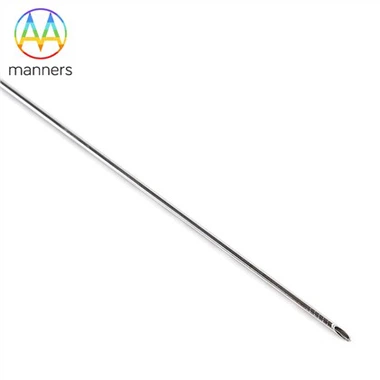
Quincke Spinal Needle 22G 90mm: Choosing Between Cutting And Atraumatic Tips
Nov 26, 2026
The Pain Point: The Headache Arithmetic
The choice between a cutting bevel and an atraumatic tip is usually presented as a trade between success and safety. That framing is too simple, but it contains the number that matters: the incidence of post-dural puncture headache. The complication is driven by the size of the dural defect, the patient's age and sex, the volume of fluid lost, and the number of attempts. Needle gauge and tip design are the two factors the operator controls completely.
Where a large cutting needle has been used, headache rates in young adults and obstetric patients can be high enough to change departmental policy. Where fine atraumatic needles are used, rates fall, but the procedure becomes slower, flow is weaker, and the number of passes rises in difficult spines. Every unit therefore ends up with two defaults: one for the routine elective patient, and one for the patient whose anatomy or procedure demands something more robust.
The Working Principle: Defect Size and Defect Shape
Defect size follows the needle. A 22G cannula is about 0.7 millimetres across, and a cutting bevel opens a slit whose length is greater than that diameter. An atraumatic tip of the same gauge separates the dural fibres and leaves an opening that is nominally the cannula diameter and tends to gape less because the fibres recoil around it. The difference in leak is not proportional to gauge alone; shape and the orientation of the cut relative to the dural fibres both contribute.
Defect behaviour also differs over time. A cut edge leaves a clean slit that closes by elastic recoil of the compressed dura, while a separated opening leaves fibres folded back into the track, which can hold the track open briefly and then seal. This is why the clinical difference between tip types is most visible in the first forty-eight hours, and why the same needle can produce headache in one patient and none in the next.
Flow is the compensating advantage of the cutting tip. A 22G Quincke aperture admits cerebrospinal fluid freely under gravity, so the hub fills quickly, opening pressure can be read within seconds of entering the space, and multiple tubes can be collected without repeated repositioning. A 25G or 27G atraumatic needle of the same nominal flow path can take several minutes for the same volume, and in a patient with low opening pressure the flow may be too slow to confirm placement confidently.
The Product Family: Placing the 22G 90mm in the Range
The workable portfolio has four bands. Fine cutting needles of 25G to 27G are used where a small defect is wanted but a sharp tip is preferred, typically for short diagnostic taps. Atraumatic needles of 25G to 27G dominate elective anaesthesia in obstetric and ambulatory practice. The 22G 90mm cutting needle covers diagnostic and therapeutic procedures that need flow, pressure measurement or robustness. Larger 18G to 20G cutting needles are reserved for therapeutic drainage and for procedures where a catheter or a larger sample is required.
Length is a separate axis. Ninety millimetres is the standard adult length; shorter needles serve paediatric and low-BMI patients, and longer lengths exist for obesity. A department that standardises on 90mm and stocks only one tip type usually discovers, within a year, that it is improvising on both ends of the range: too large for the elective obstetric patient, too fine for the therapeutic tap.
Demand planning is part of the same decision. A department that stocks only a fine atraumatic needle and a large cutting needle will find itself using the large one for diagnostic taps simply because the middle of the range is missing. The 22G 90mm cutting needle exists precisely to fill that middle: it is small enough to be reasonable in most adults and large enough to measure pressure and collect several tubes without a delay that tempts the operator to redirect a correctly placed needle.
Practical Use: A Decision Sequence
Start with the patient rather than the procedure. Age under forty, female sex, pregnancy, low body mass and a history of headache after a previous puncture all raise the cost of a large defect, and these patients should receive the finest atraumatic needle that can be reliably placed. Then consider the procedure: if opening pressure, rapid collection, therapeutic drainage or a planned intrathecal drug are involved, flow and lumen size become requirements rather than preferences.
Then consider the spine. A patient with calcified ligaments, previous lumbar surgery, scoliosis or a high BMI is likely to need multiple passes with a fine soft needle, and each pass adds trauma that offsets the theoretical benefit of the smaller defect. In that situation a 22G cutting needle placed once with ultrasound or fluoroscopic guidance is often the lower-risk path, and the decision should be recorded rather than left implicit.
Finally, consider the operator and the setting. Experience changes the arithmetic, because a skilled operator using a fine needle needs fewer attempts. In an emergency department at night, with a patient who cannot sit still, the needle that gives the clearest end point is the one that finishes the procedure fastest, and speed is itself a safety property.
Field Experience: What Units Actually Report
Units that switch their elective default to a fine atraumatic needle usually report a fall in headache calls and a rise in procedure time, followed by a gradual recovery of speed as technique adapts. The adaptation is specific: operators learn to advance more slowly, to use ultrasound for landmarking, and to accept a weaker flow signal instead of re-directing the needle. Units that skip that adaptation conclude, wrongly, that the atraumatic needle does not work.
Conversely, units that keep a 22G cutting needle as their only stock report a recurring pattern of headache in young patients, occasional blood patch procedures, and a persistent difficulty with very thin patients where a 90mm needle is longer than necessary. Neither policy is irrational; both are incomplete, and the fix in each case is a small, deliberately stocked second option rather than a wholesale change.
Documentation closes the loop. Recording the needle gauge, the tip type and the number of passes turns an individual decision into a departmental dataset, and that dataset is what shows whether a policy is working. Without it, a change of default is judged by the loudest recent case rather than by a rate, and the loudest case is usually the one that went wrong for reasons unrelated to the needle.
Summary: Match the Defect to the Patient
The 22G 90mm Quincke is the correct choice when flow, pressure measurement, therapeutic volume, or a difficult spine makes a single clean pass more valuable than a smaller hole. It is the wrong choice for the routine elective tap in a young, ambulatory or obstetric patient, where an atraumatic needle of 25G or finer offers a materially lower headache risk.
The decision is not a matter of department loyalty but of documented patient and procedure factors. Written into a short protocol with two needle options, it removes the improvisation that produces both unnecessary headaches and unnecessary repeated passes.
Outlook: Narrowing the Gap
Both tip families are converging. Cutting bevels are being ground with smaller edge radii and shorter faces to limit defect length, and atraumatic tips are being refined with firmer cones and better echogenicity to improve trackability under ultrasound. The gap in flow performance is also narrowing as thin-wall cannula tubing becomes standard, which raises lumen size for a given outer diameter.
The likely outcome is not a single winning design but a smaller number of better-defined roles: a fine atraumatic default for elective anaesthesia, a robust 22G cutting needle for diagnostic and therapeutic work, and clearer packaging that states which is which. For procurement, that means the interesting question stops being which tip is better and becomes whether the supplier can document the dimensions that make each tip behave as intended.