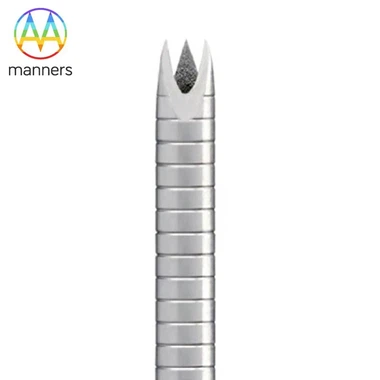
Quincke Or Pencil Point: Choosing Spinal Needle Tip Geometry
Nov 23, 2026
1 The Tip Makes the Headache
Two needles can share a gauge, a length, a hub colour and a sterile pack, and behave entirely differently in the same patient. The difference is the tip. A Quincke needle ends in a sharp bevel that cuts its way through the dura; a pencil-point needle ends in a closed, ogival tip with side openings that parts and stretches the tissue instead. Both reach the cerebrospinal fluid. Both are used every day. But the defect they leave, the way they behave when the patient moves, and the rate at which patients develop a post-dural puncture headache are not equivalent, and the choice between them is one of the few decisions in the procedure that has a strong evidence base behind it. The confusion that surrounds this choice is largely linguistic. Sales literature describes tips as "atraumatic", "pencil point", "Whitacre", "Sprotte" and "Quincke" as though they were interchangeable adjectives. They are not. A buyer who specifies "pencil point" without specifying the side-hole arrangement, the tip length, or the stylet fit may receive a product that behaves like neither of the designs the clinicians had in mind. Understanding the geometry is the only way to write a specification that survives translation.
2 Cutting Versus Parting the Dura
The dura mater is a fibrous membrane with a pronounced grain. A bevel needle severs fibres along the line of its cutting edge and leaves a slit whose edges may not seal promptly, particularly when the bevel lies across the grain rather than along it. This is the anatomical basis of the classical advice to orient a Quincke bevel parallel to the dural fibres, and it is also the reason a Quincke puncture can produce a persistent leak even when the needle was small. The defect is a cut, and cuts in fibrous tissue heal by scarring rather than by immediate apposition. A pencil-point needle produces a different injury. Its closed tip displaces and separates fibres, and the side holes discharge fluid laterally. The resulting opening is smaller, more nearly circular, and more likely to close under the normal pressure of the epidural space and the surrounding tissue. Randomised trials and pooled analyses have consistently shown lower headache rates with pencil-point needles than with bevel needles at comparable gauges, and the effect is large enough that many departments no longer stock a Quincke needle for diagnostic lumbar puncture at all. There is a cost to the geometry. A closed tip cannot cut, which means it cannot easily pass through dense ligament or scarred tissue, and it must be advanced with a stylet in place to prevent tissue from entering the side holes. Flow through side openings is slower and can be interrupted by the dural edge itself, so a pencil-point needle that has reached the subarachnoid space may still show nothing at the hub until it is rotated or advanced a millimetre. The gentler needle demands a more patient operator.
3 A Family of Tips, Not a Single Design
Within the pencil-point family the differences are real. The Whitacre design uses a short, bullet-shaped tip with a single side hole; the Sprotte uses a longer ogival tip with a larger, more proximal side opening, which improves flow at the cost of a longer tip that must clear the dura before fluid appears. Variants with two opposing side holes reduce the dependence on rotational orientation but can weaken the tip. Each design trades flow against the size of the dural opening and the ease of manufacture at fine gauges. Quincke-type needles also vary. Bevel angle, the presence of a back cut, and the sharpness of the transition from bevel to shaft all affect cutting behaviour and the risk of "coring" tissue into the lumen. A back-cut bevel is often specified for epidural and combined spinal-epidural work because it improves the feel of the loss-of-resistance transition, but it is not a substitute for an atraumatic tip when headache risk is the dominant concern. Materials multiply the options. Stainless steel remains the default for rigidity and cost. Nitinol tips and shafts appear at the finest gauges, where superelastic behaviour resists kinking in a long, angulated tract. Ceramic and polymer tips have been tried for very fine spinal work; their advantage is a non-cutting profile and their disadvantage is manufacturing consistency at 27G. The buyer's task is not to choose the most advanced tip but to match the tip to the procedure, and to state the geometry precisely enough that the supplier cannot substitute a look-alike.
4 Choosing and Using Each Geometry
For diagnostic lumbar puncture in an adult, a 22G pencil-point needle at 90 mm is the mainstream choice, and the evidence supports moving to 25G when headache risk matters. For spinal anaesthesia, 25G or 26G pencil point is standard in day-case practice, with 27G used where the anaesthetist is confident in the flow and the patient is at high risk of headache. For therapeutic drainage or a sample that must be obtained quickly, a 20G or 21G Quincke needle remains reasonable, because the volume and speed requirements outweigh a headache risk that is already accepted in that population. Technique must follow the tip. A pencil-point needle is advanced with the stylet fully seated and is not used to probe or reposition; the shaft is withdrawn and re-angled rather than levered. Once the presumed depth is reached, the stylet is removed slowly and the hub observed for several seconds before any conclusion is drawn. If no fluid appears, rotating the needle in small increments is legitimate because side-hole orientation matters; advancing another centimetre is not, because overshoot is the commonest cause of a bloody tap. With a Quincke needle, the bevel is oriented before puncture, the stylet is kept in place until the dura is crossed, and the needle is not rotated after entry if the bevel orientation is to be preserved. Depth control is the shared discipline. The needle should be advanced in millimetres with the stylet removed at intervals, not driven to a landmark and then withdrawn. In a patient with a deep tract, the longer needle reduces the temptation to push the hub into the skin, but it also increases the distance over which the tip can drift off axis. Ultrasound guidance or a pre-measured depth converts both tips from guesswork into a planned trajectory.
5 What Changes When the Tip Changes
Operators who move from a bevel to a pencil-point needle notice three things in the first month. Flow is slower, and the wait at the hub must be taught rather than assumed; a trainee who has learned on 22G Quincke needles will interpret a 25G pencil-point pause as failure. The second is the feel of the dura: a closed tip transmits a distinct, elastic resistance that a sharp bevel converts into a sudden give. The third is the headache rate, which falls far enough to be visible in a department's own follow-up calls rather than only in a journal. The most common error in a mixed department is a mismatch between needle and technique. A pencil-point needle advanced without its stylet collects a plug of tissue in the side hole and produces a dry hub that no amount of rotation will fix. A Quincke needle rotated after entry can cut a second track in the dura and double the defect. Neither failure is a manufacturing fault, and neither is captured by incoming inspection; both are training problems that a specification alone cannot solve.
6 Summary
Tip geometry decides the nature of the dural injury, and therefore the headache risk, the flow behaviour and the technique required. Bevel needles cut, reach fluid quickly, and leave a slit that may leak; pencil-point needles part tissue, flow more slowly, and leave a smaller opening that closes more readily. Within each family, tip length, side-hole number and position, bevel angle and material all matter. A specification that names only "pencil point" or "Quincke" leaves the most important variables unstated.
7 The Next Generation of Tips
Current development is aimed at removing the residual compromise between a small dural defect and a usable flow. Multi-orifice pencil tips, thin-wall shafts and nitinol reinforcement all pursue that goal from different directions. A second line of work targets the defect itself, with coated needles and closure devices intended to speed sealing. For procurement, the practical consequence is a demand for clearer drawings: as tips become more sophisticated, a trade name is no longer an adequate description, and the side-hole geometry that determines performance must appear on the specification.