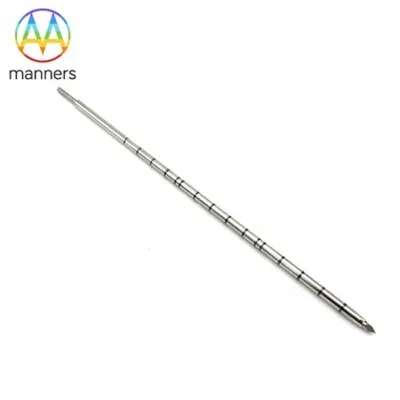
Quality Control Standard And Packaging Logistics Specification Of Radioactive Particle Localization Needles
Aug 11, 2026
1. Industry Pain Points
Imperfect quality control and non-standard packaging logistics are important hidden dangers affecting the clinical application effect of particle localization needles. In the production link, some products have unqualified precision processing, uneven coating thickness, unclear scale markers and unsmooth inner walls, leading to seed jamming, positioning deviation and reduced service life in clinical use. The lack of unified quality inspection standards results in uneven product quality in the industry, with large performance differences between different batches and manufacturers. In terms of packaging and logistics, non-standard carton packaging is prone to extrusion, collision and vibration during transportation, causing needle body deformation, coating peeling and tip damage. Unprofessional packaging cannot realize dust-proof, moisture-proof and sterile protection, leading to product contamination and failure to meet clinical sterile use standards. In addition, the single packaging form cannot meet the differentiated packaging needs of conventional and customized products, affecting the safe circulation and clinical use efficiency of products.
2. Quality Control and Packaging Working Principle
The quality control and standardized packaging of radioactive particle localization needles are based on medical device safety and clinical applicability principles, covering full-process quality assurance from production to circulation. The core quality control principle is to take precision processing parameters, surface treatment effect, structural stability and functional performance as inspection indicators, and conduct full-item detection of necking, swaging, grinding, laser processing and electropolishing effects to ensure that all product parameters meet medical clinical standards. The silicon coating uniformity, echo visualization effect, scale accuracy and puncture sharpness are strictly tested to eliminate unqualified products. The packaging protection principle is to adopt standardized carton overall packaging, with internal fixed buffer structure, which can resist external extrusion and vibration, avoid needle body deformation and structural damage. The dust-proof, moisture-proof and sterile packaging design ensures that the product maintains a sterile and intact state during circulation, meeting the requirements of clinical sterile operation. At the same time, it supports personalized packaging adjustment according to customer needs to adapt to different storage and transportation scenarios.
3. Classification of Quality Inspection Items and Packaging Modes
The quality control of localization needles covers five core inspection categories. First, dimensional precision inspection: detect needle gauge, length, tube wall thickness and structural size tolerance to ensure compliance with standard and customized parameters. Second, surface processing inspection: check the uniformity and firmness of silicon coating, the smoothness of electropolished surface, and the absence of burrs and scratches on the inner and outer walls. Third, functional performance inspection: test echo visualization effect, puncture sharpness, seed delivery smoothness and structural stability. Fourth, marking inspection: verify the clarity, accuracy and wear resistance of laser scales and orientation markers. Fifth, safety inspection: detect biocompatibility, corrosion resistance and sterile performance of products. In terms of packaging classification, it is divided into standard carton packaging and customized packaging. Standard carton packaging is suitable for conventional batch products, with fixed buffer protection and sterile sealing; customized packaging adjusts packaging size, protection structure and labeling information according to customer usage scenarios and batch requirements.
4. Full Process Quality Control and Packaging Operation Guidelines
To ensure product quality stability and circulation safety, implement full-process standardized management. First, production quality control: strictly implement various precision processing technologies, conduct real-time sampling inspection of each process, and recheck all indicators after product forming to ensure full compliance with standards. Second, finished product screening: eliminate products with unqualified size, uneven coating, unclear marking and unsmooth inner walls to ensure 100% qualified rate of outgoing products. Third, standardized packaging operation: clean and disinfect the finished needles, place them in fixed sterile trays, adopt buffer protection structure for positioning and fixing, avoid mutual collision of needle bodies, and complete sealed packaging. Fourth, batch marking management: mark product specifications, production batch, inspection results and sterile validity period on the packaging surface for traceability management. Fifth, logistics protection: adopt shockproof and pressure-resistant transportation measures, avoid violent handling, and ensure that the products are intact and sterile when arriving at the destination. Sixth, customized packaging docking: according to customer's personalized packaging requirements, adjust packaging structure and form to meet special storage and use needs.
5. Practical Experience of Quality and Packaging Management
Full-process quality control and standardized packaging management effectively solve the quality and safety problems of particle localization needles in production and circulation. Strict multi-process quality inspection makes the product dimensional accuracy and functional performance reach the industry high standard, the clinical seed jamming rate and positioning error rate are reduced to less than 1%, and the product stability and durability are greatly improved. Standard sterile carton packaging completely avoids product contamination and structural damage during transportation, the product intact rate in circulation reaches 100%, and the sterile qualification rate meets national medical device standards. Customized packaging services meet the differentiated needs of different medical institutions for product storage, batch management and clinical use, improving the overall service level of products. Perfect quality and packaging management system ensures the consistency and reliability of product clinical application effect, and wins high recognition in clinical medical institutions.
6. System Value Summary of Quality and Packaging Management
The systematic quality control and standardized packaging system build a complete safety guarantee system for the production and circulation of radioactive particle localization needles. Strict multi-dimensional quality inspection standards standardize the production process of products, ensure the high precision, high stability and high safety of medical devices, and eliminate the hidden dangers of clinical application quality. Standardized and customized dual packaging modes realize the safe circulation and sterile storage of products, protect the structural integrity and functional stability of products, and meet the standardized management needs of medical devices. The whole-process traceability management further improves the controllability of product quality, providing solid guarantee for the safe and standardized clinical application of brachytherapy needles.
7. Industry Standard Upgrading and Development Suggestions
In the future, the industry should further unify the quality inspection standards for radioactive particle localization needles, establish a full-item digital quality detection system, realize intelligent and precise quality control. Optimize the packaging protection structure, develop lightweight, environmentally friendly and high-strength medical special packaging materials, improve the anti-collision and sterile protection performance of packaging. Improve the customized packaging service system, realize flexible matching of packaging forms and customer needs. Strengthen industry standard publicity and implementation, standardize the production, inspection and packaging behaviors of various manufacturers, promote the overall upgrading of industry product quality and service level, and ensure the long-term stable and safe clinical application of products.