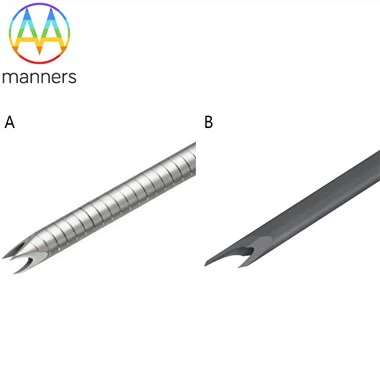
OEM Customisation Solutions For 21-32G Blood Lancet Needles
Nov 15, 2026
Meta Description: Full OEM customisation guide for 21-32G Blood Lancet Needles. Learn drawing-based development, sample reverse engineering, gauge & length adjustment, private label packaging and pre-production sample validation. (Word count: 1394) Medical device brands, diagnostic kit developers and global distributors frequently encounter a common product development challenge: off-the-shelf standard lancet specifications cannot perfectly match their self-designed lancing devices or branded POCT kits. 21-32G Blood Lancet Needles offer mature, flexible OEM customisation services, accepting customer 2D engineering drawings, 3D CAD models or physical reference samples to replicate and optimise needle parameters. This service allows brands to build differentiated capillary sampling products without investing millions into building their own precision grinding workshop and sterile production line.
Before launching a custom OEM project, buyers need to clarify core custom parameters and clinical goals. The 21–32G gauge portfolio forms the main custom range, covering 21G thick lancets for high-volume blood collection, mid-range 24–28G universal models and 29–32G ultra-fine low-pain variants. Beyond gauge, customisable features include effective puncture length, tip grinding bevel angle, rear connection structure, surface polishing and lubricant coating. The overall product system supports 10G–36G, diameter 0.5–20 mm and unlimited custom needle length, giving design engineers substantial freedom to adapt lancet geometry to fit different hardware structures and clinical use cases.
There are two mainstream customisation modes: drawing-based forward development and physical sample reverse engineering. If customers supply complete engineering drawings with clear tolerance marks, the factory engineering team first conducts a manufacturability review. Unrealistically tight tolerances or structurally unreasonable tip designs will be flagged and discussed for adjustment before prototype production starts. If customers only have a physical reference sample without technical files, the technical team scans the sample, takes precise dimensional measurements, generates formal engineering files and produces pre-production prototypes for customer confirmation. Sample confirmation is a non-negotiable checkpoint. Buyers must test sharpness, penetration performance and mechanical compatibility with their lancing device before approving mass production. Skipping prototype validation often leads to costly rework and production delays.
Medical stainless steel is the default raw material for all custom lancets. Special alloy requirements or unique surface treatment specifications can be negotiated during the pre-production phase. The standard lancet tip geometry can be adjusted according to clinical priorities. Some customers require a steeper grinding angle for fast penetration on thick calloused skin, while paediatric diagnostic brands prefer a milder, finer tip for minimal tissue trauma in children. All custom lancets follow the same strict QC standards as standard stock products: microscope tip inspection, dimensional verification, sharpness testing and biocompatibility validation. No custom order receives relaxed quality thresholds.
Packaging is also a fully customisable module. Bulk wholesale customers select standard export cartons to minimise logistics expenses. Private label clients can order custom sterile blister packs, printed brand logos, multilingual instruction leaflets and colour retail boxes. Many POCT kit brands bundle 21-32G Blood Lancet Needles together with test strips and other sampling accessories, so the supplier can adjust outer package dimensions to fit the layout of the complete diagnostic kit. Every custom batch supports full batch traceability, with sterilisation certificates and material test reports supplied alongside shipping documents to meet import and regulatory requirements.
Customised lancets still follow universal capillary sampling rules. Users should prick the lateral side of the finger instead of the fingertip pad, avoid forceful squeezing, hang the hand down to promote natural blood flow, and switch to another finger if blood flow stops. Custom longer 21G lancets require extra attention to bleeding control after sampling. Custom ultra-fine 32G lancets benefit from hand warming and gentle massage to generate enough blood drops for testing.
Many custom projects fail because buyers only check visual appearance and ignore clinical performance metrics. Acceptance criteria should include consistent penetration force, stable blood output, zero burr defects and reliable compatibility with the lancing device. A lancet with correct dimensions but poor surface polishing will still create high friction and excessive pain during use. Functional testing is just as important as dimensional inspection.
Common application scenarios for custom 21-32G Blood Lancet Needles include branded diabetes self-test kits, hospital portable blood analysers, paediatric screening kits, veterinary diagnostic kits and community health screening supplies. OEM customisation helps brands escape homogeneous price competition and build unique selling points around sampling comfort and seamless device compatibility. With the continuous expansion of the global POCT market, flexible customisation capability has become a core competitive advantage for manufacturers of 21-32G Blood Lancet Needles.