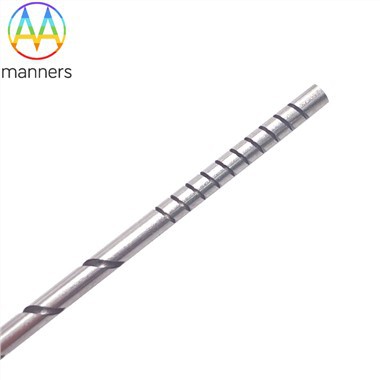
Product Specification Advantages Of Manners RF Transseptal Puncture Needles
Jul 01, 2026
https://pmc.ncbi.nlm.nih.gov/articles/PMC4333976/
As a precision cardiac interventional instrument, parameter accuracy directly determines clinical surgical outcomes. Leveraging a standardized, refined, and professional parameter system, the Manners RF transseptal puncture needle forms differentiated advantages in dimensions such as size specifications, physical performance, and machining accuracy. Precisely matching global mainstream cardiac interventional surgical operating standards, it stands as an industry parameter benchmark product.
Regarding core dimensional parameters, the product features a dual-specification diameter system: 0.6 mm and 0.7 mm precisely cover the surgical needs of the entire population. The 0.6 mm ultra-thin specification is suitable for children, petite patients, and delicate minimally invasive surgeries, minimizing tissue trauma. The 0.7 mm conventional specification applies to routine adult interventional surgeries, balancing puncture stability and surgical efficiency. The unified 6.5 mm standard working length is compatible with the supporting sizes of mainstream sheaths, dilators, and interventional instruments, requiring no additional adaptation or modification, thus offering extremely strong compatibility.
At the precision parameter level, the overall dimensional tolerance of the product is strictly controlled within ±0.01 mm, far exceeding general industry standards. The needle body features uniform thickness and precise tip symmetry, ensuring balanced force during puncture and accurate positioning without deviation. The machining angular tolerance is controlled within 0.1°, ensuring the precise fixation of the RF energy emission angle. This guarantees focused energy at the puncture point, preventing energy dispersion and burns to surrounding tissues, thereby achieving targeted, precise puncture.
Physical performance parameters are highly advantageous. Relying on the cold-working process of 304/305 medical stainless steel, the hardness is stably maintained within the golden HRC 22-25 range. This parameter perfectly balances puncture rigidity and toughness, solving the problems of soft needles bending and inaccurate positioning, while avoiding the defects of high-hardness needles being brittle, prone to breaking, and easily tearing tissue. It is suitable for various complex transseptal puncture scenarios, including thickened, fibrotic, and aneurysmal types.
Process supporting parameters are equally standardized. The machined surface roughness is Ra < 0.4 μm, and after electropolishing, the needle tip bevel roughness drops to as low as Ra 0.25 μm, achieving medical mirror-like finish. This thoroughly eliminates burrs, micro-cracks, and debris residues. Simultaneously, it is equipped with standardized radiopaque marker bands, providing clear imaging and precise positioning, perfectly adapting to various interventional image navigation systems. This complete set of precise parameters has been clinically validated for stable performance and wide adaptability. Compared to similar products, its accuracy, safety, and compatibility are at the industry's leading level.