Preoperative Preparation Process Of Breast Biopsy
Aug 18, 2026
https://www.mayoclinic.org/tests-procedures/breast-biopsy/about/pac-20384812
Pain Points Incomplete and non-standard preoperative preparation is a key inducement for various problems in breast biopsy procedures. Many clinical operations ignore systematic preoperative evaluation, resulting in mismatched biopsy needle specifications, unreasonable puncture paths and unrecognized operative contraindications. Failure to accurately assess lesion depth and breast thickness leads to selection of inappropriate needle length and gauge, causing failed puncture, insufficient sampling or excessive tissue trauma. Inadequate skin disinfection and incomplete sterile preparation greatly increase postoperative infection risks. Lack of preoperative patient communication and physical condition evaluation easily trigger intraoperative stress reactions and abnormal vital signs. In addition, missing preoperative equipment inspection leads to unqualified needle performance, affecting sampling stability and procedural smoothness, seriously restricting the safety and efficiency of biopsy operations.
Working Principle The core principle of breast biopsy preoperative preparation is risk pre-control and personalized scheme matching, laying a safe and accurate foundation for intraoperative sampling. Preoperative imaging evaluation realizes precise lesion localization, clarifying the size, depth, nature and peripheral tissue distribution of suspicious lumps, microcalcifications and non-palpable lesions, providing data support for needle selection and puncture path planning. Physical examination and medical history inquiry screen high-risk factors such as coagulation disorders and allergic constitution to eliminate operative contraindications. Standardized sterile preparation and equipment inspection ensure the sterile state and functional integrity of biopsy needles and auxiliary instruments. Preoperative patient guidance relieves psychological tension and ensures intraoperative cooperation. Scientific preoperative preparation realizes personalized matching of patients, lesions and equipment, avoiding various intraoperative risks caused by preparation omissions.
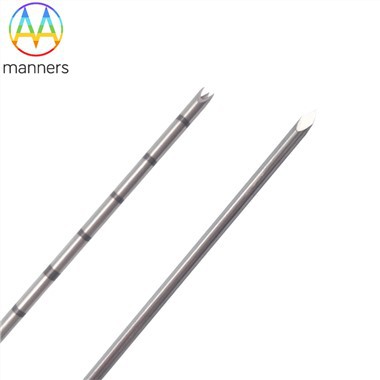
Equipment Classification Preoperative preparation needs to match different types of breast biopsy needles for targeted inspection and debugging. First, medical polymer disposable needles: focus on checking packaging integrity, sterile validity and needle body smoothness before operation, eliminate expired and damaged products, suitable for routine preoperative screening preparation. Second, stainless steel reusable needles: complete pre-operative high-temperature sterilization and surface inspection, remove needles with rust, burrs and deformation, confirm the stability of puncture and sampling structure, suitable for routine clinical biopsy preparation. Third, titanium alloy high-precision needles: fine check needle tip precision and lumen smoothness, ensure no blockage, specially prepared for deep micro-lesion biopsy with high accuracy requirements. All gradient specifications of length and gauge need to be classified and reserved according to lesion types to meet personalized preoperative matching needs.
Practical Operation Guide Standardized preoperative preparation process is divided into four core modules. First, lesion assessment and scheme formulation: combine ultrasound and mammography results to confirm lesion characteristics, formulate targeted puncture path, and select matching needle length and gauge. Second, patient preoperative evaluation: inquire about medical history, detect coagulation function and vital signs, screen anesthesia and operation contraindications, and complete preoperative informed communication. Third, sterile preoperative preparation: guide patients to complete local skin cleaning, implement multi-layer standardized disinfection of the operative area, and lay sterile towels to build a sterile operative environment. Fourth, preoperative equipment debugging: classify and inspect disposable and reusable biopsy needles, confirm the integrity of sampling function and sterile state, and prepare anesthetic, specimen preservation solution and hemostatic auxiliary materials in advance to ensure full preparation before operation.
Practical Experience Clinical preoperative preparation practice shows that complete standardized preparation can reduce intraoperative unexpected risks by more than 80% and improve the one-time puncture success rate significantly. Accurate preoperative lesion localization and equipment matching completely solve the problems of specification mismatch and path deviation, avoiding repeated puncture trauma. Strict sterile preparation controls the postoperative incision infection rate to nearly zero. Comprehensive physical evaluation effectively avoids operative accidents caused by contraindications. Sufficient preoperative psychological guidance improves patient cooperation, ensuring the smooth progress of biopsy procedures. Preoperative preparation has become an indispensable key link to guarantee high-quality biopsy operation.
Summary and Sublimation Preoperative preparation is the primary guarantee for the safe, efficient and accurate implementation of breast biopsy procedures, and the core link of pre-control of procedural risks. It transforms the traditional empirical operation mode into data-based personalized precise operation through systematic lesion evaluation, equipment matching and risk screening. Standardized preoperative preparation makes biopsy operation targeted and standardized, eliminating various hidden dangers from the source. It not only improves the safety and success rate of single operation, but also lays a foundation for the standardized and large-scale popularization of breast biopsy technology in clinical screening and diagnosis.
Future Suggestions Future preoperative preparation will develop towards intelligent and refined management. First, build an intelligent preoperative evaluation system to automatically identify lesion parameters and recommend optimal biopsy needle specifications and puncture paths. Second, formulate exclusive preoperative preparation norms for special groups such as pregnant women, obese patients and elderly patients. Third, realize digital management of preoperative equipment inspection to ensure 100% qualification rate of operative instruments. Fourth, standardize preoperative patient education processes to unify guidance standards and improve patient intraoperative cooperation.