Precision In Regional Anesthesia: Mastering Nerve Block Needles
Aug 28, 2026
Identifying the Pain Points
In regional anesthesia, imprecise needle placement remains a leading cause of failed blocks, nerve injury, and patient dissatisfaction. Traditional landmark-based techniques often result in inconsistent outcomes, especially in obese or anatomically challenging patients. The lack of tactile feedback and limited visibility of conventional needles exacerbates these issues, leaving clinicians frustrated and patients in avoidable pain.
Principle of Operation
Nerve block needles are engineered to deliver local anesthetic agents-such as lidocaine-directly adjacent to target nerves, interrupting pain signal transmission. The underlying principle relies on the diffusion of anesthetic into the perineural sheath, achieving conduction blockade. Precision in needle tip positioning is critical; even a few millimeters of deviation can mean the difference between complete analgesia and partial failure. Modern needles often incorporate design features that enhance echogenicity under ultrasound, allowing real-time visualization of the shaft and tip as they traverse tissue planes toward the neural target.
Equipment Classification
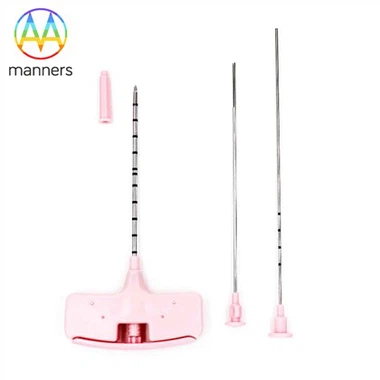
Nerve block needles vary primarily by gauge, length, tip geometry, and surface treatment. Gauges range from 8G to 26G, with larger bores (e.g., 18G) used for catheter placement and finer gauges (e.g., 22G–25G) for superficial blocks. Tip designs include short-bevel, long-bevel, and pencil-point styles, each offering distinct penetration characteristics. Surface treatments such as electropolishing reduce tissue drag, while laser marking provides depth reference. Some needles feature insulating coatings except at the tip, enabling use with nerve stimulators to elicit motor responses and confirm proximity to the nerve.
Practical Guide
Successful blockade begins with selecting the appropriate needle for the targeted anatomy. For example, an interscalene block may employ a 22G, 50 mm short-bevel needle, while a sciatic block might require a 20G, 100 mm insulated needle. Under ultrasound guidance, the needle should be inserted using an in-plane technique to maintain continuous visualization. Advance slowly, aspirate periodically to avoid intravascular injection, and inject incremental doses of anesthetic while observing for proper spread. Adjust trajectory as needed based on real-time feedback. Always have rescue equipment available, and document the procedure meticulously.
Real-World Experience
Experienced practitioners emphasize that no single needle suits every scenario. One anesthesiologist recalls a case where switching from a standard 21G needle to a 22G insulated needle with a micro-blade tip improved both visibility and patient comfort during a supraclavicular block. Another clinician notes that electropolished needles significantly reduce the force required to penetrate dense fascia, decreasing the risk of sudden advances that could damage underlying structures. These insights underscore the value of matching needle characteristics to the clinical context.
Summary and Elevation
Mastering nerve block needles is not merely a technical skill but an art that blends anatomy, physics, and patient-centered care. The evolution from blind poking to image-guided precision reflects a broader shift toward safer, more effective regional anesthesia. As clinicians, our commitment to refining these techniques directly translates into reduced opioid consumption, faster recovery, and enhanced patient satisfaction.
Outlook and Recommendations
The future of nerve block needles lies in smarter materials and integrated technologies. We anticipate wider adoption of needles with embedded sensors that provide continuous feedback on tissue impedance or proximity to nerves. Manufacturers should focus on developing disposable, eco-friendly options without compromising performance. Clinicians are encouraged to pursue ongoing education in ultrasound-guided regional anesthesia and to participate in device evaluation studies. By embracing innovation and sharing clinical experiences, the medical community can collectively elevate the standard of care in pain management.