Power Injection And Huber Needles — Engineering A Pressure-Safe Pathway
Oct 22, 2026
The Pain Point
Radiology departments face a unique challenge when administering contrast media for CT or MRI scans. The power injectors used for these studies generate pressures of 300 to 500 psi, far exceeding the pressures of manual injections. If a standard infusion needle is used, the pressure can cause the needle to dislodge, the tubing to burst, or the contrast to extravasate into surrounding tissue. Extravasation of contrast media can cause severe pain, tissue necrosis, and compartment syndrome, leading to malpractice claims and patient harm.
The pain point is that power injection requires a pressure-rated pathway from the injector to the patient's bloodstream. Every component in this pathway, including the port, the needle, and the extension tubing, must be rated for the pressures involved. Using a non-rated component creates a weak link that can fail catastrophically.
Principle
The principle of power injection is controlled delivery of contrast media at high flow rates. The power injector is programmed to deliver a specific volume at a specific rate, generating pressure that varies with the viscosity of the contrast, the diameter of the catheter, and the resistance of the system. The pressure must be contained within the system to ensure that the contrast reaches the bloodstream without leaking.
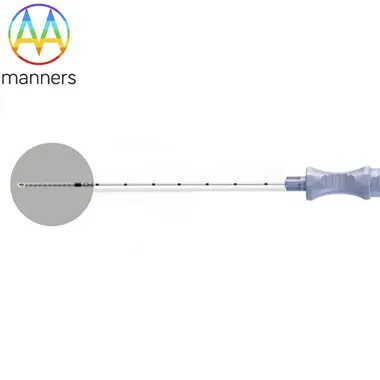
Power-injectable ports are designed with reinforced septa and thicker catheter walls to withstand these pressures. Power-injectable Huber needles are designed with thicker shafts and reinforced hubs to match. The needle must be able to handle the pressure without bending, kinking, or dislodging.
The principle is simple: the weakest component in the system determines the maximum safe pressure. If the port is rated for 300 psi but the needle is rated for only 100 psi, the system is only safe to 100 psi. Matching all components to the required pressure is essential.
Equipment Classification
Power-injectable Huber needles are classified by their pressure rating, which is typically 300 or 500 psi. They are often color-coded, with orange being a common color for power-injectable devices. The needle may be straight or bent, with or without wings.
Non-power Huber needles are not rated for power injection and should never be used with a power injector. Using a non-rated needle can cause the needle to dislodge, the tubing to burst, or the contrast to extravasate.
Hands-on Guide
Before any power injection procedure, the clinician must verify that the port is power-injectable. This information should be documented in the patient's chart and confirmed by the patient or their caregiver. The clinician must also verify that the Huber needle is power-rated. The needle packaging should be checked for the pressure rating label.
The port is accessed using the same technique as for standard infusion. The needle is inserted perpendicular to the septum, and blood return is confirmed. The port is then flushed with saline to ensure patency.
The power injector is programmed with the appropriate volume and flow rate. The pressure limit is set according to the rating of the port and needle. The injection is initiated, and the clinician monitors the patient for any signs of pain, swelling, or extravasation.
Real-World Experience
Radiology technologists report that power injection through ports is generally well-tolerated by patients. The main risk is using the wrong needle or port. Many facilities have implemented color-coding and labeling systems to prevent errors. Some facilities require a second person to verify the compatibility of all components before injection.
Summary
Power injection is a safe and effective technique when all components are properly matched. The Huber needle is a critical link in the pressure-rated pathway. Using a power-rated needle with a power-rated port ensures that the system can handle the pressures required for diagnostic imaging.
Outlook
The future of power injection will see standardized color-coding across all manufacturers, reducing the risk of mismatch. Smart ports with embedded sensors may one day communicate with power injectors to automatically verify compatibility and adjust pressure settings.