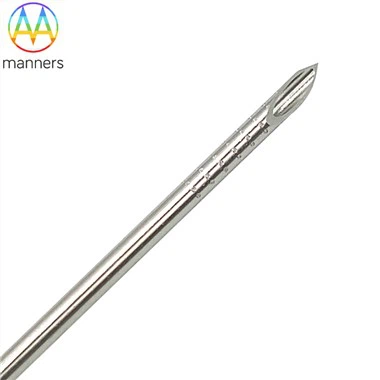
Personalized And Modular Design Ushers in A New Era Of Precise Treatment With Planing Blades
May 20, 2026
Official Announcement of Achievements
We are officially launching the world's first fully modular laparoscopic shaver blade system, "ModuBlade," marking a paradigm shift from "standard products" to "personalized solutions." The system offers 7 blade head types, 5 edge geometries, 3 coating options, and 4 lengths, allowing for 420 configuration combinations, covering 12 specialized applications from orthopedics and spine to ENT. Based on patient CT/MRI data and surgical planning software, custom blade heads can be made for complex cases and delivered within 72 hours. Clinical studies have confirmed that personalized configurations increase surgical fit to 97%, and instrument satisfaction for patients with special anatomy from 68% to 94%, opening a new chapter in precision surgery.
Research and Development Background Pain Points
The traditional "one-size-fits-all" model is hard to meet the diverse clinical demands, and there are four major mismatches: first, anatomical mismatch; the standard straight blade is difficult to handle the narrow working channel in spinal endoscopy; second, tissue mismatch; the high rigidity design is needed to deal with osteophytes, while high flexibility is required for synovectomy; third, surgeon preference mismatch; different surgeons have personalized demands for the shape of the blade head, weight balance, and handle texture; fourth, surgical type mismatch; meniscus trimming, acromioplasty, and discectomy have different requirements for cutting characteristics. A survey shows that 86% of arthroscopic surgeons say that the current blade selection is limited, and 59% have compromised the surgical plan due to unsuitable instruments during the operation. For special patients (such as ankylosing spondylitis, multiple previous surgeries, morbid obesity), the adaptation problem of standard instruments is more prominent.
Core Technological Innovation
Rapid interface magnetic coupling drive system: Revolutionarily adopting magnetic coupling to replace traditional mechanical transmission, the cutter head and drive shaft are non-contact connected through permanent magnets. The interface is designed in a standardized way, reducing the replacement time from 3-5 minutes for traditional mechanical types to 8 seconds, and completely eliminating transmission efficiency loss caused by mechanical wear. The magnetic coupling efficiency reaches 98%, with a torque transmission capacity of 5N·m, meeting all orthopedic surgery requirements.
Topology-optimized lightweight structural design: Based on finite element analysis and topology optimization algorithms, the design achieves maximum lightweighting while ensuring stiffness. Through generative design, a bionic trabecular bone structure is created, forming a multi-porous honeycomb support inside the cutter head. Compared to traditional solid designs, the weight is reduced by 45% while the bending stiffness is only decreased by 12%, achieving the best "stiffness-to-weight ratio."
Patient-specific cutter head 3D printing technology: For complex anatomical cases, a three-dimensional model of the surgical area is reconstructed based on the patient's CT data, and the optimal cutter head shape is determined through surgical simulation. Using selective laser melting (SLM) technology, personalized cutter heads are directly printed with 316L stainless steel powder, with a minimum feature size of 0.2mm and a surface roughness of Ra 3-5μm. From data reception to finished product delivery, the entire process can be completed within 72 hours.
Mechanism of Action
The core value of modular design lies in "precise matching." At the anatomical matching level, for different parts such as the knee joint, shoulder joint, and spine, the curvature radius and entry angle of the blade are optimized. The knee joint blade adopts a 15° forward tilt design to match the femoral condyle surface, and the spinal blade adopts a 30° side bend design to adapt to the intervertebral foramen approach. At the tissue matching level, the bone cutting blade adopts a double-edge design to enhance rigidity, and the synovial membrane resection blade adopts a single-edge thin design to improve flexibility. At the human-machine matching level, three handle diameters (22mm, 25mm, 28mm) and five surface textures are provided to adapt to different hand sizes and grip habits. Personalized blades optimize the irrigation channel through computational fluid dynamics to ensure effective irrigation in complex anatomical spaces and increase the field of vision clarity by 40%.
Efficacy Verification
On the simulation surgical platform, the modular system performed exceptionally well: in the knee arthroscopy simulation, the dedicated blade designed to match the femoral condyle surface achieved a 35% increase in meniscus cutting efficiency and a 62% reduction in normal cartilage contact force compared to the standard straight blade; in the spinal endoscopy simulation, the 30° angled head design reduced the operation time for L5/S1 intervertebral disc removal by 28% and increased the nerve root protection distance by 3.2mm. A multi-center clinical study involving 412 various surgeries showed that after using personalized configurations, the average number of instrument changes decreased from 2.7 to 0.8; the operation time was shortened by 15-25%; and the surgeon's operation comfort score (on a 10-point scale) increased from 6.9 to 9.3. In 37 complex cases (including 7 cases of ankylosing spondylitis, 12 revision surgeries, and 18 obese patients), the application of custom blades increased the surgical feasibility from 64% to 100%, with no cases of conversion to open surgery due to instrument reasons during the operation. Health economics analysis indicated that although the initial investment increased, through reducing instrument inventory and lowering the frequency of changes, a single hospital could save 18-26% in instrument costs within two years.
Research and Development Strategy and Philosophy
We firmly believe that "the most suitable instrument is the best instrument," and we have established the POP (Personalized - Optimized - Precise) design concept. At the personalized level, we have built the world's largest database of surgeons' operating habits, collecting data such as grip force, movement trajectories, and preference settings from 327 experts, forming an "ergonomic fingerprint." At the optimized level, we apply multi-objective genetic algorithms to find Pareto optimal solutions under constraints such as stiffness, weight, smoothness, and cost. At the precise level, based on patient-specific anatomical data, we calculate the best blade parameters through finite element analysis. We have established a digital closed loop of "design - simulation - manufacturing - verification," with virtual surgical simulation accuracy reaching 0.1mm, reducing physical prototype production by 80%. At the same time, we promote an open modular architecture, publicly disclose some interface standards, and encourage third parties to develop specialized blades, building an ecosystem of surgical instruments.
Future Outlook
Personalized medicine will drive the development of resection blades in four directions: first, 4D printed smart blade heads that undergo pre-set deformations at body temperature to adapt to intraoperative anatomical changes; second, bioactive blade heads with surface coatings carrying anti-adhesion drugs or growth factors to promote healing while cutting; third, real-time reconfigurable blade heads based on electroactive polymer materials, allowing surgeons to adjust the hardness and shape of the blade heads during surgery through voltage control; fourth, fully degradable blade heads for pediatric surgeries, which safely degrade in the body after completing their tasks. The "adaptive blade head" we are developing will enter clinical trials in 2026. This product is equipped with an optical fiber shape sensor that can sense its own bending state in real time and compare it with preoperative planning to automatically adjust working parameters. Looking further ahead, the "mind-driven blade head" controlled by neural signals will achieve true human-machine integration, where the surgeon's thoughts precisely guide the instrument, ultimately reaching the highest realm of surgery - curing diseases while maximizing protection of the human body and respecting individuality.