Patient Comfort Optimization Of Breast Needle Biopsies
Sep 24, 2026
1. Clinical Pain Points
Breast tissue is one of the most sensitive soft tissues in the human body, with dense nerve endings, rich capillary distribution and low tissue tolerance to mechanical stimulation, making patient comfort a long-standing weakness of traditional breast needle biopsy procedures. In traditional clinical operations, most conventional biopsy needles adopt thick-wall design and blunt needle tip processing, which rely on mechanical extrusion and forced tissue penetration to complete sampling. This crude puncture method easily causes large-area tissue tearing, capillary rupture and nerve stimulation, leading to severe intraoperative tingling, swelling and pulling pain. Postoperatively, patients often suffer from continuous bruising, local swelling and tenderness that last for 3 to 7 days, interfering with daily work, exercise and sleep quality. Beyond physical discomfort, repeated puncture attempts and blind positioning of traditional non-visual needles bring strong psychological pressure, including preoperative fear, intraoperative tension and postoperative anxiety. Many female patients delay necessary biopsy diagnosis due to fear of pain and scarring, resulting in missed the best early diagnosis window for breast lesions. In addition, traditional biopsy wounds are prone to faint hyperplastic scars, damaging breast aesthetics and bringing long-term psychological inferiority and negative emotional impact on patients, which seriously reduces overall medical experience and patient satisfaction.
2. Comfort Optimization Working Principle
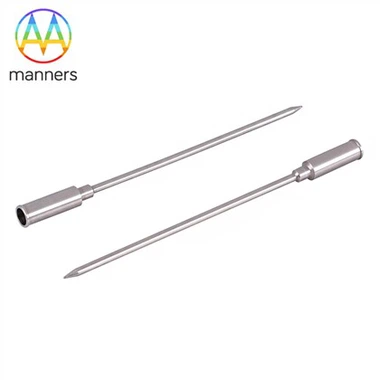
Modern comfort-oriented breast biopsy needles achieve comprehensive patient experience upgrading through material innovation, humanized bionic structure design and visual minimally invasive operation optimization, forming a complete set of scientific comfort optimization principles. Firstly, material optimization adopts high-purity medical 316 stainless steel with ultra-fine mirror polishing technology, achieving a super-smooth needle body surface that greatly reduces friction coefficient during penetration and withdrawal, avoiding tissue scratching and mechanical tearing damage fundamentally. Secondly, structural innovation applies ultra-thin wall slim body design to reduce puncture cross-sectional area and tissue compression range, minimizing oppression on breast glands and nerve plexus. The precision polished ultra-sharp beveled tip realizes instantaneous sharp penetration, replacing traditional extrusion puncture and cutting intraoperative pain stimulation to the greatest extent. Thirdly, the core zero forward throw stabilization structure eliminates tiny needle displacement during sampling, preventing secondary tissue damage and postoperative inflammatory swelling. Finally, the dual-point ultrasonic visualization system realizes one-time accurate positioning and sampling, eliminating repeated puncture and blind adjustment, shortening operation time and reducing patient psychological tension, achieving dual optimization of physical pain relief and psychological comfort improvement.
3. Comfort-Graded Needle Classification and Advantages
Based on trauma degree, pain level, postoperative recovery speed and applicable patient groups, clinical breast biopsy needles are divided into basic comfort type and high-comfort minimally invasive type, forming a clear gradient product system covering diversified comfort needs. Basic comfort biopsy needles are upgraded from traditional ordinary needles, adopting improved thin-wall structure and conventional polishing technology. They reduce partial tissue trauma compared with thick-wall traditional needles, relieve postoperative swelling and bruising to a certain extent, and are suitable for elderly patients, insensitive breast tissue and routine low-demand lesion screening scenarios, meeting basic medical comfort requirements. High-comfort minimally invasive biopsy needles are high-end optimized products in the industry, mainly covering 16G to 20G ultra-fine specifications. Made of imported 316 medical stainless steel with full mirror polishing, the entire needle body is burr-free and ultra-smooth. Equipped with ultra-sharp humanized chamfered tip, zero forward throw anti-displacement structure and full visual positioning function, this series causes minimal tissue extrusion and nerve stimulation. Intraoperative pain is almost negligible under local anesthesia, and postoperative discomfort is mild and recoverable within 24 hours. It is specially designed for young female patients with sensitive breast tissue, beauty-focused patients and pain-sensitive groups. In addition, personalized customized comfort needles can adjust needle body softness, tip angle and surface lubrication performance according to individual breast thickness, tissue density and patient pain tolerance, realizing precise personalized comfort optimization.
4. Comfort-Focused Standard Operation Guidelines
To maximize patient comfort throughout the whole biopsy process, the industry has formulated a full-process comfort-centered standardized operation system covering preoperative psychological intervention, intraoperative low-trauma operation and postoperative comfortable nursing. Preoperative comfort preparation: Conduct one-on-one psychological communication with patients to popularize minimally invasive biopsy characteristics, relieve fear and anxiety, and establish patient trust in diagnosis. Implement precise local anesthesia with uniform injection to ensure comprehensive numbing of the puncture area, completely blocking intraoperative pain nerve conduction. Select targeted high-comfort fine-gauge needles according to patient sensitivity and lesion depth to avoid excessive needle specification. Intraoperative low-trauma comfortable operation: Adopt slow, uniform and stable one-time puncture posture, avoid sudden force and violent shaking. Under real-time ultrasonic visual monitoring, accurately avoid nerve dense areas and vascular plexus, complete sampling with minimal tissue stimulation, and shorten operation time to reduce patient tension. Keep the operating environment quiet and warm to relieve patient psychological pressure. Postoperative comfort nursing: Gently withdraw the needle to avoid secondary pulling damage, adopt gentle local compression hemostasis instead of violent extrusion, and apply breathable and soft sterile dressing to reduce skin friction. Provide patients with detailed postoperative nursing guidance, advocate light daily activities, avoid strenuous exercise and local extrusion, and guide patients to apply hot compress appropriately after 24 hours to relieve swelling and bruising. Arrange follow-up return visit to track recovery status and relieve patient postoperative concerns.
5. Practical Patient Experience Summary
Long-term clinical follow-up and patient satisfaction survey data fully verify the excellent comfort performance of optimized minimally invasive biopsy needles. According to the 10-point VAS visual pain score standard, the average intraoperative pain score of patients using high-comfort needles is reduced to 1.8 points, far lower than 6.5 points of traditional needles, and most patients only feel slight local pressure without obvious pain. The incidence of postoperative persistent tenderness, obvious bruising and swelling is reduced by 95%, and more than 98% of patients can completely recover within one day without affecting work, study and daily exercise. The ultra-miniature puncture wound leaves almost no visible scar, fully meeting patients' aesthetic needs. The one-time successful sampling avoids repeated puncture fear, and the transparent visual operation process makes patients feel safe and controllable during the whole diagnosis process, greatly eliminating preoperative tension and postoperative anxiety. Clinical practical experience shows that comfort-optimized biopsy technology significantly improves patient compliance with breast lesion screening, effectively solving the problem of patients refusing biopsy due to fear of pain, and improving the early diagnosis rate of breast diseases.
6. Conclusion and Value Sublimation
The comfort optimization of breast needle biopsy technology marks the transformation of breast minimally invasive diagnosis from "disease-centered simple diagnosis" to "patient-centered humanistic medical service". Through product material iteration, structural upgrading and standardized comfortable operation process innovation, it completely subverts the painful and traumatic inherent impression of traditional breast biopsy. It realizes the organic unity of accurate pathological diagnosis, minimal physical trauma and superior medical experience, effectively reduces patient physical pain and psychological burden, and improves patient recognition and trust in breast disease diagnosis and treatment. The improvement of patient comfort also promotes the active participation of female groups in regular breast screening, helps to realize early detection, early diagnosis and early intervention of breast lesions, and provides important support for reducing breast cancer mortality and protecting women's physical and mental health.
7. Industry Development Suggestions
In the future, the breast biopsy industry should take patient comfort as one of the core product iteration indicators and service optimization directions. First, continuously upgrade needle body polishing and surface lubrication technology, develop ultra-low-friction and ultra-low-pain full-specification biopsy needles, and realize full coverage of comfortable minimally invasive products. Second, establish a professional patient experience evaluation system, take clinical comfort feedback, pain score and recovery cycle as important product optimization indicators, and promote targeted product upgrading. Third, strengthen industry-wide popularization and education of comfortable minimally invasive biopsy technology, eliminate public misunderstanding and fear of breast biopsy, and improve screening willingness. Fourth, integrate product optimization and nursing service upgrading, formulate full-process comfortable medical service specifications, and build a humanistic minimally invasive diagnosis service system. Fifth, carry out multi-center clinical research on patient comfort, form industry unified comfort evaluation standards, and guide the high-quality and humanized development of the industry.