Minimally Invasive Therapy Value Of Medical RF Needle For Lumbar Disc Herniation .
Oct 05, 2026
1. Clinical Industry Pain Points
Lumbar disc herniation is one of the most prevalent orthopedic diseases, caused by degenerative lesions or traumatic rupture of the lumbar annulus fibrosus, leading to nucleus pulposus protrusion and nerve root compression, which results in intractable lumbocrural radiating pain, numbness and limited movement. Traditional treatment methods have obvious technical bottlenecks: conservative treatments such as drug therapy and physical therapy can only relieve superficial symptoms temporarily, failing to solve the fundamental problem of nucleus pulposus compression, with high recurrence rate. Open surgical resection requires large-scale tissue dissection, causing huge trauma, massive bleeding, long postoperative recovery cycle and easy complications such as spinal instability and adhesion. Conventional interventional instruments lack precise targeting performance, easily damage normal lumbar cartilage and nerve tissues during operation, resulting in incomplete decompression and persistent postoperative pain. These pain points severely restrict the clinical treatment effect and patient rehabilitation efficiency of lumbar disc herniation.
2. Core Treatment Principle
Medical RF Needle realizes precise minimally invasive treatment for lumbar disc herniation based on high-frequency thermal coagulation and nerve modulation mechanism. The lumbar disc tissue consists of hyaline cartilage plate, annulus fibrosus and nucleus pulposus. When the RF needle is accurately implanted into the herniated lesion, it outputs high-frequency alternating current to form a local radiofrequency electric field. The ions in the nucleus pulposus and annular tissues vibrate and rub at high speed, generating controllable thermal effect. Under 65–75℃ stable thermal temperature, the protruding nucleus pulposus collagen fibers undergo denaturation, coagulation and volume shrinkage, which directly relieves the mechanical compression of nerve roots. Meanwhile, the thermal effect can destroy the pain sensory nerve fibers growing in the ruptured annulus fibrosus, block lumbocrural pain signal transmission, and eliminate inflammatory stimulation around nerve roots. The whole treatment process features controllable temperature, accurate lesion targeting and no damage to normal lumbar vertebral structure, realizing dual effects of decompression and analgesia.
3. Medical RF Needle Equipment Classification
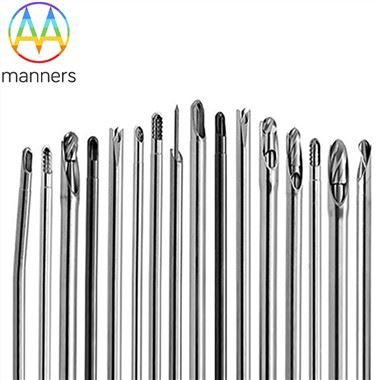
According to lumbar disc lesion characteristics and clinical intervention demands, medical RF needles are divided into three professional categories. First, conventional disc decompression needles (16G–20G): made of high-purity medical stainless steel, with moderate rigidity and penetration, suitable for moderate lumbar disc protrusion and routine nerve root decompression, covering most common clinical cases. Second, fine precise intervention needles (22G–26G): processed by ultra-fine grinding and laser cutting, with tiny needle body and minimal trauma, specially used for mild disc herniation and superficial nerve pain modulation, avoiding damage to delicate annular fibers. Third, customized special disc needles: personalized processing based on 2D/3D drawings, with special needle tip angle and insulation design, adapting to complex lumbar anatomical structures and atypical disc herniation lesions. All products undergo necking, swaging, electropolishing and strict sterilization treatment to meet orthopedic minimally invasive treatment standards.
4. Standard Clinical Operation Guidelines
The minimally invasive treatment of lumbar disc herniation with Medical RF Needle follows standardized fluoroscopy-guided procedures. Firstly, preoperative positioning examination: confirm the lesion segment and herniation range via lumbar MRI and CT, select matching needle specification, and check product sterility and integrity. Secondly, precise puncture implantation: under C-arm fluoroscopy real-time guidance, perform percutaneous slow puncture, accurately send the needle tip to the center of the herniated nucleus pulposus, and avoid penetrating normal cartilage plate and nerve tracts. Thirdly, staged RF treatment: conduct low-frequency sensory and motor nerve stimulation to verify safe positioning, then start high-frequency thermal ablation, maintain stable temperature for 3–5 minutes to realize nucleus pulposus shrinkage and nerve block. Fourthly, postoperative processing: withdraw the needle slowly after confirming complete decompression, disinfect and bandage the puncture wound, and guide patients to carry out standardized postoperative rehabilitation training to avoid early lumbar strain.
5. Practical Clinical Application Experience
Long-term orthopedic clinical practice verifies that Medical RF Needle has irreplaceable advantages in the treatment of lumbar disc herniation. Compared with conservative treatment, it can fundamentally remove nerve compression lesions, with a clinical effective rate of over 96% and significantly reduced recurrence rate. Different from open surgery, the percutaneous minimally invasive operation avoids massive tissue trauma and blood loss, and patients can get out of bed and recover in 24 hours, greatly shortening the hospital stay. The graded needle specifications adapt to different degrees of disc herniation: thick needles solve severe compressive lesions efficiently, while fine needles ensure ultra-minimally invasive treatment for mild cases. The polished smooth needle body reduces lumbar tissue friction and puncture trauma, and the sterile one-time use design completely avoids postoperative infection complications, with stable and reliable clinical safety.
6. Summary and Sublimation
Medical RF Needle breaks through the technical limitations of traditional lumbar disc herniation treatment by virtue of precise thermal coagulation decompression and nerve modulation technology. It solves the core pain points of incomplete conservative treatment and excessive trauma of open surgery, and realizes minimally invasive, efficient and safe treatment of lumbar disc lesions. Diversified classified products meet the differentiated treatment needs of mild, moderate and severe disc herniation, and standardized operation specifications ensure the repeatability and stability of clinical efficacy. As the core minimally invasive consumable for orthopedic spinal diseases, it optimizes the clinical diagnosis and treatment system of lumbar disc diseases and improves the quality of life of patients with chronic lumbocrural pain.
7. Industry Development Suggestions
The industry should further optimize the structural design of spinal special RF needles, develop bendable fine needle bodies to adapt to complex lumbar disc space puncture, and improve lesion targeting accuracy. Strengthen the research and development of temperature intelligent control matching technology, form targeted temperature parameter standards for different disc herniation degrees, and further standardize treatment parameters. Accelerate the promotion of customized needle products for complex spinal lesions, enrich the product system for special clinical scenarios. Strengthen clinical academic research and technical training, improve the operational proficiency of orthopedic clinicians, and promote the popularization of RF minimally invasive intervention technology in primary medical institutions, driving the standardized development of spinal minimally invasive treatment industry.