Micron-Level CNC Art - Unveiling The Cutting-Edge Manufacturing Process Of The Top Joint Endoscope Conical Reaming Toolhead Manufacturer
May 21, 2026
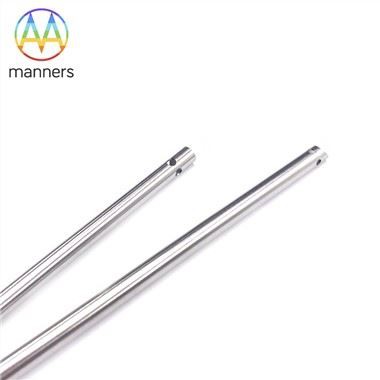
In the eyes of the general public, a bone surgery burr head might just be a metal tube with holes at the front end; but in the field of medical manufacturing, it is a comprehensive embodiment of materials science, fluid mechanics, and ultra-precision processing. To remain stable under the centrifugal force of tens of thousands of revolutions per minute, and to achieve instantaneous tissue cutting and smooth discharge, any micrometer-level manufacturing defect could lead to an operational disaster. Today, we will delve into a modern sterile workshop and take a look at how a top manufacturer of joint cavity cone burr heads uses "black technology" to forge this microscopic battle knife.
Five-axis Laser Cutting: The Ultimate Forging with Flawless Edges
Traditional stamping or mechanical cutting often leaves microscopic burrs at the edges of the metal, which not only pulls on the patient's healthy synovial tissue but also causes eccentric vibrations in the cutting head when it operates at high speed. To completely solve this problem, leading manufacturers have introduced ultra-high-precision five-axis laser cutting technology. The cutting seam width is only a fraction of a hair's width (15-30 micrometers), and the processing accuracy is controlled within ±10 micrometers. This non-contact cold processing not only eliminates mechanical stress deformation but also cuts extremely smooth cuts. Combined with the five-axis CNC grinding center with one-time clamping, the cutting edge is polished as sharp as a razor blade, ensuring "selective and precise cutting" of soft tissues.
Five-axis CNC Machining: The "Magic" of Reshaping the Geometry of the Cutting Tool Head
The core difficulty of the conical cutter head lies in the complexity of its three-dimensional curved surface. If the concentricity of the inner and outer tubes deviates, the inner cutting window will be unable to form an effective shear force with the outer window. The five-axis CNC machining technology has successfully overcome this challenge. Through one-time clamping and the simultaneous multi-dimensional machining and online deburring, it greatly eliminates the repetitive positioning errors. This enables the manufacturer of the arthroscopic conical boring cutter head to achieve highly customized complex cutting edge geometries at a very low cost and with an extremely fast delivery cycle, meeting the individual hand feel requirements of different surgeons.
Electrolytic Polishing and Ultrasonic Cleaning: The "Baptism" that Confers Biocompatibility
Even the most precise mechanical processing will leave tiny unevenness on the metal surface. To ensure that the removed tissue does not stick together and to reduce the post-operative infection rate, the knife head must undergo a final "ritual". First, through the electrolytic polishing (Electropolishing) technology, the microscopic protrusions on the metal surface are dissolved using the principle of electrochemistry, reducing the roughness to the nanometer level and presenting a mirror-like luster. Then, the high-frequency ultrasonic cleaning uses cavitation to completely remove the tiny metal debris inside the deep holes. This ultimate clean surface treatment not only makes the knife head glide smoothly through the tissues like silk, but also lays a material foundation for the rapid recovery of patients.
This is the truth about the manufacturing of modern medical consumables. It has long surpassed the traditional processes of turning, milling, boring, and grinding, evolving into a precise symphony that integrates optics, mechanics, and micro-engineering. Only those manufacturers with an extreme obsession for craftsmanship can produce surgical tools worthy of being entrusted with lives.