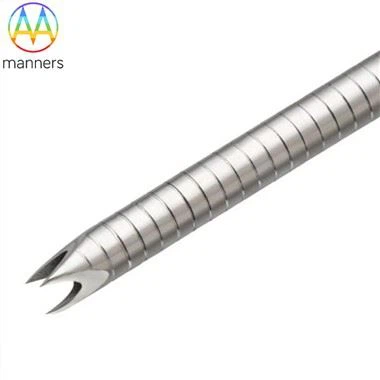
Micro-Dimension Machining Technology For Medical Swiss Parts
Sep 26, 2026
Industry Pain Points Medical device miniaturization puts forward ultra-high requirements for micro-dimension machining. Hypotubes used in precise intervention surgery have a minimum diameter of 0.20mm, and ultra-fine kerf width of 0.012mm, which is difficult for traditional machining equipment to achieve. Micro-parts are prone to dimensional drift, wall thickness deviation, and concentricity errors during processing. Thin-walled micro-tubes are easy to deform under cutting force, resulting in poor product roundness. In mass production, the consistency of micro-dimensions is difficult to guarantee, leading to differences in the flexibility and mechanical properties of batch products. These micro-dimensional errors will directly affect the safety and precision of minimally invasive surgery, becoming a major bottleneck restricting the production of high-end medical micro-components.
Micro-Machining Core Principle Swiss micro-dimension machining relies on the integrated technology of sliding headstock precise support and micro-laser cutting. The equipment uses ultra-precision ceramic guide bushings to achieve zero-clearance support for micro-workpieces, eliminating workpiece vibration and bending deformation during high-speed rotation. The micro-laser cutting system adopts focused beam technology to control kerf width accurately at 0.012mm, realizing ultra-fine cutting of micro-tube walls. The high-resolution numerical control system realizes micron-level feeding and positioning, ensuring the consistency of dimensional tolerance and geometric accuracy of micro-parts. The real-time temperature compensation system eliminates dimensional changes caused by thermal expansion and contraction, maintaining long-term stable micro-machining accuracy.
Classification of Micro-Machining Equipment Medical micro Swiss machining equipment is divided into three categories by precision level. First, ultra-micro precision lathes, dedicated for 0.20mm–2mm ultra-small-diameter medical tubes, with nanometer-level vibration damping systems, meeting the highest medical micro-precision standards. Second, conventional micro-machining centers, suitable for 2mm–10mm medium micro-medical parts, balancing precision and production efficiency for mass production. Third, large-diameter precision Swiss machines, targeting 10mm–20mm medical tubular parts, ensuring micro-precision cutting and pattern processing of large-size thin-walled tubes. All equipment is equipped with professional medical micro-inspection systems to realize real-time dimensional monitoring.
Practical Micro-Machining Operation Guidelines Strict micro-precision operation specifications are required in production. First, carry out ultra-precision equipment calibration before processing, calibrate spindle runout, guide bushing concentricity, and laser kerf accuracy to eliminate initial errors. Second, adopt low-load micro-cutting parameters, reduce single cutting feed, and use high-speed fine cutting to avoid workpiece deformation. Third, configure micro-high-pressure low-temperature coolant to take away cutting heat rapidly and prevent thermal deformation of micro-parts. Fourth, implement full-inspection system for micro-dimensions, use high-magnification microscope and precision micrometer to detect wall thickness, kerf width, and concentricity of each product. Fifth, classify and store micro-parts to avoid extrusion deformation during transportation.
Practical Industry Experience After adopting standardized Swiss micro-machining technology, high-end medical component manufacturers have achieved a dimensional tolerance accuracy of ±0.005mm for micro-hypotubes. The ultra-micro equipment completely solves the deformation problem of 0.20mm ultra-fine tubes, and the batch dimensional consistency rate reaches 99.5%. In the production of neurological micro-intervention tubes, micro-precision cutting ensures that the tube has ultra-high flexibility without kinking, successfully meeting the surgical needs of ultra-fine human vascular intervention. The application of real-time temperature compensation technology reduces thermal deformation errors by 80%, greatly improving the yield rate of high-precision medical micro-parts.
Summary and Sublimation Micro-dimension precision is the core symbol of high-end medical device manufacturing. Swiss micro-machining technology breaks through the precision limit of traditional processing, realizing reliable production of ultra-fine and ultra-precise medical tubular parts. Systematic equipment classification and standardized operation specifications ensure the stability and consistency of micro-dimensional precision. It provides precise component support for the miniaturization and refinement of modern minimally invasive medical technology and promotes the development of precise and minimally invasive clinical diagnosis and treatment.
Future Development Suggestions Enterprises should further upgrade nano-level precision Swiss machining equipment to meet the processing needs of smaller medical micro-components. Promote the integration of automatic micro-inspection and processing equipment to realize one-stop production and inspection. Strengthen the research on micro-deformation control technology of special medical materials, and continuously improve the precision level and batch stability of medical micro-parts processing.