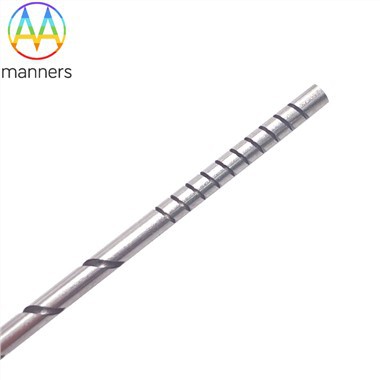
Medical Tubing – Torque Transmission Performance For Minimally Invasive Catheter Delivery
Sep 14, 2026
A persistent pain point in interventional device development is inconsistent torque transfer through medical tubing. During minimally invasive procedures, clinicians rotate the catheter handle to steer the distal hypotube toward target lesions. Ordinary medical tubing suffers from torsional lag: rotation applied at the proximal end does not fully transmit to the tube tip. Partial twist energy dissipates along the shaft, creating angular offset and poor directional control. The issue worsens after laser cutting if patterns are asymmetric. Poor torque control increases risk of vessel wall injury, inaccurate device placement and longer procedure time. For high-precision procedures including intracranial intervention and PTCA, unreliable torque performance on medical tubing becomes a critical barrier to clinical adoption and regulatory approval.
The core principle of torque transmission in medical tubing is maintaining circumferential structural symmetry. Torque propagates through the tube wall as shear stress. When medical tubing retains balanced wall sections after laser cutting, shear force moves uniformly along the shaft, synchronizing proximal rotation with distal tip rotation. Asymmetric cut patterns create weak zones that deform preferentially under torsion and absorb rotational energy. Our laser cutting equipment delivers 0.012mm ultra-narrow kerf on medical tubing from Ø0.20mm to 20mm. By programming symmetric spiral or interrupted spiral patterns, we preserve continuous load-bearing ribs in the medical tubing wall. These solid ribs act as torque carriers while cut gaps add controlled flexibility. Engineers can adjust the width and spacing of uncut ribs to dial in the exact balance between torsional rigidity and bending compliance.
Medical tubing for torque-critical hypotubes is grouped by material and pattern function. Interrupted spiral patterned 316L medical tubing is the primary choice for coronary PTCA delivery systems, retaining strong torque while maintaining moderate flexibility. Continuous spiral patterned Nitinol medical tubing delivers softer torque response for neurological microcatheters, where sharp rotation must be avoided to protect delicate vessels. Radial-cut 17-7PH medical tubing provides local flexibility zones while keeping global torsional stability for AAA stent delivery devices. Bespoke patterned L605 medical tubing serves specialized peripheral vascular tools requiring high cycle torsion resistance. Each medical tubing alloy has different shear modulus, so pattern geometry must be recalculated per material grade.
The step-by-step operational guideline begins with defining torque specification requirements from OEM drawings or samples. Choose the matching medical tubing alloy and outer/inner diameter. Design fully symmetric laser cut pattern to avoid torsional imbalance. Calibrate laser focal parameters to stabilize the 0.012mm kerf and prevent uneven material removal. Cut medical tubing in segmented zones where needed. Post-processing removes laser slag and edge burrs; electropolishing eliminates micro-notches that could create stress concentration under repeated torsion. Conduct bench torsion testing to measure torque loss and angular hysteresis. Record all test data for ISO13485 traceability. Final packaging follows customer requirements or standard carton packing.
Real-world manufacturing experience highlights how pattern symmetry directly defines medical tubing torque behavior. A peripheral vascular hypotube prototype using asymmetric custom cuts on 304 medical tubing showed 14° angular lag in torsion testing. When redesigned with fully mirrored interrupted spiral patterns on the same medical tubing blank, angular lag dropped below 1.2°. The corrected hypotube transmitted rotation reliably through sharp vessel bends. The project proved that even high-quality medical tubing will deliver poor torque performance if laser pattern symmetry is neglected in the design phase.
In conclusion, reliable torque transmission is not an inherent property of raw medical tubing; it is engineered through symmetric laser pattern design. The ribs left uncut on the medical tubing wall serve as the primary pathway for rotational force. Balancing rib geometry and cut gaps lets designers combine steerability and flexibility in one hypotube.
Future outlook: Next-generation interventional devices will demand tighter torque accuracy and smaller tubing diameters. Ultra-fine Ø0.20mm medical tubing with 0.012mm kerf cutting will grow in demand for neurovascular applications. Medical tubing suppliers with simulation tools to predict torsional behavior before cutting will shorten OEM development cycles significantly.