Materials Science And Veress Needle Performance
Jul 11, 2026
https://en.wikipedia.org/wiki/Veress_needle
The performance of a Veress needle is largely dictated by material selection and processing techniques. Currently, leading global Veress Needle Manufacturers utilize medical-grade stainless steel as the core material, with 304 and 316L being the predominant alloys. This choice is not incidental but rooted in their exceptional biocompatibility, mechanical properties, and corrosion resistance.
Biocompatibility is the primary prerequisite for clinical application. Both 304 and 316L stainless steels contain high chromium (Cr) content, which spontaneously forms a dense, stable chromium oxide (Cr₂O₃) passive film upon exposure to air or bodily fluids. This film not only prevents metallic ion leaching-which could cause hypersensitivity or cytotoxicity-but also confers outstanding corrosion resistance. This is particularly vital for reusable Veress needles, which must withstand repeated autoclaving (typically 134°C, 2.1 bar, for 4–6 minutes). Type 316L stainless steel, augmented with 2%–3% molybdenum (Mo), offers significantly superior resistance to pitting and crevice corrosion compared to 304, maintaining stability even in chloride-rich bodily fluids. Consequently, 316L is often specified for premium or single-use Veress needles.
Regarding mechanical properties, the needle cannula demands high rigidity and toughness. Piercing the abdominal fascial layer requires substantial axial force; if the material is too soft, the cannula may buckle or collapse, causing insertion failure. Conversely, excessive hardness risks brittle fracture, leading to catastrophic device failure. Medical-grade stainless steel typically exhibits a hardness range of HV 200–250 and a tensile strength exceeding 500 MPa. This "rigid yet resilient" characteristic allows it to penetrate the abdominal wall effortlessly while maintaining structural integrity. Additionally, work hardening at the needle tip further enhances local hardness, ensuring sustained sharpness.
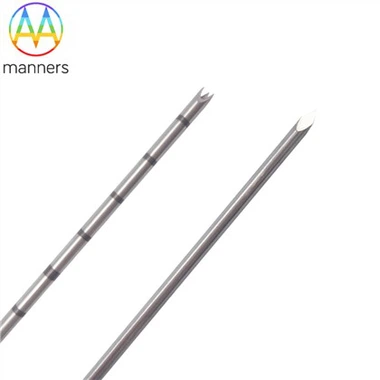
Surface treatment technology is pivotal in elevating material performance. Modern manufacturing mandates electropolishing as a critical process. Utilizing electrochemical dissolution principles, microscopic surface peaks and burrs are removed, reducing surface roughness (Ra) to below 0.2μm, achieving a near-mirror finish. This not only substantially lowers tissue friction during insertion-minimizing patient trauma-but also eliminates microbial harborage sites, enhancing cleaning and sterilization efficacy. Some premium manufacturers apply specialized passivation treatments post-polishing to further augment the passive film's thickness and density.
While advancing materials science sees some manufacturers exploring titanium alloys or high-performance polymers to reduce weight or improve MRI compatibility, medical stainless steel remains the mainstay for Veress needle production due to its mature processing infrastructure, proven reliability, and cost-effectiveness. A thorough understanding of these material sciences empowers clinicians to look beyond the surface and appreciate the technological rigor underpinning a quality Veress needle.