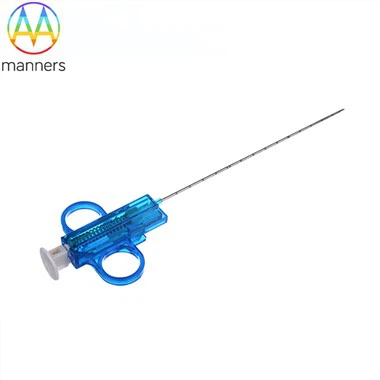
Materials Science And The Hasson Standard — 316L Stainless Steel And Surface Treatment Of The Veress Needle
Jul 12, 2026
https://en.wikipedia.org/wiki/Veress_needle
The Hasson technique is synonymous with high safety standards, attributable not only to its visual nature but also to its stringent requirements for instrument material integrity and biocompatibility. Evaluating the Veress needle under this high-standard framework reveals that material selection-specifically the use of 316L stainless steel and advanced surface treatments-is paramount. This focus extends beyond mere durability to ensuring patient safety and instrument reliability through countless cycles of sterilization.
Grade 316L stainless steel is the premier choice for high-end Veress needles due to its exceptional corrosion resistance, high tensile strength, and superior biocompatibility. From a Hasson-centric viewpoint, instruments must endure rigorous reprocessing-cleaning, disinfection, and repeated autoclaving-without degradation. The "L" in 316L denotes its low carbon content, which significantly mitigates the risk of chromium carbide precipitation at grain boundaries during welding or thermal cycling, thereby preventing intergranular corrosion. For an instrument designed to traverse multiple tissue planes, even microscopic pitting can harbor bacteria or predispose the needle to fracture. Thus, selecting 316L ensures both immediate sharpness and long-term structural integrity.
However, the raw material is merely the foundation. The Hasson technique emphasizes gentle tissue handling, which demands an exceptionally smooth instrument surface. This brings us to Electropolishing-a critical surface treatment. Unlike abrasive mechanical polishing, electropolishing is an electrochemical process that removes microscopic surface peaks and burrs, reducing roughness (Ra) to below 0.2 µm, achieving a near-mirror finish. Under the Hasson standard, this offers multiple benefits: firstly, the ultra-smooth surface drastically reduces insertion friction, minimizing tissue tearing-fully aligned with Hasson's "minimal trauma" principle. Secondly, a non-porous surface prevents protein and tissue fluid adhesion, vastly improving cleaning efficacy and reducing cross-contamination risks. Finally, electropolishing removes free iron ions from the surface, stabilizing the passive layer and further boosting corrosion resistance.
Beyond electropolishing, Passivation is indispensable. Treating the needle with nitric or citric acid removes free iron and promotes the formation of a dense chromium oxide layer. This passive film is the 316L's primary defense against the corrosive milieu of the human body. While Hasson surgeons can visually inspect instruments for rust or damage, the Veress needle must maintain this protective barrier autonomously at a microscopic level.
In summary, mapping the Hasson technique's high standards onto Veress needle manufacturing reveals a profound commitment to materials science and surface engineering. The selection of 316L stainless steel, the mirror-like finish from electropolishing, and the chemical barrier provided by passivation collectively form the safety cornerstone of the Veress needle. This represents not just a guarantee of instrument longevity, but a solemn commitment to patient safety.