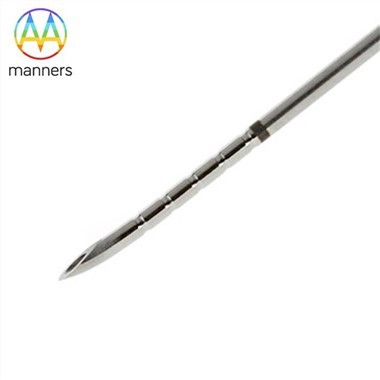
Materials Science And Biocompatibility: Exploring The Foundation Of The Life Compatibility Of Close-range Radiotherapy Needles.
May 02, 2026
In close-range radiotherapy, the treatment needle acts as an inorganic foreign object that remains in the human body for a long time or temporarily, and serves as a conduit for delivering high-activity radiation sources. The selection of its material is far from being merely based on mechanical properties. Biocompatibility - the ability of the material to produce an appropriate response when in contact with human tissues and body fluids - is the overriding principle. At the same time, as a precision instrument, it must also possess excellent mechanical strength, corrosion resistance, and radiation compatibility. Medical-grade stainless steel and titanium alloys are the outstanding performers among them, jointly establishing the "life compatibility" foundation for the safety and reliability of the close-range treatment needle.
I. Core Requirements: Multidimensional Interpretation of Biocompatibility. Biocompatibility is a comprehensive system engineering issue. According to the ISO 10993 series standards, it needs to be evaluated from multiple dimensions:
1. Cytotoxicity: The material or its extract must not have inhibitory or toxic effects on cell growth and proliferation. This is the most basic requirement.
2. Sensitization: The material should not cause allergic reactions in the human body. Nickel is a common allergen, so the release of nickel elements in stainless steel needs to be strictly controlled.
3. Local reaction: After the material is implanted under the skin, it should not cause excessive inflammation or irritation.
4. Systemic toxicity: The material should not cause acute or chronic systemic toxicity in the body.
5. Genetic toxicity: The material must not cause gene mutations or chromosomal damage. For close-range treatment needles, since the contact time with tissues varies from several minutes (temporary implantation) to several days (permanent particle implantation), and may come into contact with various body fluids such as blood and tissue fluid, it must undergo the above comprehensive or corresponding biological evaluation.
II. Medical-grade Stainless Steel: The Classic Choice and Performance Balance. Austenitic stainless steel, particularly AISI 316L (corresponding to the Chinese grade 00Cr17Ni14Mo2), is the most classic and widely used material for manufacturing close-range therapy needles.
- Outstanding corrosion resistance: The key lies in the alloy composition. Chromium (Cr) (with a content of approximately 16-18%) can form a very thin and dense chromium oxide passivation film on the surface, which isolates the metal substrate from the corrosive medium (such as chlorine ions in body fluids). The addition of molybdenum (Mo) (with a content of approximately 2-3%) further enhances the resistance to pitting and crevice corrosion in environments containing chlorine ions (such as physiological saline), which is crucial for the long-term safety of implantation.
- Excellent mechanical properties: 316L stainless steel has high yield strength and tensile strength, and also possesses certain toughness. This ensures that the treatment needle has sufficient rigidity during the puncture process (especially when penetrating dense structures such as prostate capsules or breast fibrous tissues), preventing bending deformation and guaranteeing the straightness and depth accuracy of the puncture path. Its good processing performance also facilitates precise turning, grinding, and polishing.
- Biocompatibility guarantee: Medical-grade 316L has stricter control over impurity elements such as carbon, sulfur, and phosphorus, and undergoes special smelting and heat treatment processes (such as vacuum smelting) to ensure the uniformity and purity of the tissue. Although the nickel (Ni) content (approximately 10-14%) may cause concern for a small number of patients with severe nickel allergies, surface passivation treatment can significantly reduce the release rate of nickel ions, making it safe for the vast majority of patients.
- Economy and accessibility: Compared to titanium alloys, 316L stainless steel is cheaper in cost, has more mature processing techniques, and makes it an economically reliable choice for large-scale clinical applications.
III. Titanium and Titanium Alloys: The Premium Choice and Performance Peak. For applications with higher requirements, pure titanium (CP Ti) or titanium alloys (such as Ti-6Al-4V ELI) are becoming increasingly popular choices.
- Unparalleled biocompatibility: Titanium is hailed as a "biophilic metal". Its surface can spontaneously form a stable, dense, and inert titanium dioxide (TiO₂) oxide film, which has excellent affinity with human tissues and can promote bone integration, and causes almost no inflammation or allergic reactions. Titanium alloys typically do not contain nickel, completely avoiding the risk of nickel allergy.
- Higher specific strength and better fatigue performance: The strength-to-weight ratio (specific strength) of titanium alloys is much higher than that of stainless steel. This means that while achieving the same or even higher strength, titanium alloy needles can be made thinner and lighter, thereby further reducing puncture trauma and tissue damage. Its excellent fatigue strength is also suitable for scenarios requiring repeated use (such as reusable guide needle kits for disinfection).
- Excellent corrosion resistance: Titanium's corrosion resistance, especially in chloride environments, is even better than that of stainless steel, and can be regarded as "never corroding".
- Low magnetic susceptibility and image compatibility: Titanium alloys are non-ferromagnetic materials, and the artifacts generated in magnetic resonance imaging (MRI) are minimal. This is a significant advantage for patients undergoing close-range treatment under MRI guidance (such as MRI-guided prostate seed implantation) or those requiring MRI follow-up assessment after surgery. Stainless steel, on the other hand, is ferromagnetic and may shift in a strong magnetic field and produce larger artifacts.
- Challenges: The cost of titanium alloys is significantly higher than that of stainless steel, and the processing is more difficult (such as being prone to sticking to the grinding tool during grinding), which places higher requirements on manufacturing processes.
IV. Surface Treatment: A Transcendence from "Compatibility" to "Friendliness". The intrinsic properties of the material need to be perfectly demonstrated through meticulous surface treatment.
1. Electrolytic polishing: This is a standard process for finely processing stainless steel and titanium alloy needles. Through an electrochemical process, the microscopic protrusions on the surface are selectively dissolved, resulting in a mirror-like smooth surface. This not only significantly reduces the friction coefficient, making the puncture process smoother and reducing patient discomfort and tissue damage, but more importantly, the smooth surface reduces the possibility of bacterial and biofilm attachment, enhancing biological safety. For titanium alloys, electrolytic polishing can further strengthen the titanium oxide oxide film on the surface.
2. Passivation treatment: For stainless steel, after electrolytic polishing, nitric acid passivation is usually performed. The aim is to remove free iron ions on the surface and promote the formation of a thicker and more stable chromium oxide film, maximizing its corrosion resistance.
3. Hydrophilic coating (optional): Some high-end products coat the surface of the needle with a very thin hydrophilic polymer coating. When the coating comes into contact with tissue fluid, it becomes extremely smooth, further reducing the initial penetration force during puncture by more than 50%, achieving a nearly painless puncture experience.
V. Matching of Material Selection and Clinical Application. The manufacturer offers different material options based on various clinical requirements:
- Standard percutaneous puncture implantation: For most temporary implants (such as transperineal prostate puncture and interstitial breast tissue implantation) that are removed after treatment, medical 316L stainless steel is the mainstream choice due to its excellent comprehensive performance and cost-effectiveness.
- Permanent particle implantation: For permanent iodine-125 or palladium-103 particle implants for prostate cancer, the particle needle will remain in the body temporarily as a carrier. Although it will eventually be removed, considering the potential impact on a small number of patients with nickel allergies and the possible MRI follow-up requirements in the future, more and more centers are beginning to prefer using titanium alloy needles.
- MRI-guided/compatible brachytherapy: With the widespread use of MRI-guided brachytherapy, titanium alloy has become the preferred choice in this scenario due to its nearly non-contradictory characteristics.
- Combined diagnosis and treatment: In some scenarios where biopsy and treatment planning need to be carried out simultaneously, higher requirements are placed on the rigidity and sharpness of the needle. The high specific strength characteristic of titanium alloy enables it to be made into thinner and sharper needles while maintaining rigidity.
VI. Future Prospects: New Materials and New Processes. The development of materials science is endless. Shape memory alloys such as Nitinol, due to their unique superelasticity, have potential in manufacturing more flexible needles that can adapt to curved paths. The exploration of biodegradable polymer materials is also underway, aiming to develop temporary delivery devices that can safely degrade in the body, but it faces challenges such as strength and controllable degradation. Additionally, surface functionalization modifications, such as loading antibacterial coatings or anticoagulant coatings on the needle surface, to further reduce the risks of infection and thrombosis, are also research hotspots.
In summary, the selection of materials for close-range radiotherapy needles is a scientific and artistic endeavor to achieve the optimal balance among biocompatibility, mechanical properties, imaging compatibility, processing techniques, and cost. Whether it is the classic 316L stainless steel or the high-end titanium alloy, behind them lies a profound understanding of material characteristics and a high level of responsibility for patient safety. It is these invisible "material foundations" that silently support each precise dose delivery and safeguard the efficacy and safety bottom line of radiotherapy.