Materials & Manufacturing Perspective | The Meaning Of The Needle Tip: Ultra-Hard Alloys And Surface Topology Under Extreme Tissue Environments
Apr 10, 2026
Materials & Manufacturing Perspective | The Meaning of the Needle Tip: "Ultra-Hard Alloys and Surface Topology" under Extreme Tissue Environments
In the eyes of materials scientists and senior process engineers, the needle meaning is by no means a concept of merely "a steel wire." It represents the ultimate testing ground for material failure modes under extreme service conditions. Unlike ordinary injection needles, the trocar must withstand immense instantaneous impact loads when penetrating tough fascia, calcified ligaments, or even bone, while simultaneously resisting electrochemical corrosion from chloride ions and proteins in saline and tissue fluid. This is a quintessential engineering case of balancing ultra-high rigidity, extreme wear resistance, and long-term biocompatibility on a micrometer scale. This article will deeply dissect the full-chain materials science innovation path of trocars, from specialty alloy smelting and ultra-precision microfabrication to surface micro-texturing modification.
Multi-Level Gradient Material Architecture of Trocar Needles
Modern high-performance trocars adopt a composite structure of "combining rigidity and flexibility with functional zoning," featuring a highly sophisticated internal material topology:
Tip Cutting Section (The Hard Core Warhead): Core materials abandon ordinary 304/316L, opting for 440C high-carbon martensitic stainless steel or precipitation-hardened stainless steel (17-4PH). Through special vacuum quenching and cryogenic treatment processes, the localized hardness of the needle tip spikes to HRC 58-62. This ensures that when penetrating calcified lymph nodes, thick joint capsules, or cirrhotic nodules, the needle will not suffer from rolled edges, chipping, or irreversible plastic deformation.
Shaft Transmission Section (The Ductile Backbone): Utilizes cold-drawn tubes of 301 full-hard stainless steel. This section leverages its extremely high work hardening rate and tensile strength (>1300 MPa) to ensure that, even in a 15cm ultra-long shaft, it can withstand axial thrust applied by the surgeon without buckling instability or fracture when navigating complex anatomical paths with bending radii less than 5cm.
Cannula Connection Section (Human-Machine Interface): Employs medical-grade titanium alloy (TC4) or chrome-plated brass. The former provides an excellent strength-to-weight ratio and torque transmission efficiency, while the latter ensures high radiopacity under X-ray fluoroscopy for real-time needle tracking.
Microfabrication and Geometric Topology
The manufacturing of trocars represents the pinnacle of precision machining, where geometry dictates success:
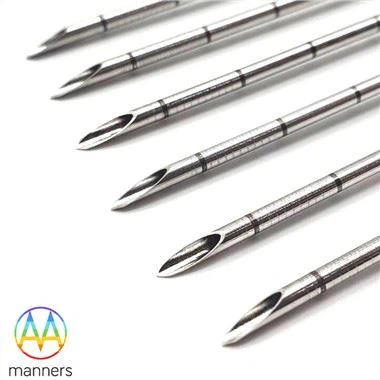
Tip Geometry: Unlike the single-bevel incision of ordinary needles, trocars often feature an asymmetric triangular prism or pencil-point design. This structure achieves an optimal balance between "sharpness" (reducing initial penetration resistance) and "cross-sectional area" (maintaining pushability in deep tissues). Through 5-axis CNC laser cutting and micro-grinding, the cutting edge radius is controlled within 3μm, achieving "atomic-level" sharpness for truly "self-sharpening" penetration.
Surface Super-Lubrication Engineering: To combat "tissue grabbing" or high friction in dense fascia with a 15cm long needle, the surface undergoes dual-layer composite treatment: The base layer uses Physical Vapor Deposition (PVD) to coat a Chromium Nitride (CrN, 2μm thick, golden color, friction coefficient 0.12); the top layer is coated with Polydimethylsiloxane (PDMS), which instantly forms a hydrophobic lubricious layer upon contact with body fluid, reducing dynamic friction by 70% and allowing the needle to slice through tissue like a hot knife through butter.
Extreme Validation of Corrosion Resistance and Fatigue Life
As a Class II/III high-risk medical device, trocars must pass brutally stringent accelerated aging and reliability tests:
Neutral Salt Spray Corrosion Test: Continuous spraying in a 5% NaCl salt spray environment at 35°C for 96 hours. Requirements stipulate a surface corrosion rate <0.002mm/year and an increase in surface roughness (Ra) of <0.05μm, ensuring the tip does not roughen over time to snag tissue or guidewires.
Bending Fatigue and Kink Resistance Test: Simulating maximum clinical bending angles (e.g., shoulder arthroscopy approach), the needle must withstand 5,000 bending cycles (bending radius 5cm) while maintaining >95% of the initial connection strength between the tip and the hub, with no blockage or deformation of the internal lumen.
Conclusion
The material evolution of trocars is progressing toward "Bio-inspired Non-smooth Surfaces" and "Smart Fluid Dynamics." Inspired by the micro-grooved structure of rattlesnake scales, researchers are developing laser-microtextured needle surfaces that actively expel tissue fluid during penetration, further reducing insertion force by over 30%. Advances in materials science are forging this "metal filament" into a "micro-hydraulic drilling apparatus" capable of defying physical limits and navigating autonomously within the human body.