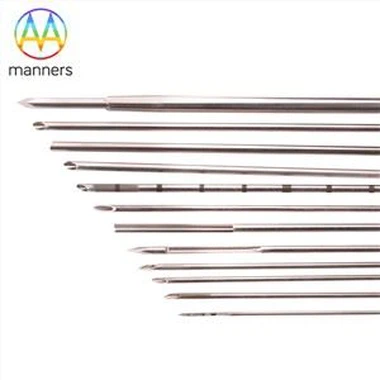
Material Selection & PVD Coating Engineering By Laparoscopy Shaver Blade Manufacturers
Jul 09, 2026
Laparoscopy Shaver Blades directly contact blood, lymph, and diverse soft tissues while rotating at thousands of RPM, imposing stringent demands on material strength, toughness, corrosion resistance, and edge retention. Professional Laparoscopy Shaver Blade Manufacturers strategically combine base materials and surface treatments based on product positioning (disposable vs. reusable, blade body vs. cutting edge).
Two Primary Base Material Pathways
Austenitic Stainless Steel (SS304/SS316L): Offers excellent ductility, corrosion resistance, and proven ISO 10993 biocompatibility. Primarily used for blade shafts, handle connections, and low-load disposable blade bodies. Its drawback is low hardness (HRB 80–90, ~HV 200), leading to rapid edge dulling. Consequently, pure SS304/316 is rarely used for edges requiring long-term sharpness (reusable blades). It is mainly deployed in low-cost, full-SS316 disposable lines, relying on the "use-and-discard" model to circumvent wear limitations.
Martensitic Precipitation-Hardening Stainless Steel (440C, 420B, 17-4PH): Through quenching + cryogenic treatment + tempering, these achieve hardness of HRC 52–58 (HV 550–650+). Edge retention is orders of magnitude superior to SS304, making them the mainstream choice for reusable blade edges and premium disposable tips. 440C offers high carbon/chromium content-corrosion resistance exceeds carbon steel but falls short of 316L, necessitating passivation and electropolishing. Note: Markings like "NiT" often denote surface treatments or typos; true NiTi shape memory alloy usage requires specific phase transformation and nickel ion release validation.
TiN (Titanium Nitride) Coating-Hardness & Reduced Friction
TiN exhibits a golden hue and microhardness of HV 2000–2300. Applied via PVD (Physical vapor Deposition) to a 2–4μm thickness on edges and flanks, it triples/quadruples surface hardness and lowers the friction coefficient (μ ≈ 0.4 → 0.2). This significantly reduces tissue adhesion and extends edge life. The critical process pitfall: excessive coating buildup at the extreme cutting edge rounds the theoretically sharp apex. Expert manufacturers control coating thickness within 0.05–0.1mm of the edge tip (creating an "Exclusion Zone") or apply ultra-thin layers here. Scratch testing (critical load Lc₂) validates film adhesion to prevent intraoperative flaking into the surgical field.
DLC (Diamond-Like Carbon) Coating-Ultra-Low Friction & Chemical Inertness
DLC boasts hardness up to HV 2500–4000 and an exceptionally low friction coefficient (0.05–0.1). Its chemical inertness and tunable hydrophilicity dramatically reduce adhesion when cutting protein/fibrin-rich tissues compared to TiN. Challenges include sensitivity to deposition temperature-processes must avoid temperatures causing martensitic stainless steel temper softening (typically <300°C, often lower). Gradient interlayers (e.g., Ti/TiC) are essential to mitigate thermal expansion mismatch and prevent delamination. Compliant manufacturers validate DLC products for adhesion, thickness distribution, and appearance/adhesion retention post-autoclave cycles.
Passivation, Electropolishing & Biocompatibility
Regardless of substrate or coating, non-coated surfaces undergo citric or nitric acid passivation to promote a dense Cr₂O₃ passive film. Electropolishing reduces Ra, minimizing protein adhesion. Final products comply with ISO 10993 for cytotoxicity, sensitization, and hemolysis. Coated products undergo additional assessment for particulate shedding risks (dynamic wear or post-ultrasonic cleaning particle counts).
Material and coating selection is fundamentally a multi-objective optimization balancing "Edge Life × Corrosion Resistance × Biocompatibility × Cost." When selecting a Laparoscopy Shaver Blade Manufacturer, demand explicit disclosure of base material grades, heat treatment protocols, coating types, and supporting validation reports. Factories offering vague claims like "Imported Stainless + Golden Coating" without verifiable data lack genuine process control.