Material Performance Advantages Of Manners Laparoscope Tubes In Tubal Surgery
Aug 24, 2026
Industry Pain Points
Unreasonable material selection and unstable material performance are key hidden dangers affecting the safety and effect of laparoscopic tubal surgery. Most ordinary laparoscope tubes adopt inferior stainless steel with low surface finish and uneven wall thickness, which are prone to oxidation, stain adhesion and tiny metal debris falling off during long-time pelvic cavity operation, easily causing secondary pollution and tubal tissue adhesion. Ordinary plastic fixing accessories have poor heat resistance and low dimensional stability, which are easy to deform and loosen under intraoperative LED light heat and electrocoagulation high temperature, leading to lens displacement and imaging distortion. In addition, non-specialized tube materials have poor smoothness, large friction coefficient, easy scratch damage to precision lenses, and cannot support frequent telescopic adjustment in delicate tubal surgery. These material defects lead to unstable intraoperative visualization, increased surgical risk and poor postoperative recovery effect, restricting the clinical popularization of high-precision tubal laparoscopic surgery.
Material Matching Working Principle
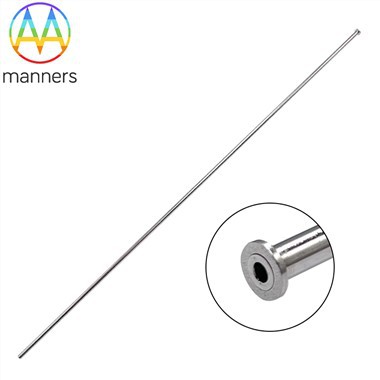
Manners laparoscope tubes adopt scientific dual-material collocation principle tailored for the high-precision and high-temperature resistant working environment of laparoscopic tubal surgery, realizing functional complementarity of different components. The main tube body adopts medical-grade stainless steel material with ultra-high purity and uniform wall thickness, which has excellent surface smoothness, oxidation resistance and corrosion resistance. It can maintain long-term stable gloss and flatness in humid pelvic cavity and high-temperature surgical environment, avoid stain residue and metal debris falling off, and provide a low-friction precise channel for lens movement. The fixing holder adopts imported Delrin (polyacetal/polyformaldehyde) heat-resistant polymer material, which has high rigidity, low friction coefficient and excellent dimensional stability. It can resist intraoperative continuous heat radiation without deformation and loosening, stably lock the coaxial position of the tube body and lens, and ensure the stability of optical imaging. The dual-material system perfectly matches the long-time high-precision operation needs of tubal surgery, realizing the integration of smooth guidance, stable fixation and anti-pollution performance.
Material Classification and Product Advantages
Manners laparoscope tube materials are divided into core tube body material and fixing accessory material, with graded professional advantages adapting to tubal surgical scenarios. The stainless steel tube body adopts medical special thin-wall processing technology, with ultra-bright and smooth inner diameter, no burrs, no scratches and no oxidation spots, featuring uniform wall thickness, high rigidity and strong deformation resistance. Compared with ordinary stainless steel tubes, it has lower friction coefficient, better biocompatibility and stronger anti-pollution ability, effectively avoiding pelvic tissue irritation and secondary adhesion. The Delrin polymer holder is a professional precision engineering plastic, with outstanding heat resistance, low-temperature dimensional stability and wear resistance. It will not soften or deform under long-time LED lighting heat and electrocoagulation operation temperature, and its low-friction characteristics avoid lens abrasion and jitter. All materials pass ISO9001 and ISO13485 medical certification, meeting the highest hygiene and safety standards of gynecological minimally invasive surgery, and support long-term repeated clinical use and high-intensity surgical operation.
Material-Based Standard Operation Guidelines
According to the material performance characteristics of Manners laparoscope tubes, targeted standardized operational specifications are formulated for laparoscopic tubal surgery. First, preoperative material inspection: check the stainless steel tube inner wall for smooth gloss without stains and scratches, verify the Delrin holder for no deformation, cracks and looseness, and confirm the overall structural stability of the equipment. Second, scenario-based material adaptation: adopt standard stainless steel + Delrin matched tubes for routine tubal adhesion lysis and recanalization surgery; select high-rigidity thickened stainless steel tubes for high-intensity complex ectopic pregnancy resection surgery to enhance deformation resistance. Third, intraoperative material protection: avoid high-temperature electrocoagulation equipment directly contacting the tube body and holder to prevent local material aging; operate lens telescopic movement slowly along the smooth inner wall to reduce friction loss. Fourth, postoperative material maintenance: clean the stainless steel tube with professional medical cleaning solution to keep the inner wall bright and smooth; check the wear degree of the Delrin holder regularly and replace aging accessories in time to ensure stable equipment performance.
Practical Material Application Experience
Clinical practical application fully verifies the superior material performance of Manners laparoscope tubes in tubal surgery. The medical-grade stainless steel thin-wall tube body maintains ultra-smooth and clean state during long-time pelvic cavity operation, effectively reducing blood stain and tissue residue adhesion, avoiding repeated lens cleaning and surgical interruption, and greatly improving the continuity and efficiency of delicate tubal surgery. The excellent corrosion and oxidation resistance prevents metal material deterioration and debris falling off, reducing the risk of postoperative pelvic infection and tubal adhesion. The Delrin high-temperature resistant holder always maintains firm fixation and stable size in high-temperature surgical environment, completely solving the problems of lens offset and imaging distortion caused by accessory deformation of ordinary products. The low-friction material characteristics protect the precision lens from scratch damage, prolong the service life of endoscopic equipment, and ensure consistent high-definition imaging effect in the whole process of tubal dissection, dredging and resection surgery.
Summary and Sublimation
Scientific and high-standard material collocation is the fundamental guarantee for the stable performance of laparoscope tubes in laparoscopic tubal surgery. Manners Technology's medical-grade stainless steel and professional Delrin polymer dual-material system completely solves the material aging, deformation, friction damage and pollution hidden dangers of ordinary products. The excellent smoothness, heat resistance, stability and biocompatibility of the materials adapt to the complex and precise operational environment of gynecological tubal minimally invasive surgery, provide continuous and stable high-definition visual support for surgical operations, effectively reduce surgical complications, and improve the safety and effectiveness of tubal lesion treatment and functional recovery. The certified high-quality material system reflects the rigorous manufacturing standards of medical minimally invasive equipment and provides reliable material guarantee for the high-quality development of gynecological laparoscopic surgery.
Industry Prospects and Suggestions
In the future, high-performance medical special materials will become the core upgrading direction of laparoscopic tube products for gynecological tubal surgery. It is suggested that industry manufacturers abandon inferior ordinary materials and fully popularize medical-grade stainless steel and high-temperature resistant engineering polymer materials to improve the overall material stability and safety of products. Further optimize tube inner wall polishing and anti-fouling material technology to reduce intraoperative stain adhesion and improve surgical continuity. Medical institutions should take medical certification material configuration as the core procurement standard for laparoscopic equipment, eliminate unqualified material products, and standardize equipment use and maintenance specifications. Promote the industry to form unified material quality standards for gynecological special laparoscope tubes, and drive the iterative upgrading of industry product quality.