Material, Manufacturing Technology And Industrial Quality Control Standards Of 22g 90mm Spinal Puncture Needles
Aug 03, 2026
Material and manufacturing technology determine the safety, stability and service life of medical devices. As a class interventional puncture consumable, Quincke Spinal Needle 22g 90mm strictly follows quality control standards for medical devices. Manufactured from premium medical-grade stainless steel with refined processing technologies, it implements full-process quality management covering raw material screening, production, sterilization, packaging and finished product inspection, establishing itself as a representative high-quality conventional puncture needle in the industry.
Medical-grade stainless steel serves as the core raw material, different from ordinary industrial stainless steel. It offers excellent biocompatibility, corrosion resistance and bending resistance. No heavy metal precipitation, allergenic components or pyrogenic substances exist. When contacting human tissues, it will not trigger inflammation, allergic reactions or rejection, fully satisfying biosafety standards for interventional medical devices. Proper material hardness delivers slim shaft geometry while maintaining high toughness. The 22G thin-gauge shaft resists bending, deformation and fracture under compression from human muscles and ligaments during puncture, eliminating hidden safety hazards such as broken needles and stuck needles to satisfy intensive clinical operation requirements.
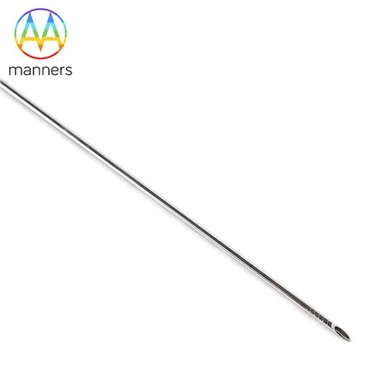
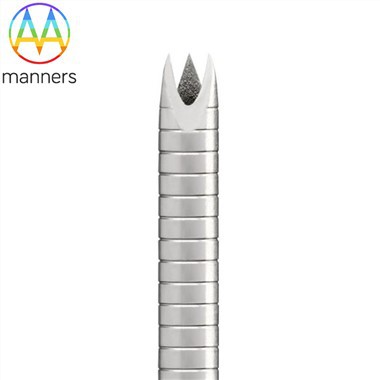
In terms of production processes, the needle shaft adopts precise seamless wire drawing technology. The surface remains smooth without burrs or scratches to minimize friction trauma to human tissues during puncture. The tip undergoes precision bevel grinding with uniform angles and sharp edges. Regular puncture openings ensure smooth cerebrospinal fluid outflow and steady drug injection. Thin-wall precision machining is applied to the lumen. While maintaining shaft strength, the inner diameter is maximized to enhance flow capacity and address the industry challenge of insufficient flow rate in thin-gauge puncture needles. The seamless joint between hub and needle shaft provides reliable sealing to prevent drug leakage and air entry into the spinal canal and guarantee diagnosis and treatment safety.
Sterilization and packaging comply with stringent industry standards. Ethylene oxide (EO) sterilization achieves thorough disinfection without residual toxicity, protecting needle materials and avoiding adverse effects on patients. Post-sterilization independent sealed packaging provides waterproof, dustproof and anti-pollution protection to sustain sterile conditions and stable shelf life. Customers can choose standard carton packaging or customized solutions to meet hospital bidding procurement, bulk distribution by distributors and international export demands. Packaging specifications fully comply with domestic and international medical device circulation regulations.
Finished products pass dozens of special inspections before delivery, including shaft strength testing, tip sharpness testing, flow rate testing, sealing performance testing, sterility testing and biocompatibility testing. Strict quality control leads to an extremely low defect rate, and clinical stability exceeds the industrial average. Amid severe homogenized competition in the medical device sector, rigorous material processing and quality control standards constitute the core competitiveness that enables this product to maintain mainstream market status over the long term.