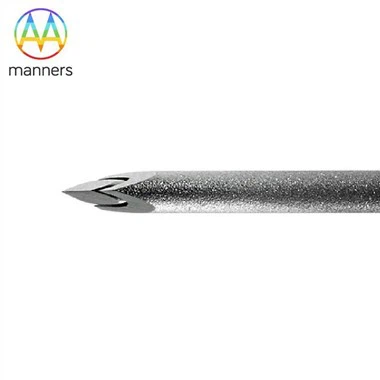
Matching PDO Thread Lift Needle Length With Treatment Coverage
Nov 02, 2026
Pain Point
Needle length selection is frequently oversimplified in daily aesthetic practice. Many practitioners only rely on fixed habitual specifications and ignore the horizontal span of sagging soft tissue. When treating large contour areas such as buttock and thigh, they use short 25mm–60mm facial needles, requiring multiple overlapping punctures and creating dozens of independent needle tracks. Multi-site penetration greatly accumulates trauma, increases hematoma probability and raises infection risk; this risk is analogous to repeated acupoint embedding operations with poor disinfection, where each puncture is a potential pathogen entry point. On the opposite side, applying long 100mm–150mm body needles on small facial zones leads to over-penetration beyond the target superficial fascia, irritating facial nerve branches and triggering persistent numbness. Some suppliers only provide limited fixed lengths without custom service, failing to adapt to different facial widths, fat thickness and sagging ranges across diverse ethnic groups. Customers often confuse needle length with thread length, generating disputes when lifting coverage cannot meet expectation. Even with macromolecular, medium and small molecular HA composite coating, repeated short-needle punctures create too many micro-wounds and weaken the overall repairing effect.
Working Principle
Needle length defines the maximum one-time delivery distance of preloaded threads under skin. A needle of suitable length can finish thread deployment through a single entry point, forming a complete lifting vector without repeated skin pricks. After the needle advances to the designed terminal position, operators hold the thread steady and pull the needle out. The barbs on PDO, PLLA, PCL or WPDO threads lock fascia and subcutaneous tissue to achieve soft tissue repositioning. The three-layer HA coating lubricates the whole long needle track during insertion, eases friction injury and suppresses excessive inflammatory response along the embedding tunnel. Longer needles fit wide continuous sagging planes; shorter needles suit local concentrated wrinkle zones. It is critical to distinguish needle length from preloaded thread length: thread length determines the actual anchoring coverage, while needle length is merely the delivery channel. The same needle length can be equipped with different thread lengths according to clinical demand.
Classification of PDO Thread Lift Needles by Length
The customizable length spectrum ranges from 25mm to 150mm, with matched preloaded thread length from 30mm to 190mm.
25mm–60mm Short needles: For local facial zones including periorbital wrinkles, forehead fine lines, small cheek sagging and nasolabial fold correction. Mostly paired with mono or short cog threads, low overall trauma.
70mm–90mm Medium-long needles: For full cheek lifting, jawline contour reshaping and neck band improvement, covering medium-range facial sagging.
100mm–150mm Extra-long needles: Dedicated to body contouring such as thigh tightening, buttock lifting and abdominal skin tightening, designed for wide, continuous subcutaneous fascial planes. All length variants support 18G–30G gauge options and can be packed individually in sterile kits containing tray, pad, tweezers, scissors, gloves, mask and sealing sleeve or standard bulk cartons.
Practical Operation Guidelines
Mark treatment range in advance before selecting needle length. Facial local wrinkle treatment chooses 25–60mm short needles, one entry point for one small zone. Full mid-face lifting adopts 70–90mm medium-long needles, marking entry at hairline to hide puncture scars. Buttock and thigh shaping under standing marking uses 100–150mm extra-long needles, arranging fan-shaped lifting vectors to build multi-point anchoring networks. Never push long needles forcefully when meeting tissue resistance; stop and adjust direction to avoid nerve and vessel injury. For extra-long needle implantation, strict aseptic discipline is mandatory: long tunnels contact abundant tissue fluid and blood, and reused or non-sterile needles may transmit blood-borne diseases just like unsafe acupoint catgut embedding for weight management. After thread placement, confirm that the thread terminal stays within the marked sagging boundary. Schedule follow-up at 1 month to check contour symmetry and induration absorption along long tracks.
Real Clinical Experience
Experienced operators confirm that properly selected long needles reduce total puncture counts significantly, which cuts down overall bruising and patient recovery time. However, 120–150mm long needles demand far slower, steadier manipulation; rapid advancement easily drags threads out of position and disarranges barb anchoring. HA coating delivers prominent value for extra-long needle tracks, lowering palpable strip sensation and subcutaneous hard lumps. Many failed buttock lifting cases trace back to using short facial needles and dense overlapping punctures, which cause uneven traction and scattered nodules. For patients with thin subcutaneous fat on the hip, excessively long needles may penetrate close to muscle fascia and induce soreness after treatment.
Summary
Needle length controls the number of punctures and single-vector coverage area in thread lifting. Short needles serve local delicate correction, while extra-long needles support large-area body contour reshaping. Length mismatch either brings redundant traumatic punctures or overshooting penetration into risky deep anatomical layers. Long needle tracks carry elevated infection transmission risk, so sterile disposable kits are non-negotiable, consistent with the safety rule of acupoint embedding procedures. HA composite coating relieves track inflammation, but cannot compensate for wrong-length selection and off-plane insertion.
Prospect and Suggestion
Manufacturers will launch regionally fixed length sets: facial delicate set, facial structural lifting set and body contour set to simplify clinical selection. Custom micro-adjustment of needle and thread length will become a standard service for clinics serving diverse ethnic patients. Aesthetic training should add anatomical span matching modules for needle length. Clinics should inform clients of the difference between needle delivery length and effective lifting thread length before operation to eliminate expectation bias. Combined long-needle PCL thread lifting and radiofrequency tightening will become mainstream body rejuvenation protocols.