Manufacturing Process And Performance Regulation For Core Dimensional Parameters Of Phlebotomy Needles
Jun 05, 2026
https://pmc.ncbi.nlm.nih.gov/articles/PMC11507497/
Represented by contemporary blood collection and capillary lancets, phlebotomy needles fall into the category of high-precision metallic components within medical device manufacturing. The realization and tight tolerance control of core dimensional indicators - outer diameter, inner lumen diameter, wall thickness, overall shaft length and tip geometry - entirely rely on ultraprecision machining technologies. Collectively, these dimensional features govern puncture force, fluid flow rate, structural rigidity and end-user comfort.
1. Tubing Forming and Basic Dimensional Regulation
Modern hollow phlebotomy cannulas are predominantly fabricated from medical-grade stainless steel (304 / 316L) or specialty alloy thin-wall tubing.
- Cold drawing process: Raw tubing is sequentially cold-drawn through graded precision dies to incrementally downsize outer diameter (OD), inner diameter (ID) and wall thickness until matching target gauge specifications. Finer high-gauge cannulas require more drawing passes with tighter dimensional tolerance. Inner lumen directly dictates volumetric blood flow per unit time, serving as a decisive parameter for therapeutic phlebotomy devices.
- Material-dependent dimensional optimization: 316L stainless steel delivers superior mechanical strength versus 304 grade, enabling reduced wall thickness under identical outer dimension. This engineering advantage enlarges inner bore for improved flow without compromising structural integrity, or lowers penetration resistance while keeping outer diameter unchanged.
2. Tip Forming: Core Determinant of Puncture Performance
Needle tips impose the strictest precision requirements; bevel angle, cutting profile and cutting-edge sharpness constitute functionally critical dimensions.
- Mechanical abrasive grinding: Conventional processing adopts multi-angle precision wheel grinding to form sharp bevel facets with controlled bevel angles commonly ranging from 12° to 18° and strict geometric symmetry. Bevel configuration directly modulates insertion resistance and incidental soft tissue trauma during venipuncture.
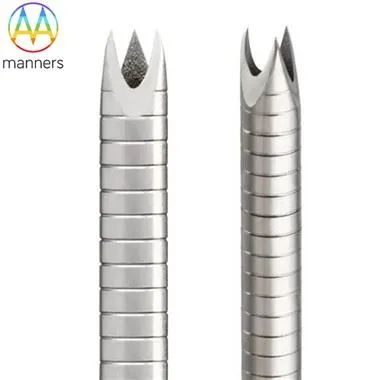
- Electrochemical polishing & laser micromachining: Electrolytic polishing eliminates micro burrs and refines cutting-edge radius to boost sharpness. Advanced laser ablation enables one-step near-net shaping of high-precision symmetric tips and sophisticated proprietary profiles (e.g., pencil-point geometry designed to prevent rubber stopper coring) unattainable via traditional grinding, substantially optimizing puncture smoothness.
3. Length Calibration and Rear-End Post-processing
- Precision cutoff to fixed length: Continuous drawn tubing is segmented to predefined cannula length with tightly constrained dimensional tolerances. For disposable capillary lancets, exposed needle length dictates penetration depth and stands as a core safety specification.
- Dispensing and hub assembly: Quantitative adhesive dispensing at the cannula proximal end facilitates permanent bonding with plastic hubs or Luer connectors. Adhesive dosage and positioning are critical process dimensions influencing joint pull resistance and fluid tightness of the assembly.
4. Specialized Dimensional Technology for Capillary Lancets
Disposable fingertip lancets demand micrometer-level ultra-precision production:
- Micro-shaft fabrication: Solid ultra-fine metal wire is precision ground into micro sharp tips; alternative specialty forming yields miniature hollow microcannula structures.
- Depth-limiting mechanical design: The core safety feature lies in mechanical stop built into plastic housing and spring ejection system rather than bare needle length. Such functional travel dimension restricts maximum penetration depth (e.g., 2.0 mm ±0.2 mm), mechanically preventing excessive tissue injury for clinical safety.
Conclusion
Dimensional precision lays the physical foundation for clinical safety and functional performance of phlebotomy needles. From millimeter-scale outer dimensions down to micron-level cutting-edge edge geometry, every feature is finalized via a standardized, rigorous process chain. Under the ISO 13485 quality management framework, dimensional inspection runs through incoming raw material QC, in-line process monitoring and finished-product release testing, with optical comparators and laser micrometers deployed for full metrology verification.
Driven by evolving material science (superelasticity and shape memory of nitinol alloy) and advanced microfabrication, next-generation phlebotomy needles trend toward minimal invasiveness and intelligent sensing (real-time penetration depth detection), all enabled by continuously refined dimensional control capabilities.