Life‑And‑Death Game At Micron Scale – Uncovering Materials Science And Precision Manufacturing Of Top‑Tier Intraosseous Infusion Needle Manufacturers
May 21, 2026
To ordinary people, an intraosseous (IO) infusion needle may be nothing more than a perforated steel pin. Yet for medical device engineers and senior IO needle manufacturers, it represents an integration of materials science, fluid mechanics and microsurgical technology. How extreme must process control be to pierce the body's hardest compact cortical bone within seconds, while maintaining an unobstructed internal infusion channel and avoiding devastating tissue damage to patients? Today we step deep into manufacturing workshops to reveal the secrets behind this micron‑level production.
Core Material: Hardness and Toughness of Medical‑Grade Stainless Steel
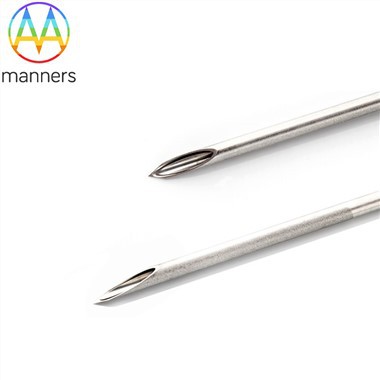
IO needles operate under extremely harsh conditions. To penetrate cortical bone with extremely high Brinell hardness, needle tips must possess superior hardness and wear resistance. Currently, special medical‑grade stainless steels such as 304V and 316LVM are widely recognised as the industry gold standard. Produced via vacuum melting, these materials feature ultra‑low impurity content and outstanding fatigue resistance. Top‑tier IO needle manufacturers subject steel to multi‑pass cold drawing to enhance strength through work hardening.
Hardness alone, however, is insufficient. The needle shaft must also retain adequate toughness; otherwise brittle fracture may occur under resistance, leaving broken needle fragments inside the patient's body. For this reason, precise heat treatment - accurately controlled tempering within the martensitic transformation temperature range - marks the dividing line between mediocre and exceptional manufacturing.
Surface Engineering: The Art of Silicone Coating and Painless Penetration
Why do some IO needles pierce like "cutting flesh with a blunt knife", while others glide like "cutting butter with a hot blade"? The secret lies in surface treatment. High‑end IO needles require surface modification to improve skin penetration and reduce bone friction. The most common method is silicone coating. Via electrostatic spraying or dipping processes, a micron‑thin medical‑grade silicone film adheres to the needle surface, lowering the friction coefficient between metal and bone tissue by over 80%.
Additionally, some cutting‑edge IO needle manufacturers adopt diamond‑like carbon (DLC) coatings. Extremely smooth and highly biocompatible, these coatings effectively prevent platelet adhesion and guarantee unobstructed infusion.
Lumen Design: Ultimate Application of Fluid Dynamics
Inner‑diameter design of IO needles is sophisticated engineering. An overly large lumen enables fast flow yet increases puncture trauma and intramedullary pressure, risking compartment syndrome. An excessively small lumen fails to meet emergency rapid volume‑resuscitation requirements.
Leading manufacturers utilise computational fluid dynamics (CFD) simulation software to calculate optimal flow rates for liquids of varying viscosity (crystalloids, colloids, whole blood) under specific pressure (e.g. 300 mmHg). They apply streamlined shaping to the tapered hub connection to eliminate turbulence and ensure smooth laminar‑flow drug delivery. Such rigorous attention to fluid dynamics directly determines drug administration efficiency during resuscitation.
Quality Control: From Micron‑Scale Defects to Batch Consistency
Inside Class 100,000 cleanrooms, every IO needle undergoes stringent quality inspection. Manufacturers use high‑precision optical projectors to check geometric angles of needle tips, tolerating deviations of only ±1°. Electronic tensile testers verify hub‑to‑shaft bonding strength, ensuring resistance to dozens of Newtons of pull‑out force without detachment. Fatigue tests using simulated bone models confirm tip sharpness remains intact after hundreds of consecutive punctures. Any needle bearing invisible microcracks or burrs is ruthlessly eliminated by automatic sorting systems.
This is the reality behind modern IO needle production. Far beyond simple lathe machining, it is a precision symphony of materials, physics and chemistry. Only IO needle manufacturers willing to invest heavily in research, development and quality control can produce devices truly worthy of human lives.