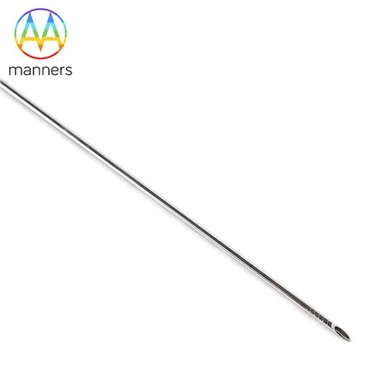
Laser Processing Precision Control For Ultra-Fine Perforated Hypotube
Sep 04, 2026
Pain Point
Ultra-fine perforated hypotubes with a diameter below 1mm are core components of precision neurological and micro-vascular interventional catheters, belonging to the high-precision category of laser-cut medical hypotubes. Relying on 304, 316L stainless steel and Nitinol materials, they adopt micro-hole perforated structures to realize precision drug delivery and micro-pressure monitoring functions, with a standard minimum laser kerf width of 0.012mm. However, ultra-fine tube bodies have thin tube walls and weak structural rigidity, making precision control extremely difficult in processing. Slight laser parameter deviation will cause kerf width exceeding the standard, uneven aperture, tube wall deformation and perforation offset. Excessive laser heat input leads to local tube wall thinning, affecting the kink resistance and torque stability of ultra-fine hypotubes. At present, many factories lack targeted precision control schemes for ultra-fine perforated hypotubes, resulting in low product yield and difficulty in meeting the high-precision requirements of micro-minimally invasive surgery. The precision control bottleneck restricts the clinical promotion of ultra-fine perforated hypotubes.
Principle Introduction
The precision control principle of ultra-fine perforated hypotube laser processing is based on micro-laser precision scanning and constant temperature processing technology, focusing on controlling kerf width consistency, aperture uniformity and tube wall structural integrity. For 0.20mm–1mm ultra-fine diameter hypotubes, the processing core is to balance micro-perforation precision and tube wall structural stability, strictly locking the 0.012mm minimum kerf width to avoid excessive cutting damage to the thin tube wall. Adopt low-energy high-frequency laser pulse output to realize cold processing of ultra-fine tube bodies, reduce thermal deformation and tube wall thinning. Through full-axis real-time positioning and scanning calibration, ensure that all perforations are evenly distributed on the tube axis without offset. The precision control system retains the gradient flexibility design of traditional laser-cut hypotubes, ensures that the ultra-fine tube body has excellent pushability and trackability while realizing micro-permeability functions, and avoids structural rigidity loss caused by precision processing.
Equipment Classification
The precision production of ultra-fine perforated hypotubes requires three sets of high-precision professional medical equipment. First, micro-fine focusing laser perforation equipment. Specialized for 0.20mm–1mm ultra-fine hypotube processing, with micron-level positioning accuracy, stably controlling 0.012mm ultra-fine kerf width, low thermal output, effectively avoiding thin tube wall deformation, supporting customized perforation according to customer drawings and samples. Second, full-automatic axial positioning calibration equipment. Realize 360-degree non-dead-angle scanning of ultra-fine tube bodies, correct processing offset in real time, and ensure the consistency of perforation position and aperture. Third, micron-level dimensional detection equipment. Accurately measure kerf width, aperture size and tube wall thickness of ultra-fine perforations, detect micro-deformation and tiny defects that cannot be identified by naked eyes, and ensure that all precision indicators meet medical-grade standards. Precision laser equipment guarantees processing accuracy, positioning equipment ensures structural symmetry, and detection equipment realizes full-quality control.
Practical Operation Guide
The precision processing workflow of ultra-fine perforated hypotube complies with ISO13485 high-precision medical component standards. Step one, ultra-fine blank screening. Strictly inspect the roundness, wall thickness uniformity and surface flatness of 0.20mm–1mm hypotube blanks, eliminate blanks with tiny structural deviations. Step two, equipment precision calibration. Calibrate laser focal length, positioning accuracy and kerf width parameters before processing to ensure stable output of 0.012mm standard kerf. Step three, low-energy cold laser perforation processing, adopt segmented slow scanning to avoid thermal deformation of ultra-fine tube walls, control perforation spacing and aperture with micron-level precision. Step four, micro-post-processing cleaning, use low-power ultrasonic cleaning to remove tiny laser residues in perforations without damaging the tube wall structure. Step five, full-precision dimensional detection, verify kerf width, aperture uniformity and tube wall integrity one by one. Step six, mechanical performance testing, confirm that the ultra-fine hypotube retains qualified torque, flexibility and kink resistance. Step seven, finished product sorting and precision packaging, adopt shockproof customized packaging for ultra-fine products to avoid transportation deformation. All precision parameters are archived for quality traceability.
Real-world Industrial Experience
Practical precision processing experience shows that thermal deformation and kerf inconsistency are the two main defects of ultra-fine perforated hypotubes. Conventional high-energy laser processing will cause local thermal shrinkage of ultra-fine tube walls, resulting in unbalanced proximal and distal flexibility. Uncalibrated positioning equipment leads to perforation offset, which affects the uniform permeability of the tube body. After adopting low-energy cold processing and real-time positioning calibration, the precision pass rate of ultra-fine perforated hypotubes is increased from 65% to 98%. The 0.012mm minimum kerf width is the optimal precision threshold for ultra-fine tube processing, which can ensure perforation smoothness without damaging tube wall structural strength. Nitinol ultra-fine hypotubes are more sensitive to thermal processing, requiring stricter laser energy control than stainless steel products. In neurological micro-intervention tests, high-precision perforated ultra-fine hypotubes show excellent navigation precision and functional stability, completely meeting the clinical precision requirements of micro-minimally invasive surgery.
Summary & Elevation
Precision laser processing technology effectively solves the processing bottleneck of ultra-fine perforated hypotubes, realizing micron-level control of kerf width, aperture and tube wall structure. Through low-energy cold processing and real-time positioning calibration, it avoids thermal deformation and structural damage of ultra-fine tube bodies, fully retains the excellent mechanical properties of laser-cut hypotubes, and realizes the integration of ultra-precision structure and stable performance. Strict full-process precision detection and standardized operation ensure that ultra-fine perforated hypotubes meet the high-standard requirements of micro-medical intervention and ISO medical certification, filling the precision gap of traditional laser-cut hypotube products in ultra-fine specification scenarios.
Prospect & Suggestions
Ultra-fine high-precision perforated hypotubes will become the mainstream core components of future micro-minimally invasive medical devices. Manufacturers should further upgrade micro-laser processing equipment to realize automatic intelligent precision calibration of ultra-fine tube bodies. Optimize the precision processing parameter database of different ultra-fine specifications and materials to improve production efficiency and yield. Add full-process precision detection indicators into customer customized design drawings to unify production and acceptance standards. Future R&D focuses on developing nano-level ultra-precision perforation technology and composite ultra-fine perforated hypotubes with multi-functional integration, to adapt to the development of ultra-micro minimally invasive intervention technology.