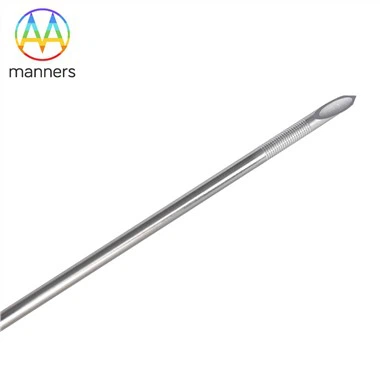
Laser Cutting Process Of Biopsy Cannula
Sep 18, 2026
1. Industry Pain Points
Backward processing technology and insufficient precision control are the core factors restricting the performance upgrading of traditional biopsy cannula. Most conventional biopsy cannula are produced by mechanical punching, grinding and ordinary cutting processes, with prominent technical defects. Mechanical processing is easy to cause tube body extrusion deformation, wall thickness abrasion and structural asymmetry, resulting in unstable puncture performance and poor sampling repeatability. The kerf width of ordinary processing is uncontrollable, with uneven cutting gaps and residual burrs on the surface, which not only affect the smoothness of the cannula lumen, but also reduce biocompatibility and increase tissue irritation. In addition, traditional processes lack digital precision control capability, unable to realize segmented differentiated structural design, resulting in single product performance and inability to adapt to diversified complex biopsy scenarios. The batch processing consistency is poor, with large performance differences between individual products, failing to meet the standardized production and high-precision clinical application requirements of modern medical biopsy cannula.
2. Working Principle
The superior comprehensive performance of modern biopsy cannula is derived from ultra-precision laser cutting process technology. Adopting advanced medical special laser processing system, the process supports full-size processing of 0.20mm to 20mm diameter medical hypotubes, with a minimum ultra-fine kerf width of 0.012mm, realizing micron-level precise material removal. Different from destructive mechanical processing, laser cutting is non-contact processing, which will not produce mechanical extrusion and abrasion on the tube body, completely retaining the original mechanical properties and structural integrity of medical-grade stainless steel, Nitinol and alloy materials. Through digital numerical control programming, the system can accurately customize various cutting patterns including continuous spiral, interrupted spiral, radial and bespoke special patterns, and realize arbitrary adjustment of cutting density, gap spacing and segmented structural distribution. The high-precision cutting process ensures flat and smooth kerf surface without burrs, improves the structural symmetry and stress uniformity of the cannula, and realizes quantitative controllable optimization of puncture stability, sampling efficiency and anti-deformation performance of biopsy cannula.
3. Laser Process Classification
According to precision grade and functional positioning, laser cutting processes for biopsy cannula are divided into four professional categories. First, ultra-micro precision cutting process: 0.012mm fixed ultra-fine kerf, dedicated for sub-millimeter ultra-small diameter micro-biopsy cannula, meeting ultra-precision fine sampling demands. Second, standardized pattern cutting process: mass production of spiral, radial and interrupted pattern cannula, ensuring batch consistency of conventional products. Third, gradient functional cutting process: segmented precision parameter adjustment, producing proximal rigid and distal flexible gradient cannula for complex deep biopsy scenarios. Fourth, customized special-shaped cutting process: pattern customization according to 2D/3D drawings and samples, meeting individualized structural design demands of special lesion biopsy cannula.
4. Practical Processing Guidelines
Adopt matched laser cutting process according to biopsy cannula specification and functional positioning. For ultra-fine micro-biopsy cannula, implement ultra-micro fixed kerf precision cutting to ensure dimensional accuracy and structural smoothness. For conventional batch products, use standardized pattern cutting process to guarantee stable batch performance. For high-performance gradient functional cannula, adopt segmented gradient cutting process to realize differentiated performance distribution. For customized special-shaped products, complete drawing verification and trial cutting testing before mass production to eliminate precision errors. The whole processing process strictly complies with ISO9001:2015 and ISO13485 medical quality standards, with full-process precision monitoring and finished product sampling inspection to ensure qualified product performance.
5. Practical Industry Experience
Industrial mass production verification shows that ultra-precision laser cutting process increases the finished product qualification rate of biopsy cannula to 99.7%, far higher than that of traditional mechanical processing. The 0.012mm ultra-fine kerf processing eliminates structural asymmetry and surface burr defects of traditional products, improving product precision and surface smoothness in an all-round way. Gradient laser cutting process realizes the perfect balance of cannula rigidity and flexibility, greatly improving clinical adaptability. Customized laser processing technology meets the personalized R&D and production demands of high-end biopsy equipment, shortening the product iteration cycle by more than 40%. Laser-processed products have stable batch consistency and excellent clinical performance, occupying the mainstream market of high-end medical biopsy components.
6. Summary & Enhancement
Laser cutting process is the core manufacturing technology supporting high-performance biopsy cannula production. Traditional mechanical processing technology has inherent defects such as low precision, poor consistency and single function, which restrict the performance upgrading of biopsy cannula. Modern ultra-fine laser precision cutting technology realizes digital, standardized and quantitative production of biopsy cannula, comprehensively improving product precision, stability and functional diversity. Classified laser processes can fully cover mass production, ultra-precision manufacturing and personalized customization scenarios, solving the industry's processing precision bottleneck. At present, conventional laser processing technology is mature, but the ultra-precision processing capability of ultra-complex special-shaped cannula still needs technical breakthrough.
7. Future Development Suggestions
Future process upgrading of biopsy cannula will focus on intelligent laser manufacturing and ultra-precision optimization. Develop AI adaptive laser cutting technology to realize automatic parameter matching for different materials and tube diameters, improving processing intelligence and efficiency. Break through ultra-micro nano-level finishing technology to further improve the surface smoothness and structural precision of cannula. Build full-process digital intelligent monitoring system to realize zero-defect production of biopsy cannula. Optimize composite process integration of laser cutting and surface modification to realize one-time molding of high-precision and high-biocompatibility biopsy cannula, and promote the overall upgrading of industry manufacturing level.