Intraosseous Access When Peripheral IV Fails
Nov 20, 2026
Why Peripheral Access Fails at the Worst Possible Moment
Peripheral intravenous cannulation is the reflexive first move in nearly every emergency, and for most patients it works. That reliability is what makes its failure so disruptive. The technique rests on a chain of assumptions: that the vein is patent, that it is distended by adequate preload, that vasoconstriction has not flattened it, and that the operator has two hands, good light, and time to hunt. In shock, obesity, edema, burns, chronic intravenous drug use, and small pediatric anatomy, several of those assumptions collapse at once.
The cost is not measured in a single failed puncture but in the minutes that follow. Teams escalate through a second and third attempt, then call for ultrasound, then reposition, then consider a central line that requires equipment and a physician who may not be present. Prehospital teaching frequently cites a two-attempt or ninety-second threshold before switching routes, yet the threshold is applied loosely, because the alternative feels unfamiliar rather than unavailable.
The deeper problem is cognitive. Catheter failure reframes the encounter as an access problem, and access problems invite persistence. Meanwhile the drug that was supposed to be given is still in the syringe. For time-critical pharmacology the route decision is not a logistical detail; it is the rate-limiting step. Recognizing that early, and having a pre-planned fallback, separates a controlled response from a cascade of improvisation.
How Bone Marrow Becomes a Central Circulation Shortcut
The medullary cavity is not a dry space. It contains a dense sinusoidal network that drains into emissary veins and ultimately into the central venous circulation. These sinusoids are supported by rigid trabeculae, so they do not collapse when systemic pressure falls or when catecholamines drive intense vasoconstriction. That structural persistence is why an intraosseous route stays usable when peripheral cannulation becomes geometrically impossible.
When a needle is seated correctly through the cortex into the marrow, infused fluid enters that bed and moves centrally with venous return. Onset for most resuscitative drugs is comparable to the intravenous route and far faster than the endotracheal alternative. Flow is limited by the resistance of the medullary bed rather than by gauge alone, which is why pressure-assisted infusion is routine for volume resuscitation and why gravity alone disappoints.
Two consequences follow. The route is systemic, not local: anything given intravenously can generally be given intraosseously, including crystalloid, blood products, and arrest medications. And confirmation matters, because a needle sitting in soft tissue, or one pushed through the far cortex, produces a plausible-looking device with an implausible effect.
Classifying Intraosseous Devices and Needle Specifications
Intraosseous systems fall into three families. Manual bone marrow needles rely on hand pressure and a twisting motion and remain relevant where no power source exists. Spring-loaded impact devices deliver a fixed stroke in a single action. Powered drivers use a compact motor to rotate or oscillate the needle through cortex with controlled energy.
Within the powered family, tip geometry is decisive. A cutting-tip needle for intraosseous access opens the cortex by machining a clean channel rather than by wedging and splitting bone. Paired with a low-power driver, this geometry establishes a stable, secure vascular pathway in as little as ten seconds without the operator leaning body weight onto the device. The absence of brute force is not a comfort feature; it is what makes one technique defensible in an adult with dense cortical bone and in a child with a thin, easily over-penetrated cortex.
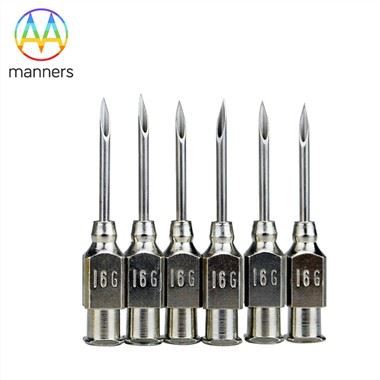
Specification follows the patient. A 15G needle covers most adults and larger children, while custom lengths address extremes of habitus. Needles are typically stainless steel to hold an edge through cortical contact and to resist bending during insertion. These devices fall within the injection and puncture instrument category and are commonly supplied as custom components, produced to 2D or 3D drawings or matched to a physical sample, then packed in standard cartons.
A Practical Insertion Sequence for the Failed-IV Patient
The sequence begins before the needle is opened. Confirm that peripheral access has genuinely failed or will consume more time than the patient has, then designate one clinician to own the procedure while others manage monitoring, ventilation, and drug preparation. Choose the site deliberately: the proximal tibia, on the flat medial surface roughly two centimeters below the tibial tuberosity, is the default because it is landmark-driven, remote from the thorax during compressions, and compatible with airway management. The proximal humerus is the alternative when the lower limbs are inaccessible.
Cleanse the skin and let the antiseptic dry. Stabilize the limb against a firm surface rather than another rescuer's hand. Seat the needle with the driver, stopping when resistance disappears; the loss of resistance, not a depth mark, is the end point. Remove the driver, keep the needle vertical, and confirm placement by aspirating marrow where possible, flushing against resistance, and observing a firm, self-supporting needle. Secure the stabilization dressing, then flush in pulses to clear the channel before connecting the infusion.
From there the route behaves like any other line, with two additions: reassess the site frequently for swelling or compartment tightness, and document insertion time so the device is exchanged once definitive access exists. The whole sequence, from decision to flowing line, should fit inside a single drug cycle rather than spanning several.
Field Experience and the Misconceptions That Cost Time
Several beliefs still slow teams down. The first is that intraosseous access is pediatric. It is not; the same route serves adults, and it works in patients who are awake, confused, or comatose, provided adequate local anesthesia or a rapid insertion. The second is that the route is acceptable only for arrest drugs. In practice it supports fluids, antibiotics, anticonvulsants, and blood products when the alternative is no access at all.
A third misconception is that a successful insertion must yield a visible aspirate. Aspiration can fail in a correctly placed needle, particularly in smaller patients, so reliance on aspirate alone drives unnecessary reinsertion. A fourth is that the device solves access permanently; it is a bridge and should give way to intravenous or central access as soon as that is safely obtainable. A fifth is inserting without securing, then losing the line during movement, which converts a solved problem back into an unsolved one.
Experienced crews invert the standard order. Rather than exhausting peripheral options while drugs wait, they place the intraosseous line early, use it to stabilize, then pursue intravenous access at leisure. That costs nothing when the peripheral attempt would have worked, and saves minutes when it would not.
What the Failure of a Peripheral Line Really Teaches
A failed peripheral line is usually described as a technical setback. It is better understood as a scheduling event. Vascular access is the first resource that must be secured in any resuscitation, and every subsequent intervention queues behind it. When the queue stalls, the visible failure is a catheter; the actual failure is time.
This reframing argues for pre-positioned equipment rather than improvised searches, for a team member whose only assignment is access, and for an explicit threshold at which the fallback is chosen rather than debated. It also argues for training that treats intraosseous placement as a core skill, because a technique practiced only in crisis will be performed slowly in crisis.
Where the Technology Is Heading and How to Choose
The direction of development is toward less force, more feedback, and better integration. Cutting-tip geometries continue to replace wedging designs because a machined channel seats more predictably. Driver platforms are becoming smaller and gentler, with controlled energy that reduces over-penetration in thin cortical bone. Depth referencing and integrated stabilization are converging into single-use kits that remove assembly from the field.
For services selecting a device, four questions matter more than brochure specifications. Does one driver accept adult and pediatric lengths across your case mix? Is the tip a cutting geometry paired with genuinely low-power delivery, or does it depend on operator force? Can the supplier manufacture to your 2D or 3D drawings or to a submitted sample, and does standard carton packaging fit vehicle storage and restocking? And can the specification be held constant across resupply so that training transfers directly to practice? A needle for intraosseous access that answers all four becomes dependable infrastructure rather than a specialist's tool.