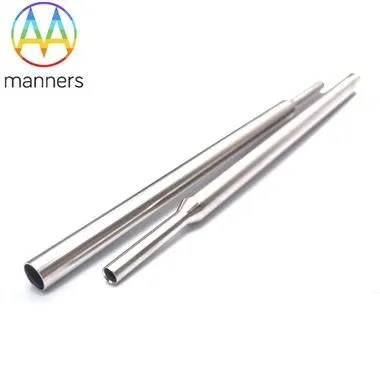
Industry Development Trend And Risk Avoidance Of Metal Tube With Small Size Flare End
Nov 06, 2026
1. Existing Industry Pain Points
The small flare end metal tubing industry faces structural contradictions. On one hand, downstream minimally invasive medical device market grows rapidly, and the demand for high-precision custom flare tubes rises continuously. On the other hand, most processing factories are low-end general metal workshops with limited precision forming capability. Many processors only own simple flaring machines and cannot support medical-grade tolerance and composite machining. Homogenized competition leads to vicious price competition. Some suppliers reduce raw material quality and skip stress relief and inspection processes to cut cost, bringing hidden safety risks for medical instruments. Supply chain risk is prominent: raw material price fluctuation of 316 stainless steel affects delivery stability. Small factories lack stable raw material channels and cannot guarantee batch consistency. Regulatory risk is another big challenge. Medical device related components are facing stricter global regulatory rules. MDR and ISO 13485 requirements raise the threshold for precision tubing suppliers. Many manufacturers only hold ISO 9001:2015 and SGS certificates but cannot meet medical device quality system requirements. Technical talent gap also restricts industry upgrading. Composite micro flaring, laser-assisted forming and precision inspection require experienced engineers, and talent shortage slows down technical iteration. Customers also face supplier selection risk. It is hard to distinguish general metal processors from medical precision tubing suppliers only by quotation.
2. Core Technical Development Principle
The future technical development of small flare end metal tubes follows three core directions: higher forming precision, lower residual stress and better controllability of material flow. The forming principle evolves from pure mechanical cold forming to laser-assisted thermo-mechanical composite forming. Local softening by laser reduces forming force and crack risk for ultra-small thin-wall tubing. Digital closed-loop control collects real-time pressure, position and temperature data during flaring, automatically adjusting feed speed to stabilize flare geometry. The whole process realizes digital parametrization, instead of relying on skilled workers' experience. Another development principle is integration of forming and inspection. In-line vision inspection is embedded into flaring stations, realizing 100% real-time quality screening. The design logic shifts from "machining after drawing" to simulation-driven design. Finite element simulation predicts material flow, stress concentration and crack risk before die manufacturing, reducing trial rounds. Biocompatibility and surface cleanliness are integrated into process design, not treated as post-inspection items. The technical system supports the upgrading from simple structural parts to high-reliability functional components for minimally invasive surgery.
3. Classification of Future Technical Routes
Laser-assisted Micro Flaring Technology
Local laser heating softens the flare deformation zone, suitable for ultra-small capillary thin-wall 316 stainless steel tubes, greatly improving forming yield.
Multi-axis CNC Composite Forming
Integrate flaring, swaging, bending, drilling and laser processing in one machine, reducing clamping error and supporting complex custom tubular assemblies.
Digital Closed-loop Forming Equipment
Real-time feedback of force and displacement, automatic parameter adjustment, stable batch quality and complete process data traceability.
Advanced Surface Modification
Laser passivation, ultra-fine chemical mechanical polishing, replacing traditional polishing processes to improve surface cleanliness for medical contact parts.
Intelligent Inspection and Sorting
AI vision automatic inspection for flare angle, concentricity, micro-cracks and surface defects, realizing full inspection without manual intervention.
Cleanroom Production System
Dust-free production environment for medical tubing to reduce particle contamination on flare sealing surfaces.
4. Risk Avoidance Operation Guide for Buyers and Suppliers
For downstream buyers: First, classify suppliers clearly. Confirm whether the supplier has medical precision tubing experience, not only general metal processing capacity. Audit quality system, process record and inspection capability before formal cooperation. Include flare functional test, tolerance requirement and traceability clause in technical agreement. Do not select suppliers only by low quotation. Arrange first article verification and batch sample inspection before mass order. Reserve sufficient development cycle for custom flare tube projects. For suppliers: First, define positioning clearly. Factories targeting medical business shall upgrade quality system toward ISO 13485. Establish raw material incoming inspection mechanism and stable material supply chain. Standardize process validation for flaring parameters and composite machining. Build complete failure analysis system when flare crack or leakage occurs. Avoid blind price competition by developing high-value composite machining service. Invest in non-contact optical inspection and laser processing equipment to improve technical barrier. Train engineers on medical regulatory requirements and material forming knowledge. Both sides shall sign formal technical specification document to avoid ambiguous requirement. When new material or new flare structure is adopted, complete design validation and fatigue test before clinical related application.
5. Practical Risk Cases and Lessons
Many quality accidents in medical instruments trace back to low-cost flare tubing. One typical case: a supplier skipped stress relief process to reduce cost. After several months, delayed micro-cracks appeared at flare roots during clinical use and caused fluid leakage. Another common risk case is mismatched process sequence. Suppliers arrange welding before flaring, and thermal deformation changes flare sealing geometry. Buyers also face the risk of over-specification. Unnecessary ultra-tight tolerance greatly increases processing cost and delivery cycle without obvious functional benefit. Raw material batch fluctuation risk cannot be ignored. If the supplier does not test incoming material ductility, the same flaring parameter may produce qualified products in one batch and cracked products in next batch. Regulatory non-compliance risk is long-term. When medical device brands carry out overseas registration, suppliers without complete traceability records will block registration progress. The lesson is that the flare end is not a trivial accessory feature but a core functional interface that determines the safety of minimally invasive surgical instruments.
6. Summary
The small flare end metal tube industry is moving toward high-precision, digital and medical-compliant development. The main risks include low-cost cutting corners, raw material instability, unreasonable process design and regulatory non-compliance. Laser-assisted forming, multi-axis composite machining and AI in-line inspection are the key technical directions. Buyers and suppliers need to establish standardized technical agreements and validation mechanisms to avoid quality risks. The core competitiveness of excellent suppliers is not only machining capacity, but also stable process control and full traceability system.
7. Prospect and Suggestion
The global minimally invasive surgical market will continuously expand, bringing stable demand for custom small flare end metal tubes. The market will gradually separate low-end general processors and high-end medical precision tubing suppliers. Suppliers with composite machining capability and medical quality system will gain higher profit margin. Standardized flare design library and modular mandrel system will shorten custom development cycle. Buyers are suggested to cooperate with one-stop suppliers integrating design review, prototype trial, batch production and inspection. The whole industry should abandon vicious price competition and compete on process stability, traceability and technical service. With the popularization of digital forming and intelligent inspection, the consistency and reliability of small flare end metal tubes will reach a higher level, supporting the innovation of endoscopic, arthroscopic and cardiac minimally invasive medical devices.