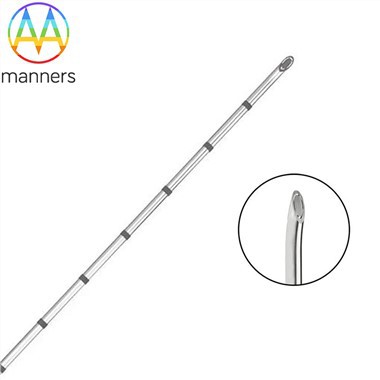
In-Depth Analysis Of The PTC Needle Market: Size, Drivers, And Competitive Landscape
May 04, 2026
Percutaneous Transhepatic Cholangiography (PTC) needles are foundational devices for interventional diagnosis and treatment of biliary tract diseases. Their market size and development trends directly reflect technological advancements and shifts in clinical needs within the global hepatobiliary-pancreatic surgery and interventional radiology fields. Driven by intensifying global aging, rising incidence of hepatobiliary diseases, and the widespread adoption of minimally invasive techniques, the PTC needle market is undergoing a critical transition from traditional products toward high-value and intelligent upgrades.
I. Global Market Size and Growth Forecast
The PTC needle market is a vital segment of the biliary interventional device market. According to industry research reports, the global biliary interventional device market was valued at approximately US\(XX billion in 2023 and is projected to grow at a Compound Annual Growth Rate (CAGR) of X% to reach US\)XX billion by 2030. Among this, puncture and biopsy devices (including PTC needles) account for around XX% of the market share. Despite PTC being a mature technology, its market growth remains steady, primarily due to the following factors:
Increased Disease Burden: The global incidence of cholangiocarcinoma, pancreatic cancer, cholelithiasis, and other diseases continues to rise. East Asian regions (e.g., China, South Korea, Japan) face a particularly heavy burden of biliary diseases due to dietary and lifestyle factors, directly driving demand for diagnostic and therapeutic punctures.
Alternative for Failed or Infeasible ERCP: Endoscopic Retrograde Cholangiopancreatography (ERCP) is the first-line minimally invasive procedure for biliary tract diseases. However, for patients with a history of subtotal gastrectomy (Roux-en-Y anastomosis), duodenal obstruction, or failed intubation, PTC becomes an indispensable alternative or complementary approach. The growing number of patients undergoing surgical procedures has expanded this patient population.
Expanded Technical Indications: PTC has evolved from purely diagnostic cholangiography to comprehensive therapeutic applications, including Percutaneous Transhepatic Biliary Drainage (PTBD), biliary stent placement, radioactive seed implantation, and tumor ablation. The broadening of indications has significantly increased the usage scenarios and frequency of PTC needles.
II. Regional Market Characteristics and Competitive Landscape
The global PTC needle market exhibits distinct regional disparities, dominated by international medical device giants, while local manufacturers demonstrate strong performance in specific regions.
North American and European Markets: As mature markets, they are led by global giants such as Cook Medical, Boston Scientific, and Medtronic. These companies offer one-stop solutions through comprehensive product lines covering puncture needles, drainage tubes, catheters, guidewires, and stents, and have built robust brand moats via extensive clinical education and academic promotion. Market competition centers on product innovation, clinical evidence accumulation, and service systems.
Asia-Pacific Market: The Chinese market, in particular, is the fastest-growing region globally. Key drivers include a large population base, high disease incidence, expanded medical insurance coverage, and rapid improvements in interventional radiology capabilities at secondary and tertiary hospitals. The Chinese market features a coexistence of international and local brands. Chinese enterprises such as MicroPort, Lifetech Scientific, and Nanjing Microinvasive Medical are continuously expanding their share in the mid-tier market and penetrating the high-end segment by leveraging cost-effective products and flexible localized services. Japan and South Korea have well-established domestic medical device industries, with companies like Olympus and Asahi Intecc holding strong regional influence.
Stratified Competition:
First Tier: Global integrated medical device giants with comprehensive product lines, strong brand equity, and premium pricing.
Second Tier: Specialized international companies in interventional radiology or gastroenterology, as well as leading local manufacturers in the Asia-Pacific region, competing through differentiated innovation and cost control.
Third Tier: Numerous small and medium-sized manufacturers primarily producing standardized, cost-effective PTC needles, covering grassroots markets through distribution networks.
III. Core Product Technological Innovation Trends
Manufacturers' competitive focus has shifted from basic functionality to micro-innovations that enhance surgical success rates, safety, and convenience.
Improved Puncture Precision and Visualization:
Ultrasound-Visible Needles: The needle shaft is coated with a specialized polymer (containing microbubbles) for enhanced visibility under ultrasound guidance, enabling real-time dynamic puncture. Particularly suitable for ultrasound-only procedures or beginners, it significantly reduces puncture attempts and the risk of vascular injury.
Enhanced X-Ray Visibility: The needle shaft features denser barium markers or high-atomic-number alloys for better visualization under fluoroscopy, facilitating precise positioning in complex anatomical structures.
Innovations in Needle Design and Materials:
Ultra-Thin-Wall Design: While maintaining sufficient rigidity and strength, the thinned needle wall allows a larger inner lumen at the same outer diameter, improving aspiration and injection efficiency, or accommodating thicker guidewires with a smaller outer diameter.
Composite Needle Tip: Laser-precision ground tri-bevel or stepped tips balance sharpness and strength, enabling smoother puncture and minimizing tissue damage.
Steerable/Controllable Needles: For complex cases, the needle tip can be manually or device-controlled to bend at a small angle, bypassing blood vessels or other obstacles to accurately reach the target bile duct.
Functional Integration and Kit Standardization:
Coaxial Puncture System: PTC needles, micro-guidewires, dilators, sheaths, and other components are pre-assembled into a kit for "one-step" procedures, simplifying workflows, reducing surgical time, and lowering the risk of access loss due to device exchanges.
Multi-Specification Compatibility: The needle hub is designed to be compatible with syringes and connecting tubes of different standards, enhancing usability in operating rooms.
IV. Industry Growth Drivers and Challenges
Drivers
Widespread Adoption of Minimally Invasive Surgery: Patients and clinicians increasingly prefer minimally invasive procedures with less trauma and faster recovery, benefiting PTC as a classic minimally invasive technique.
Advancements in Image-Guided Technology: The proliferation and improved image quality of ultrasound, CT, DSA, and other imaging devices have made PTC safer and more precise, lowering technical barriers and expanding its applications.
Promotion of Multidisciplinary Team (MDT) Model: The diagnosis and treatment of complex hepatobiliary-pancreatic diseases increasingly rely on collaboration between interventional radiology, hepatobiliary surgery, gastroenterology, and oncology departments, solidifying PTC's role as a key interventional tool.
Healthcare Infrastructure Investment in Emerging Markets: Regions such as China, India, and Southeast Asia are continuously increasing investment in imaging and interventional departments at county-level hospitals, creating new growth opportunities for the PTC needle market.
Challenges
Competition from Alternative Technologies: The continuous development of ERCP and its derivatives (e.g., SpyGlass cholangioscopy) poses competitive pressure on PTC for certain indications. Advances in non-invasive diagnostic techniques such as MRCP (Magnetic Resonance Cholangiopancreatography) have also partially replaced diagnostic PTC.
Operator Dependence and Learning Curve: PTC is technically demanding and highly reliant on operator experience. Training a proficient interventional radiologist takes a long time, limiting the rapid adoption of the technique to some extent.
Price Pressure: Globally, especially in regions with medical insurance cost controls or volume-based procurement policies, medical devices face sustained price reductions, squeezing manufacturers' profit margins and forcing them to reduce costs through large-scale production and innovation.
Risk of Complications: Risks of bleeding, bile leakage, infection, and other complications persist, imposing stringent requirements on device safety and operator skills, and driving manufacturers to continuously optimize product designs.
V. Future Outlook
The future development of PTC needles will focus on precision, intelligence, and integration. Robot-assisted puncture systems are expected to elevate surgical accuracy to new heights, reducing human error. Artificial Intelligence (AI) preoperative planning systems can automatically calculate the optimal puncture path based on patients' CT images, avoiding critical blood vessels. Smart needles with pressure or impedance sensing capabilities can provide real-time feedback on tissue types during puncture, alerting to vascular puncture risks. Furthermore, the integration of PTC with tumor ablation, brachytherapy, local drug infusion, and other treatments will deepen, transforming PTC needles from "access establishment tools" into "comprehensive treatment platforms".
For manufacturers, future competition will be a comprehensive test of technological innovation, clinical solution provision capabilities, cost control, and global market layout. Enterprises that deeply understand clinical pain points, continuously innovate in materials and design, and offer complete product lines from puncture needles to subsequent treatments will occupy a more advantageous position in the niche yet important PTC needle market.