Huber Point Needles For At-Home Infusion
Nov 26, 2026
Infusion has been moving out of hospitals for two decades, and the pace has accelerated with the growth of home antibiotic therapy, parenteral nutrition and long-term biologic treatment. The clinical logic is sound: patients recover better at home, beds are freed, and the risk of hospital-acquired infection falls. The operational logic is harder. Every device that was designed to be handled by a trained nurse in a treatment room must now work on a kitchen table, handled by a patient or a family member, with a phone number as backup.
Port-based home infusion depends on a specific component that rarely gets attention in discharge planning: the needle that crosses the septum at every session. When access happens weekly for months, that needle determines whether the port survives, whether the site stays clean, and whether the patient can perform the task confidently enough to keep going. Understanding what changes when access moves home is the difference between a program that runs and one that generates avoidable complications.
The Problem: Competence Does Not Travel With the Patient
In a clinic, access is performed by someone who does it several times a day. At home, it is performed by someone who does it once a week and may have last reviewed the steps a month ago. Skills decay quickly when they are used intermittently, and the tasks most vulnerable to decay are the ones with the least immediate feedback: site preparation, perpendicular approach, full seating, and disposal.
The environment compounds the problem. A home has no treatment couch at the right height, no dedicated light, no wall-mounted sharps container within reach, and often no second pair of hands. Supplies arrive in a carton that may sit in a warm room for weeks before use.
Safety margins that were implicit in the hospital become explicit requirements at home. A needle that is easy to handle, clearly labeled by gauge and length, and packaged for single use reduces the number of decisions a patient has to make under stress, and every decision removed is a potential error eliminated.
Why Non-Coring Access Matters More at Home
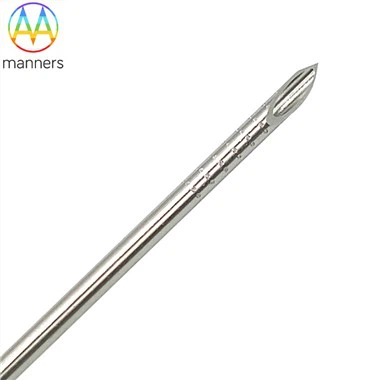
The mechanics are the same as in any port access: a deflected, closed tip parts the silicone septum instead of removing a core of it, so the puncture behaves like a slit that reseals under elastic tension. What changes at home is the consequence of failure. A septum that begins to leak in a clinic is noticed at the next visit. A septum that leaks at home may present as swelling under the skin, a wet dressing, or pain during infusion, and the patient may not connect it to the needle.
Dwell time amplifies this. Home regimens often leave an access needle in place for several days, with the hub secured under a dressing. During that period the needle is under continuous lateral load from tubing, clothing and sleeping position. A tip that is not fully seated can migrate, and a needle that was inserted at an angle rather than perpendicular will sit against the septum edge, enlarging the puncture over time. Rigid stainless steel construction helps here: a straight shaft holds its line under load, whereas a flexible one deflects and converts tubing movement into tip movement.
Flow considerations also shift. Home infusion often runs at low rates for long periods, so a partially occluded lateral eye may not be obvious from the pump, which simply continues to push against rising pressure.
Gauges, Lengths and Configurations for Home Use
Gauge selection in the home setting follows the same principle as in the clinic but with a stronger bias toward consistency. If the therapy allows it, using one gauge for every session removes a decision and reduces the chance of a mismatch between the needle and the port's pressure rating. Smaller gauges are gentler on the septum and more comfortable, but they restrict flow and are unsuitable for therapies requiring higher rates or for blood sampling.
Length must match the port depth of that specific patient, and this is where home programs most often fail. A patient with a deeply placed port needs a longer needle, and a stock shortage that substitutes a shorter one produces the classic presentation of a home access failure: the needle appears seated, the dressing looks correct, and the infusion alarms within minutes. Recording the correct length in the patient's supply list, and printing it on the carton label, prevents an entire class of avoidable events.
Right-angle and straight configurations should be chosen for the dressing and the patient's anatomy rather than for stock convenience. A right-angle needle lies flatter and is easier to secure under clothing, which matters for patients who are mobile during infusion. A straight needle is easier to palpate and to verify visually, which matters for patients with reduced sensation.
Safety-engineered designs deserve specific consideration at home. A device that shields or retracts the tip on withdrawal reduces the risk of a household injury, including injuries to family members who may assist with disposal. Single-use packaging that opens in a defined sequence, with the needle presented hub-first, reduces handling of the sharp end. Standard carton packaging with clear lot and expiry labeling supports the patient's own inventory checks, which in practice replace the clinic's stock rotation.
A Practical Protocol That Works Outside the Clinic
Start with a written, illustrated procedure that the patient keeps, not one that lives in a binder at the office. The sequence should be short enough to follow from memory and specific enough to remove judgment: clean a flat surface, lay out supplies in order, wash hands, perform hand hygiene again after setup, prepare the site for the full contact time, allow it to dry, palpate the port, stabilize it, insert perpendicular, seat fully, aspirate, flush, secure, document.
Teach the two failure signals that patients most often miss: resistance to flushing without an alarm, and any swelling, coolness or discomfort around the site during infusion. Both mean stop, not adjust. Give the patient explicit permission to stop, because the most common error in home infusion is continuing because the schedule says to.
Design the disposal step before the first session. Provide a sharps container that is small enough to keep in the room where infusion happens, and instruct the patient never to recap and never to carry an uncapped needle through the house. Arrange collection or a drop-off point, and confirm that the container actually gets replaced; a full container is one of the most common reasons patients improvise.
Finally, build in a scheduled competency check rather than relying on the initial training. A brief annual review, plus a review after any access-related event, catches drift before it becomes a complication. Record the gauge and length the patient uses, and make sure the supply shipment matches that record.
What Home Programs Learn
Programs that review their home access data describe a consistent set of issues. Wrong-length needles are the leading cause of "no blood return" calls, and they usually trace to a supply substitution rather than to a clinical change. Site reactions cluster in patients whose dressing changes are done by family members without a refresher, because the dressing rather than the needle is the usual point of failure.
The most useful finding is that simplicity outperforms sophistication. Kits that require the fewest decisions have the lowest error rates, even when the components are less technically advanced.
Summary
Home infusion asks a port access needle to work without the scaffolding of a clinic: no experienced colleague, no ideal environment, no immediate correction of a small error. The physics of non-coring access does not change, but for Huber Point Needles used at home the margin for error narrows, and the failure modes shift toward length mismatch, partial seating, long-dwell migration and improvised disposal. Gauge and length consistency, a flat-seating configuration matched to the dressing, single-use packaging with clear labels, and a written protocol with explicit stop signals cover most of the risk. The remainder is training, refreshed on a schedule rather than assumed.
Looking Ahead
The direction is toward devices and kits designed for the person performing the task rather than for the professional supervising it. Expect packaging that sequences the procedure, labeling that repeats the patient's prescribed gauge and length, and safety mechanisms that work with one hand. Ports themselves are becoming smaller and more deeply placed, which will make length selection a standing issue and favor supply systems that lock the correct length to the patient record. Coated and polymer-tip variants will continue to appear, but in the home setting the decisive qualities are still legibility, rigidity and simplicity.