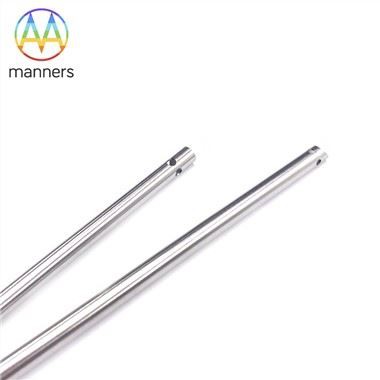
Geometric Design Of The Chiba Needle Tip Bevel And The Mechanics Of Puncture
Jul 04, 2026
Why Does the Classic Chiba Needle Adopt a 25° Bevel Angle?
https://radiopaedia.org/articles/chiba-needle
The Chiba needle, also known as a Chiba puncture needle or Chiba biopsy needle, is one of the most classic fine needle aspiration biopsy (FNAB) tools in interventional radiology. Among its many structural features, the geometric design of the needle tip bevel is the core element determining puncture feel, degree of tissue damage, and sampling quality. The standard Chiba needle tip bevel angle is typically 25°. This value was not chosen arbitrarily; rather, it is the result of decades of clinical validation, representing the optimal balance among sharpness, needle body strength, and maneuverability.
Relationship Between Bevel Angle and Puncture Force
The bevel angle refers to the angle between the cutting line of the tube end face and the perpendicular to the needle tube axis. Theoretically, the smaller the bevel angle, the sharper the needle tip, the lower the peak insertion force required to penetrate tissue, and the less pain the patient experiences. However, when the angle is too small (e.g., <15°), the cutting edge becomes too thin and is prone to rolling, deformation, or even fracture when penetrating tougher fascia or fibrous tissue. Conversely, if the bevel angle is too large (e.g., >45°, as in Turner needles), although the tip is stronger, puncture resistance increases dramatically, tending to cause tissue squeezing rather than cutting, leading to cell deformation and compromising cytological diagnosis.
The Chiba needle adopts an approximate 25° bevel angle, enabling 21G–23G fine needles to cut through skin, subcutaneous fat, and organ capsules with minimal resistance while maintaining sufficient edge strength. Experimental data show that a standard 25° Chiba needle tip requires 30%–40% less peak force to penetrate a simulated skin membrane compared to a 45° bevel needle, and achieves higher satisfaction rates in cytological smears.
Bevel Asymmetry and Deflection/Bias Effect
When puncturing with a beveled needle, a lateral force component is generated by the single-sided cutting edge, causing the needle tip to deflect slightly toward the opening direction of the bevel (bevel-up vs. bevel-down). This is particularly noticeable in deep target punctures (e.g., small pulmonary nodules, pancreatic masses). Chiba needle tips demand extremely high symmetry - the left and right cutting edges must be equal in length, and the bevel centerline must be coplanar with the needle tube axis - to minimize uncontrollable deflection. Some改良 Chiba needles feature side holes (side-hole Chiba) or reduce the bevel angle to 15° to improve penetration and reduce deflection, but the standard 25° remains mainstream.
Elliptical Tip Opening and Lumen Patency
The classic Chiba needle tip features an elliptical opening (rather than a triangular or flat cut), paired with thin-walled stainless steel tubing (304 or 316L), maximizing the inner lumen cross-sectional area. This facilitates the smooth entry of cell clusters into the needle lumen under negative pressure aspiration without clogging. The outer edge of the tip is precision-ground to form a micro-cutting edge, while the inner wall is deburred and polished to reduce tissue drag resistance.
Matching Considerations of Length and Diameter
Common Chiba needle outer diameters are 0.7–0.9 mm (20G–22G), with lengths of 15–20 cm. The bevel length is typically about 1.5–2 times the outer diameter of the tube; too long makes the tip "soft and floppy," while too short increases puncture resistance. This proportional relationship is a fundamental geometric constraint in the tip design of quality Chiba needles.
In summary, the 25° bevel angle of the Chiba needle tip is the "golden angle" selected through long-term screening by the interventional radiology community - striking a balance among sharp penetration, structural strength, low deflection, and excellent cell aspiration. It is the first key to understanding the clinical value of the Chiba needle.