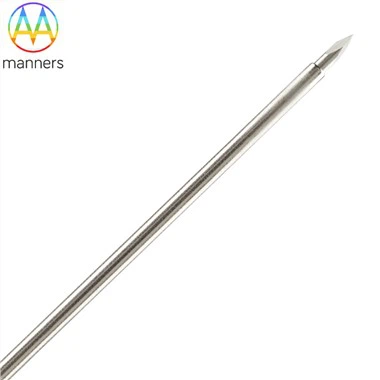
Geometric Design And Functional Implementation Principle Of The 2.5-Inch Tuohy Needle With 22mm Short Tip
Jun 22, 2026
The core design concept of the Tuohy epidural needle lies in its Huber-point curved tip - an arc-shaped inclined surface that opens laterally, with a deviation angle of approximately 15° to 30° from the needle axis, and the opening is located on the opposite side of the curved protrusion. For the conventional 18G × 90mm Tuohy needle, this curved tip has three main functions:
- It provides a blunt separation rather than a cutting action between the ligamentum flavum and the underlying dura mater;
- It controls the path of the epidural catheter through the side opening direction (with the bevel facing upwards to guide the catheter towards the cephalic side);
- It provides a clear layered tactile feedback for the surgeon to determine the LOR.
When the size is reduced to size 2.5 (≈ 22G) and the length is compressed to 22mm, the above design principles need to be rebalanced at the micrometer scale. The outer diameter of the 22G syringe is approximately 0.71mm, while the inner diameter is only about 0.41mm. The arc length and opening area of the curved side hole are proportionally reduced, but sufficient lateral openings must still be retained to allow the micro catheter to be smoothly withdrawn without bending. The precise CNC grinding process must control the curvature of the arc within strict tolerances (within ±0.01mm); too small would lose the guiding effect of the catheter, and too large would weaken the tip strength and be prone to deformation when passing through the dense sacral ligament.
The engineering challenges brought by the short needle (22mm) mainly lie in the fact that the stiffness of the needle tube significantly decreases as the aspect ratio decreases. For a 22G thin-walled stainless steel tube within a 22mm span, its bending resistance is acceptable. However, if a fixed wing (winged hub) is equipped, due to the extremely short lever arm, the finger application point is close to the needle tip. To compensate for the control torque, the wing flaps need to be widened or a finger-holding plastic base with a lower height is adopted. Some manufacturers have designed detachable mini wings or finger-pushing low-profile bases for this specification to facilitate stable single-handed advancement.
In terms of material, the syringes typically use ASTM AISI 304 or 316L medical austenitic stainless steel. Through multiple processes including drawing, sizing, and annealing, they achieve uniform wall thickness. The pipe ends are first ground into curved side holes using a diamond grinding wheel according to the Huber geometry, and then the sharp edges are removed by electrochemical etching or mechanical deburring. The inner wall is polished with a flexible shaft to ensure a roughness of Ra < 0.2 μm, preventing the micro catheters from scratching the needle chamber during passage.
Surface treatment is the key value-added step for the short and slender Tuohy needles: Electro-polishing removes the microscopic peaks and valleys on the outer wall, making the needle surface close to a flat mirror surface. This significantly reduces the friction resistance when passing through the skin, fascia, and sacrococcygeal ligaments. This is particularly important for a needle body that is only 22mm long - any additional friction would mask the "breakthrough sensation" that the operator should experience. Subsequently, it undergoes thorough cleaning with 40kHz ultrasonic waves to remove metal shavings and residual polishing solution. Then, it is sterilized with EO or γ-rays and independently packaged in blister packs.
In conclusion, the 2.5号 22mm Tuohy needle is not merely a "reduced version" of the standard epidural needle. Instead, it is a comprehensive miniaturized design that reconfigures the proportion of the curved side hole, the stiffness match, and the surface smoothness for the reconstruction of a micro-channel. Its manufacturing accuracy directly determines the success rate of clinical micro-catheter insertion and the minimization of tissue damage.