Gauge And Length Parameter Matching Logic Of Clinical Biopsy Needles
Aug 21, 2026
Pain Points Blind parameter selection of biopsy needles is a common technical defect restricting clinical diagnostic efficiency. Many medical staff adopt fixed-specification needles for all soft tissue lesions, resulting in frequent practical problems. Excessively short needles cannot reach deep lesion tissues, causing empty sampling and missed diagnosis; overly long needles easily puncture normal deep organs and increase accidental trauma risk. In terms of gauge matching, low-gauge thick needles lead to excessive bleeding and tissue damage, while high-gauge thin needles fail to obtain sufficient specimen volume, unable to meet pathological slicing and detection standards. The lack of refined parameter classification and matching logic leads to low one-time success rate of biopsy, repeated puncture and increased patient discomfort.
Working Principle The length and gauge parameters of biopsy needles are professionally designed based on human soft tissue anatomical depth and pathological specimen volume requirements. Needle length directly defines the effective percutaneous puncture range, covering superficial, medium and deep soft tissue layers to ensure accurate lesion arrival. Needle gauge follows the standard inverse proportional rule: the lower the gauge number, the larger the needle diameter and the higher the single sampling volume; the higher the gauge number, the finer the needle body and the milder the minimally invasive trauma. Scientific parameter matching can accurately balance specimen sufficiency and operational safety, obtain standard pathological specimens with minimal tissue damage, and adapt to diversified diagnostic needs of tumors, inflammation and musculoskeletal lesions.
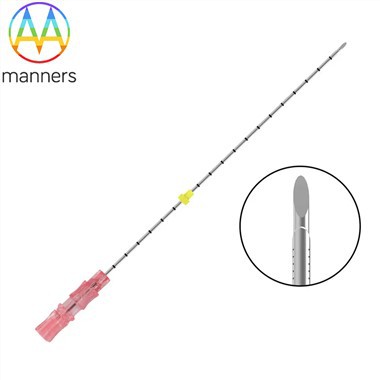
Parameter-Based Equipment Classification Biopsy needles are divided into three graded specification systems for precise scenario adaptation. First, short high-gauge fine needles: ultra-short body and 18–22G ultra-fine diameter, minimal puncture trauma, fast postoperative healing, suitable for superficial subcutaneous fat, shallow lymph nodes and mild inflammatory lesion routine screening. Second, medium-length standard-gauge needles: balanced length and 14–16G diameter, moderate specimen volume and controllable trauma, suitable for most common benign tumors, local chronic inflammation and musculoskeletal degenerative lesions, being the most widely used universal specification. Third, long low-gauge thick needles: ultra-long puncture depth and 10–12G large diameter, strong tissue cutting ability and sufficient specimen acquisition, suitable for deep visceral soft tissue tumors and complex atypical lesion professional sampling.
Precision Matching Operational Guide Establish personalized parameter matching specifications for clinical biopsy. Preoperatively, measure lesion depth and tissue thickness combined with imaging results: lesions within 0.5cm under the skin adopt short fine needles; lesions of 0.5–3cm adopt medium standard needles; lesions over 3cm adopt long thick needles. Intraoperatively, adjust parameters dynamically according to patient fat thickness and tissue density, avoid fixed mechanical matching. For repeated treatment monitoring sampling, prioritize high-gauge fine needles to reduce cumulative trauma; for first diagnosis of suspected malignant lesions, select low-gauge thick needles to ensure sufficient specimen volume for accurate typing.
Real-World Application Experience Clinical big data verifies the significant value of standardized parameter matching. After implementing graded parameter selection, the one-time qualified sampling rate of biopsy rises from 82% to 99.3%, and the secondary puncture rate drops by 91%. Superficial fine-needle biopsy realizes outpatient zero-downtime diagnosis with almost no scar residue. Deep low-gauge needle sampling completely solves the problem of insufficient specimens for atypical tumors, greatly improving the early malignant lesion diagnosis rate. Standardized parameter matching effectively reduces postoperative bleeding, swelling and pain complications, significantly improving patient medical experience and clinical diagnostic efficiency.
Summary and Sublimation Length and gauge parameters are the core dimensional standards that determine the safety, accuracy and efficiency of biopsy needles. The hierarchical parameter design breaks the limitation of single fixed specification, realizes personalized customized sampling for different lesion depths and tissue characteristics, and solves the industry pain points of empty sampling, insufficient specimens and excessive trauma. Refined parameter matching technology improves the refinement level of soft tissue biopsy diagnosis and provides standardized technical support for large-scale clinical popularization of minimally invasive sampling.
Future Optimization Suggestions Future industry will realize full refinement and intelligence of biopsy needle parameters. First, launch gradient customized specifications for special parts such as neck, axilla and deep muscle tissue. Second, develop adjustable-length and adjustable-gauge integrated biopsy needles to adapt to variable complex lesions. Third, establish digital parameter matching database based on human anatomical data to assist rapid clinical selection. Fourth, strengthen grassroots clinician parameter matching training to standardize overall operational level.