Future Development Of Blunt Bevel Metal Dispensing Needles In Emerging Precision Industries
Nov 12, 2026
1. Pain Points of Emerging Industry Dispensing and Liquid Preparation
Emerging sectors including wearable medical devices, microfluidic diagnostics, flexible electronics and new energy micro-components bring new challenges for liquid extraction and micro dispensing. New functional fluids such as hydrogel, biological reagents, conductive composite glue and thermal interface material have special rheology and strict purity requirements. Standard sharp needles produce rubber coring and particle contamination, while many existing blunt needles lack built-in filtration. R&D teams need custom tip geometry and special hub interfaces to match prototype dispensing equipment, but sample development cycles are long. Some delicate substrates are easily scratched by sharp tips, and ordinary blunt needles cause unstable glue cutoff. Regulated medical wearable products need ISO13485 traceability, while flexible electronics pursue ultra-small dispensing volume. Many new formulations are sensitive to shear force; improper tip geometry changes fluid properties and leads to performance failure. Current off-the-shelf needle products cannot cover the diversified bevel, inner diameter and filtration combinations required by iterative R&D.
2. Working Principle of High Precise Metal Dispensing Needle For Automatic Glue Machine
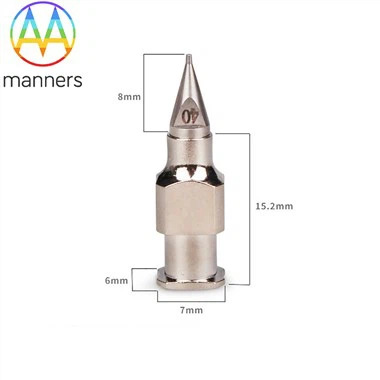
The 30–50° specially treated blunt bevel tip reduces shear stress on rubber stoppers to minimize coring, which is essential for high-purity fluid preparation in emerging industries. The optional built-in <5 μm hub filter intercepts glass fragments, rubber particles and crystals without introducing extra fittings. The stainless steel body provides stable rigidity for high-speed robotic dispensing and repeated aspiration cycles. The smooth inner bore supports micro dispensing of shear-sensitive fluids, avoiding excessive turbulent shear. The luer interface is designed for direct syringe connection, compatible with most automatic glue machines and microfluidic pumping systems. Inner diameter ranges from 0.1 mm to 0.8 mm, and custom bevel angle, tip length, inner bore and hub structure can be produced from 2D/3D drawings or samples. The needle balances anti-coring safety, filtration performance and dispensing precision. For delicate flexible substrates, the soft blunt outlet reduces scratching risk during contact dispensing. ISO13485 certified versions are available for biomedical and wearable medical product development.
3. Classification for Emerging Industry Scenarios
By filtration function, blunt filter needles are used for biological reagents, diagnostic fluids and particle-containing functional glue; non-filter blunt bevel needles are for pre-filtered pure hydrogel and low-filler flexible electronic adhesives. By inner diameter, ultra-micro 0.1–0.3 mm is for microfluidic chip spotting, wearable sensor bonding and diagnostic test strip coating; 0.3–0.6 mm is mainstream for flexible circuit encapsulation and laboratory R&D prototype testing; 0.6–0.8 mm supports high-flow thin film coating and thermal gel dispensing. By bevel tuning, 30–40° bevel models are for delicate stoppers and biological fluids; 40–50° bevel models are for high-speed automatic dispensing and fast aspiration. By customization, standard stock needles support quick trial tests, while custom needles are tailored to proprietary dispensing valves, special packaging structures and unique fluid rheology. ISO13485 certified and cleanroom packaging options serve biomedical R&D.
4. Practical Operation Guide for R&D and Pilot Process Validation
First, characterize fluid rheology before selecting needle parameters. Test shear sensitivity, viscosity and particle risk to decide whether a filter is required and select suitable bevel angle. Second, choose the right inner diameter. For shear-sensitive hydrogel, avoid overly narrow bores which create high shear and denaturation. Third, confirm filter compatibility: verify that the filter membrane material does not react with biological reagents or solvent-based glue. Fourth, prototype validation workflow: start with low-pressure trial runs, observe coring, cutoff quality and substrate scratching. Test multiple bevel variants if tailing or particle problems appear. Fifth, parameter locking: for sensitive new materials, lock dispensing pressure, vacuum, aspiration speed and tip gap tightly. Sixth, contamination control: biological and optical applications require cleanroom packaging and low particle shedding needles. Seventh, documentation for regulated products: keep needle batch records, material certificates and filter validation reports to meet ISO13485 requirements when transferring to formal mass production.
5. Practical Experience from Emerging Industry R&D Lines
R&D teams frequently select ultra-fine needles blindly for tiny dots, ignoring that high shear inside the channel changes the property of hydrogel and biological reagents. Tuning the 30–50° bevel angle is often more effective than changing inner diameter for shear-sensitive fluids. Blunt filter needles greatly reduce the risk of particle interference in diagnostic reagent batches, which directly lowers false test results. When developing custom needles for new dispensing equipment, engineers should reserve space for the hub filter in the early mechanical design. Flexible substrate production confirms that specially treated blunt bevel tips reduce film scratching compared with sharp needles. Many R&D teams switch formulations frequently, so preparing a test kit covering different inner diameters and bevel angles accelerates screening. After successful pilot validation, formalize the needle specification into BOM to avoid random replacement during mass transfer.
6. Conclusion and Value Sublimation
High precise metal dispensing needles for automatic glue machines are foundational enabling consumables for emerging precision manufacturing. The adjustable 30–50° blunt bevel, optional integrated micron filtration and drawing/sample customization provide flexible solutions for biological reagents, flexible electronics and microfluidic products. It solves the conflict between anti-coring safety, particulate control and micro dispensing precision. ISO13485 certification supports regulated biomedical innovation. It is not limited to mature pharmacy and glue processes; it accelerates iterative R&D of new material formulations and miniature devices.
7. Suggestions and Long-Term Outlook
Precision dispensing will keep moving toward smaller volume, more complex functional fluids and stricter particulate standards. R&D laboratories should keep blunt filter needle test kits covering 0.1–0.8 mm inner diameter for fast formulation screening. Dispensing equipment integrators should design new valves with compatible luer interfaces for blunt filter needles. Future development directions include anti-fouling bevel surface modification for biological fluids, ultra-thin low-shear filter membranes and disposable sensing blunt needles for closed-loop dispensing monitoring. Suppliers should build rapid custom sample service to match fast iteration rhythm of emerging industries.